
Power Plant Water Treatment: Water Treatment Systems for Power Generation
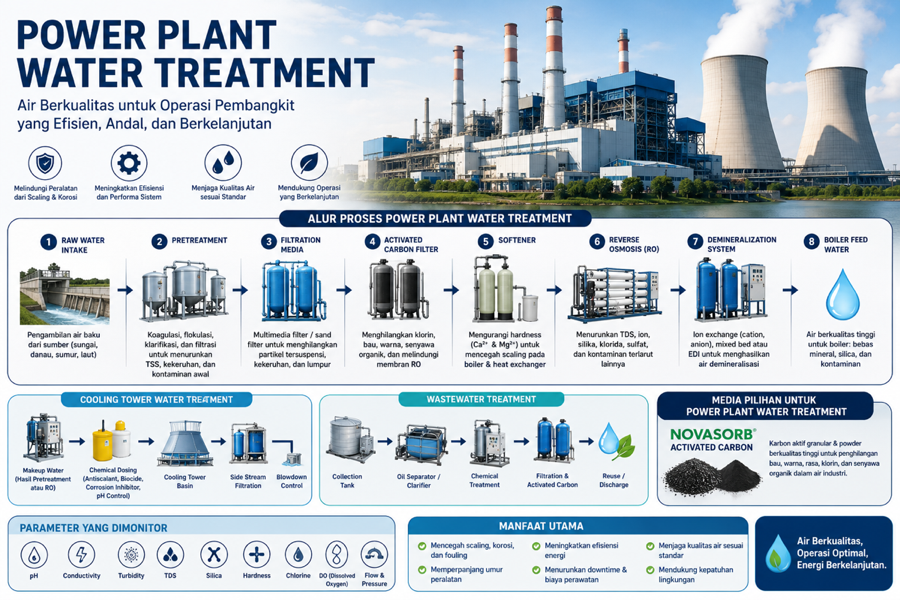
Power plant water treatment is the set of processes used to prepare, purify, condition, and monitor water for power generation facilities. It supports boiler feedwater, cooling towers, condensate polishing, demineralized water production, process water, and wastewater handling.
In power plants, water quality directly affects heat-transfer efficiency, turbine and boiler reliability, corrosion control, membrane life, chemical consumption, and unplanned downtime. Coal-fired plants, gas-fired plants, geothermal plants, biomass plants, captive power plants, and utility-scale facilities all need water treatment systems that match their raw water source and operating standard.
Why Water Treatment Matters in Power Plants
Power plants use water to generate steam, transfer heat, cool equipment, wash systems, and support auxiliary operations. If water quality is not controlled, the plant can face:
- Scaling in boilers and heat exchangers from hardness, silica, calcium, and magnesium.
- Corrosion in pipes and equipment caused by unstable pH, dissolved oxygen, chloride, or aggressive contaminants.
- RO membrane and filter fouling from suspended solids, organic matter, iron, manganese, and biofilm.
- Cooling tower performance loss from scale, corrosion, biological growth, and uncontrolled cycles of concentration.
- Operational downtime when critical systems such as boilers, RO units, demineralizers, and cooling systems lose performance.
Main Components of Power Plant Water Treatment
A power plant water treatment system is usually designed around raw water analysis, boiler pressure class, cooling system type, operating capacity, and target water quality. Common components include:
- Raw water intake and screening
- Coagulation, flocculation, and clarification
- Multimedia filtration or sand filtration
- Activated carbon filtration
- Water softening
- Ultrafiltration
- Reverse osmosis
- Ion exchange demineralization
- Mixed bed polishing
- Condensate polishing
- Chemical dosing
- Online monitoring for pH, conductivity, silica, chlorine, ORP, and turbidity
Pretreatment
Pretreatment reduces the contaminant load before water enters sensitive downstream equipment. It may include screening, clarifiers, multimedia filters, activated carbon filters, softeners, ultrafiltration, and chemical dosing.
Good pretreatment helps extend membrane life, reduce cleaning frequency, stabilize flow, protect ion exchange resin, and lower operating cost.
Reverse Osmosis and Demineralization
Reverse osmosis is commonly used to reduce TDS, silica, hardness, chloride, sulfate, and dissolved contaminants before the water enters a demineralization or polishing stage. For high-purity boiler feedwater, RO permeate may be followed by cation-anion exchange, mixed bed resin, electrodeionization, or condensate polishing depending on the required specification.
Cooling Tower Water Treatment
Cooling towers need a different treatment strategy from boiler feedwater. The main goals are to control scale, corrosion, biological growth, suspended solids, and blowdown volume. Treatment may include side-stream filtration, antiscalant, corrosion inhibitor, biocide, pH control, and conductivity-based blowdown control.
Boiler Feedwater Control
Boiler feedwater must be controlled carefully because small amounts of hardness, silica, oxygen, or dissolved solids can create major reliability problems. A typical boiler water program includes demineralization, deaeration, oxygen scavenger dosing, pH adjustment, phosphate or amine treatment, and continuous monitoring.
Choosing the Right System
The right power plant water treatment system should be based on:
- Raw water source and seasonal variation
- Boiler pressure and steam purity requirement
- Cooling tower design and cycles of concentration
- Required flow rate and redundancy
- Wastewater and blowdown handling
- Chemical availability and maintenance capability
- Online instrumentation and automation needs
For reliable operation, the design should combine proper pretreatment, suitable membrane or ion exchange technology, controlled chemical dosing, and routine water analysis.