
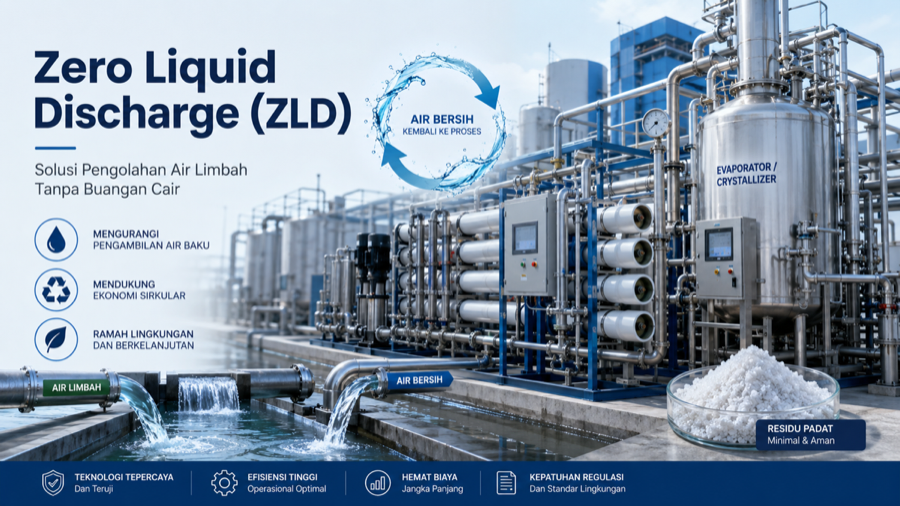
Zero Liquid Discharge (ZLD): Industrial Wastewater Treatment with No Liquid Discharge
Zero Liquid Discharge (ZLD) is a wastewater-treatment approach designed to minimize or eliminate liquid discharge from an industrial process. Its primary objective is to recover water for reuse while concentrating the remaining contaminants into solids or sludge that can be managed more effectively.
ZLD is becoming increasingly important as industrial facilities face limited raw-water supplies, stricter wastewater regulations, and pressure to improve operating efficiency. A ZLD system generally combines several technologies, including pretreatment, filtration, reverse osmosis, membrane systems, evaporators, and crystallizers, depending on the wastewater characteristics.
What Is Zero Liquid Discharge?
In simple terms, ZLD focuses on recovering as much water as practical from a liquid waste stream. The treated water may be reused for production, cooling towers, boiler feed, washing, or other utilities, depending on the required final quality.
Unlike conventional wastewater treatment, which still produces a liquid effluent for environmental discharge, ZLD reduces liquid waste to a minimum. In many applications, the final outputs are recovered water and concentrated solids.
Why Do Industries Need ZLD?
ZLD is particularly relevant to industries producing wastewater with high TDS, salts, chemicals, metals, oils, or persistent contaminants.
-
Reduce liquid-waste discharge
ZLD reduces environmental risk by preventing inadequately treated wastewater from being discharged directly. -
Increase water reuse
Recovered water can be returned to operations, reducing demand for new raw water. -
Support regulatory compliance
Facilities facing strict discharge requirements need a safer and more measurable treatment approach. -
Reduce dependence on new water sources
ZLD can provide long-term efficiency in water-stressed industrial areas. -
Manage concentrate more effectively
Instead of discharging a large liquid volume, ZLD produces a smaller, more concentrated residual stream.
Wastewater management also matters for smaller operations such as refill-water businesses. See how to manage wastewater in refill-gallon operations.
Main Components of a ZLD System
ZLD is not a single piece of equipment. It is a treatment train designed around wastewater quality, recovery targets, contaminants, and the intended use of recovered water.
1. Pretreatment
Pretreatment reduces the contaminant load before membrane or thermal processes. It may include screening, coagulation, flocculation, sedimentation, multimedia filtration, activated carbon, cartridge filtration, softening, and chemical dosing.
When wastewater contains high manganese, effective pretreatment is critical because manganese can cause fouling, scaling, color, odor, and problems in downstream filtration. See how to treat water with high manganese levels.
2. Membrane Systems
Ultrafiltration, nanofiltration, and reverse osmosis are frequently used to separate water from dissolved contaminants. In ZLD systems, membranes increase water recovery before the waste reaches energy-intensive thermal processes.
Reverse osmosis reduces wastewater volume by separating cleaner permeate from concentrated reject or brine. Better pretreatment and membrane design lead to more efficient water recovery.
3. Brine Concentration
After membrane treatment, the remaining stream is generally a high-TDS brine. Further concentration reduces its volume before final treatment.
4. Evaporators and Crystallizers
An evaporator removes water from the concentrate as vapor, which is then condensed into reusable water. A crystallizer converts the remaining contaminants into crystals or solids. Together, these technologies transform liquid waste into recovered water and a solid residual stream.
ZLD and Membrane Systems
Membrane systems are central to many industrial ZLD designs. They reduce the evaporator load by recovering most of the water earlier in the process, helping control energy consumption in the thermal stage.
Membrane applications in ZLD include:
- Reverse osmosis to reduce liquid-waste volume
- Ultrafiltration as RO pretreatment
- Nanofiltration for selective ion separation
- Specialized high-recovery membranes
- Cartridge filters protecting membranes from fine particles
Membranes must be selected using actual wastewater data. TDS, silica, hardness, iron, manganese, COD, oil, grease, and scaling potential must be evaluated. Without correct pretreatment, membrane fouling and operating costs can increase rapidly.
The Role of Chlorine in Water Treatment and ZLD
Chlorine is often used for disinfection or preliminary oxidation. However, residual chlorine must be controlled before chlorine-sensitive membranes such as many reverse-osmosis elements. ZLD systems using membranes therefore require accurate chemical dosing, dechlorination, and water-quality monitoring.
For more information, read what chlorine is and how it is used in water treatment.
Industries Suitable for ZLD
- Food and beverage
- Textiles
- Chemicals
- Pharmaceuticals
- Power generation
- Oil and gas
- Mining
- Palm oil
- Boiler and cooling-tower operations
- Manufacturing with high-TDS wastewater
For water-intensive industries, ZLD is both a wastewater-treatment system and a water-reuse strategy supporting operational continuity.
Advantages of Zero Liquid Discharge
1. Higher Water Recovery
ZLD maximizes water reuse instead of discharging water after a single industrial use.
2. Lower Environmental Risk
Reducing liquid discharge lowers the risk of contaminating surface water, groundwater, soil, and drainage systems.
3. Suitable for Difficult Wastewater
With a correct design, ZLD can treat wastewater containing high salts, TDS, metals, and chemicals.
4. Supports Sustainability
ZLD can be part of a broader strategy for water efficiency and waste reduction.
5. Supports Industrial Compliance
For facilities subject to strict liquid-waste standards, ZLD can help achieve safer waste-management targets.
ZLD Implementation Challenges
- Relatively high initial investment
- Significant energy use, particularly for evaporation
- Strict pretreatment requirements
- Membrane scaling and fouling risks
- Continuous water-quality monitoring
- Residual solids that must still be managed under applicable regulations
- Site-specific design requirements
Before building a ZLD system, an industry should conduct wastewater analysis, process studies, mass-balance calculations, membrane selection, and operating-cost evaluation.
How to Determine a ZLD Design
The design process begins with representative wastewater data, including:
- Daily wastewater flow
- TDS and TSS
- COD and BOD
- pH
- Hardness and silica
- Iron and manganese
- Chloride and sulfate
- Oil and grease
- Heavy metals
- Wastewater temperature
- Reuse-water quality target
Once these data are available, the treatment train can be designed. Depending on the application, it may combine chemical treatment, multimedia filters, carbon filters, softeners, ultrafiltration, reverse osmosis, high-pressure membranes, evaporators, and crystallizers.
Conclusion
Zero Liquid Discharge is an industrial wastewater-treatment solution intended to maximize water reuse and minimize liquid waste. It is particularly relevant to industries with high-TDS wastewater, high water-reuse demand, or strict discharge requirements.
Effective ZLD design must account for wastewater quality, pretreatment, membrane selection, chemical control, scaling potential, and final-residue management. With proper planning, ZLD can help reduce liquid waste, conserve water, and improve operational sustainability.
Need Membranes for a ZLD System?
For membranes used in Zero Liquid Discharge, reverse osmosis, nanofiltration, ultrafiltration, or industrial water treatment, visit: