Quick answer: cation resin is ion exchange media that captures dissolved cations such as calcium and magnesium, then releases another cation from the resin. In a softener, Na⁺-form resin reduces hardness. In demineralization, H⁺-form resin is the cation stage before an anion exchanger or mixed bed.
Updated 16 July 2026.
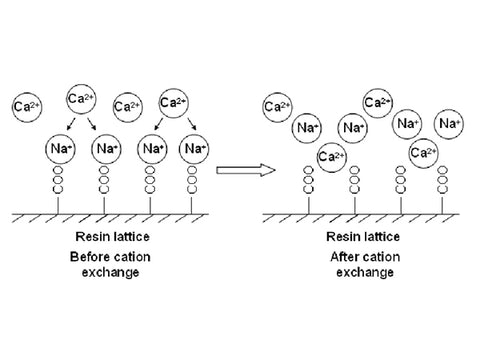
Cation resin has a polymer matrix with fixed negatively charged functional groups. Those groups attract positive ions in water; the resin does not attract “negative ions,” as some simplified explanations incorrectly state. DuPont Water Solutions illustrates softening as the exchange of Ca²⁺ for Na⁺, followed by regeneration of calcium-loaded resin with sodium chloride to return it to sodium form. The process is reversible, but actual working capacity depends on feed quality, bed depth, flow rate, regenerant dose, and the hardness endpoint.
How does cation resin work?
Water flows through the resin bed and dissolved cations diffuse into each bead. An ion with greater affinity displaces a mobile counter-ion at an active site. As useful sites approach their operating capacity, leakage rises and the resin requires regeneration.
For softening, the simplified reaction is:
2R–Na + Ca²⁺ → R₂–Ca + 2Na⁺
The reaction explains why a softener reduces hardness but does not remove all dissolved minerals. Charge remains balanced as calcium and magnesium are exchanged for sodium. Conductivity or TDS therefore does not necessarily fall significantly after softening.
What is the difference between SAC and WAC resin?
Strong acid cation (SAC) works across a broad pH range and is commonly used for softening or demineralization. Weak acid cation (WAC) has a high affinity for H⁺ and mainly exchanges cations associated with alkalinity; its application requires an assessment of feed chemistry and downstream treatment.
| Factor | SAC | WAC |
|---|---|---|
| Common functional group | Sulphonate | Carboxylate |
| Common operating form | Na⁺ for softening; H⁺ for demineralization | H⁺ for dealkalization or selected combined systems |
| Operating behaviour | Exchanges cations across a broad pH range | Effective capacity is related to feed alkalinity and pH |
| Common regeneration | NaCl for Na⁺ form; acid for H⁺ form according to design | Acid, at the dose and concentration specified for the resin and configuration |
| Selection data | Total hardness, all cations, leakage, salt/acid dose, and outlet target | Hardness relative to alkalinity, downstream CO₂, pH, regeneration, and polishing requirement |
“Strong” does not mean a mechanically stronger bead, and “weak” does not indicate an inferior product. The terms describe functional-group ionization. Select resin from the process, not the label alone.
When is cation resin used for softening?
Use sodium-form cation resin when the main problem is Ca/Mg hardness that forms scale on heaters, boiler-feed pretreatment, heat exchangers, piping, or process equipment. Design the system from hardness loading and working capacity, not vessel diameter alone.
Initial data for a water-softening application include:
- Total hardness in a stated unit, plus alkalinity, pH, TDS/conductivity, Fe, Mn, and turbidity.
- Average and peak flow, daily volume, operating hours, and duty/standby arrangement.
- Permitted outlet hardness and the sampling location.
- Resin working capacity at the selected salt dose, resin volume, bed depth, service flow, and pressure drop.
- Backwash flow, freeboard, brine draw, slow rinse, fast rinse, refill, and drain capacity.
Fe/Mn, solids, oil, organics, and oxidants can impair resin. Where those parameters are present, assess pretreatment and resin compatibility before increasing media volume.
When is cation resin used for demineralization?
In demineralization, H⁺-form cation resin exchanges cations and releases H⁺. Water then passes through an OH⁻-form anion exchanger, a degasser where required, or a mixed bed for polishing. The configuration must follow ionic loading, silica, CO₂, conductivity or resistivity target, and production demand.
H⁺-form regeneration commonly uses HCl or H₂SO₄ in a system designed for those chemicals. DuPont’s guide to acids for cation resin regeneration warns that sulphuric-acid conditions must reflect feed calcium because unsuitable concentration can precipitate calcium sulphate in the bed. Concentration, injection staging, materials, and safeguards must follow the system design and resin datasheet, not a generic value.
How is the required cation resin volume calculated?
A preliminary calculation links ionic load to resin working capacity. For a softener, the concept is:
hardness load per cycle = flow × operating time × hardness concentration
initial resin volume = hardness load per cycle ÷ working capacity at the selected salt dose
Use consistent units. Total capacity on a datasheet is not automatically the working capacity in a plant. Corrections are needed for the leakage target, regenerant level, temperature, service rate, rinse quality, resin age, fouling allowance, and design margin. After estimating volume, verify vessel diameter, bed depth, pressure drop, backwash expansion, distributor, and peak flow.
| Data | Why it is needed |
|---|---|
| Hardness or total cations | Defines the ionic load per unit of water |
| Peak flow | Checks service velocity and pressure drop |
| Water volume per cycle | Defines required working capacity before regeneration |
| Regenerant dose | Links chemical consumption to working capacity and leakage |
| Backwash flow and drain | Confirms that the bed can expand and rinse correctly |
| Outlet target | Sets the regeneration or changeover endpoint |
How can regeneration be kept consistent?
A softener cycle normally includes service, backwash, brine draw, slow rinse, fast rinse, brine refill, and return to service. A demineralizer may require acid injection, displacement, rinse, inter-vessel interlocks, and chemical-waste handling. Flow and time at each stage must suit the resin, vessel, distributor, regenerant, and outlet target.
In a system with several valves, AQ Matic valves, stagers, controllers, and fluid ejectors can be assessed for regeneration sequencing and brine or chemical draw. The buyer should provide the valve diagram for each stage, service/backwash/rinse flow, inlet and drain pressure, regenerant concentration and specific gravity, wetted materials, power supply, flow-meter input, and the safe position after control failure.
Automation does not replace the resin calculation. A timer can run normally while regeneration fails because an injector is blocked, brine is not drawn, pressure is low, a distributor is damaged, or rinse water is insufficient.
Which signs indicate a resin or system problem?
Use operating trends to distinguish exhausted resin from component failure. One sample is insufficient when the sampling point, instrument, or flow condition has not been verified.
| Symptom | Possible causes to check | Evidence needed |
|---|---|---|
| Outlet hardness rises sooner | Feed load increased, salt dose is low, brine draw failed, channeling, or resin capacity fell | Inlet/outlet hardness, volume per cycle, brine level, draw time, and regeneration history |
| Pressure drop increases | Solids, broken beads, blocked distributor, or excessive flow | Differential pressure at known flow, feed turbidity, strainer inspection, and resin sample |
| Brine-tank level does not fall | Blocked injector/tubing, insufficient motive pressure, air leak, or incorrect valve position | Level before/after, suction, pressure, valve position, and drain flow |
| Rinse takes too long to reach target | Excess regenerant, low rinse flow, channeling, or wrong sampling point | Conductivity/hardness trend, rinse flow, and sampling location |
| Capacity does not recover | Fouling, oxidation, bead damage, or an incomplete regeneration sequence | Resin analysis, bead inspection, capacity test, and full cycle audit |
Do not replace resin before checking valves, injector, flow meter, brine system, distributor, regenerant dose, and feed-water quality.
How should buyers select a cation resin product?
Use the datasheet to compare ionic form, matrix, functional group, total capacity, moisture, particle-size distribution, uniformity coefficient, shipping density, temperature limit, and regeneration guidance. Then match those data to the real system.
PT Watermart Perkasa supplies resin such as TRILITE KC-08 and KH-80 and DIONIX ion exchange resin. For a quotation, send the water analysis, target, flow, daily volume, existing schematic, regenerant, vessel size, and nameplate photographs through the Watermart contact page.

Frequently asked questions about cation resin
Does cation resin make water safe to drink?
Cation resin treats ions within its design scope, not every water risk. Drinking-water suitability requires appropriate chemical and microbiological testing plus a treatment train matched to the results.
Does cation resin reduce TDS?
A Na⁺-form softener normally exchanges hardness for sodium, so it does not remove TDS. H⁺-form demineralization followed by anion exchange can reduce ionic content much further.
How long does cation resin last?
There is no single service life for every system. Oxidants, fouling, temperature, hydraulic stress, regeneration, handling, and the outlet target all matter. Assess working-capacity, leakage, pressure-drop, and bead-condition trends.
Can SAC and WAC directly replace one another?
No. They have different chemistry, operating forms, capacities, and regeneration requirements. Changing the resin class requires a process recalculation and checks on the vessel and downstream stages.