
Ion Exchange Resin
Anthracite Filter Media Indonesia
Anthracite filter media for industrial multimedia filters. Select from water tests, grade, particle size, vessel, bed depth, flow, and project backwash data.
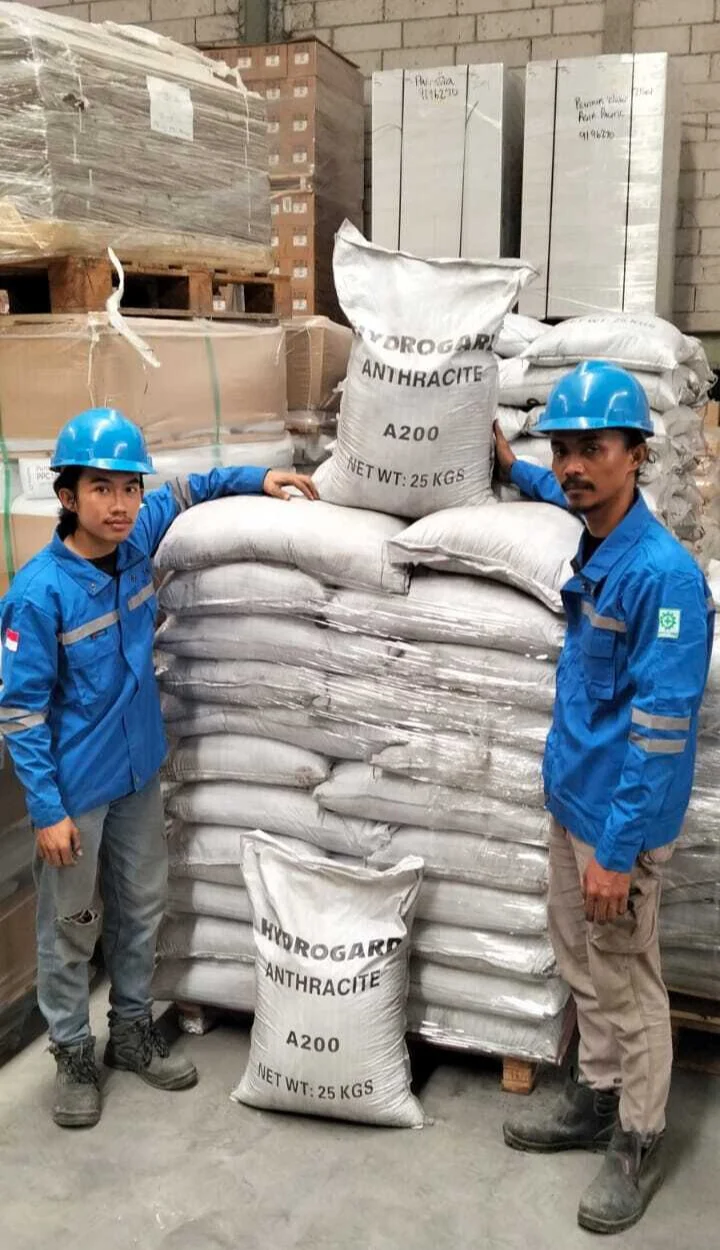
Anthracite filter media for projects in Indonesia
Anthracite filter media is used primarily as a granular layer for retaining sediment, turbidity, and suspended solids in multimedia filters. PT Watermart Perkasa supplies anthracite for commercial and industrial projects in Indonesia; grade, particle size, quantity, packing, and bed design must match the feedwater, flow, vessel, and available backwash capacity.
Updated 4 August 2026: anthracite duty, boundaries with other media, and project-selection evidence were clarified.
Anthracite is commonly placed as a lower-density layer above sand or other granular media in a multimedia filter. The actual arrangement must follow feedwater quality, filtration target, service rate, backwash capacity, particle size, density, and product guidance. The medium does not replace water testing or filter hydraulic calculations.
When is anthracite filter media the right choice?
Anthracite is appropriate when the primary duty is particle filtration in a granular bed; it is not an automatic substitute for activated carbon or iron-manganese media. Start with the measured water parameters and the required treatment mechanism, then match particle-size distribution, layer depth, filtration rate, pressure drop, expansion space, and the available backwash flow.
| Main finding or target | Media path to assess | Decision boundary |
|---|---|---|
| Sediment, turbidity, or TSS | Anthracite with sand or companion media in a multimedia filter | Define from water tests, solids loading, filtrate target, bed arrangement, and backwash |
| Odour, taste, free-chlorine residual, or selected organics | Activated-carbon media | Anthracite does not replace activated carbon’s adsorption duty |
| Dissolved iron or manganese | Iron and manganese filter media | Requires Fe/Mn, pH, oxidation, contact time, and regeneration or backwash inputs |
| Existing-media replacement | Anthracite with a verified grade and arrangement | Review the old label, each layer depth, underdrain, media loss, and operating history |
Technical sources: Hydrogard Anthracite A100/A200 product sheet, reviewed July 20, 2026, and an April 2026 U.S. EPA fact sheet describing dual-media anthracite and sand. The EPA reference explains a process principle; it is not an Indonesian regulatory requirement.
What should be checked when replacing existing anthracite?
An anthracite replacement should start with the old bed and filter condition, not simply the previous purchase quantity. Measure the vessel and each layer, confirm freeboard, support gravel, and underdrain condition, then record media loss, pressure drop, filtrate quality, and available backwash before setting the new quantity.
| Replacement check | Evidence to provide | Decision affected |
|---|---|---|
| Existing bed arrangement | Open-vessel photos and anthracite, sand, and support-gravel depths | Media to replace, retain, or rearrange |
| Mechanical condition | Distributor, underdrain, valve, vent, and drain photos | Internal repairs before new media is loaded |
| Operating history | Flow, clean/dirty pressure drop, backwash, media age, and filtrate problem | Grade, quantity, expansion space, and commissioning plan |
The replacement quotation should state whether old-media removal, vessel cleaning, support gravel, loading, initial backwash, start-up, sampling, and disposal are included.
How is the anthracite order quantity calculated?
Initial anthracite-layer volume is the vessel’s internal cross-sectional area multiplied by design bed depth: π × (internal diameter ÷ 2)² × layer depth. Keep the units consistent. Convert volume to weight only with the offered grade’s data-sheet bulk density, then round to the correct pack count and check the total across every vessel.
| Calculation input | Correct source | Error to avoid |
|---|---|---|
| Vessel diameter | Internal diameter or drawing, not nominal outside size | Using a nameplate diameter without checking internal space |
| Anthracite depth | Each layer’s design or a measured existing bed | Treating the full media space as anthracite |
| Bulk density | Datasheet for the offered grade and particle size | Using density from another product or brand |
| Pack count | Weight per pack and vessel count | Rounding at project level without checking each unit |
The geometric result is an initial quantity check, not the final filter design. Support gravel, sand or companion media, backwash freeboard, internal distributors, loading loss, and the complete bed arrangement must be checked separately before a purchase order.
What determines anthracite filter media price?
| Quotation factor | Data to provide |
|---|---|
| Grade and product | Product name or datasheet, particle size, uniformity coefficient, and density |
| Media quantity | Vessel diameter, bed area, depth of each layer, and number of units |
| Operating condition | Normal and peak flow, turbidity, TSS, and filtration target |
| Backwash | Backwash flow and pressure, freeboard, internal distributor, and bed expansion |
| Logistics | Project location, unloading access, required packing, and delivery date |
Compare prices using the same supply scope. Check whether the quotation covers media only or also support gravel, sand, delivery, vessel filling, start-up, and testing. Availability and lead time are confirmed at quotation rather than assumed from a product list.
What should an anthracite purchase order state?
An anthracite purchase order should lock the product identity, quantity, documents, delivery point, and work boundary. Writing only “anthracite media” leaves the grade, particle size, packing, and quantity basis open to a different interpretation from the technical quotation.
| Purchase-order item | Detail to state |
|---|---|
| Media identity | Brand, code or grade, particle size, uniformity coefficient, bulk density, and referenced datasheet |
| Quantity | Weight per pack, pack count, total weight, vessel count, and bed-depth basis |
| Documents | Datasheet, safety document, and the agreed quality or lot documentation |
| Handover | Location, schedule, vehicle access, unloading responsibility, and pack inspection on arrival |
| Work boundary | Media only or removal, disposal, internal inspection, support gravel, loading, initial backwash, and sampling |
Carry the units, document revision, and quotation exclusions into the purchase order. Any grade, packing, or quantity change should be checked again against the bed arrangement and available backwash before dispatch.
How to select anthracite for a filter design
- Test the feedwater. Record turbidity, TSS, iron, manganese, pH, and other parameters relevant to the water source.
- Define the target and flow. Provide normal flow, peak flow, operating hours, and the required filtrate quality.
- Check the vessel and backwash. Diameter, freeboard, valve, underdrain, pump, and backwash supply must support the proposed bed.
- Match the media data. Compare particle size, density, and recommended service and backwash conditions in the offered product datasheet.
- Request a written scope. State the quantity, packing, delivery, supporting media, installation, commissioning, and sampling that are included or excluded.
For a more specific product comparison, review Hydrogard A100/A200 anthracite media. If dissolved iron or manganese is the main problem, review iron and manganese filter media because anthracite alone does not automatically address every contaminant.
Data needed for an anthracite quotation
Send a recent water test, water source, normal and peak flow, vessel diameter and height, existing media arrangement, filtration target, backwash capacity, unit count, project location, and required date through the Watermart contact form. A vessel nameplate photo and pictures of the old media help with replacement projects.
Anthracite filter media buyer questions
Is anthracite priced by kilogram or by bag?
The quotation basis follows the product and packing available. Ask the quotation to state weight or volume per pack, pack count, and total quantity so two offers can be compared on the same basis.
Can anthracite be used as the only filter medium?
The configuration depends on the filtration target and product design. Many filters use anthracite as one part of a multimedia bed, but layer quantity, support bed, and companion media must follow the water data and filter calculations.
Is water ready to drink after anthracite filtration?
No. Drinking-water suitability must be demonstrated against applicable Indonesian requirements through a complete process design, commissioning, sanitation, operating and consumables records, representative sampling, and laboratory verification.