When Should Anion Exchange Resin Be Replaced?
Replace anion resin when outlet quality and operating capacity no longer recover after correct regeneration, valve and distributor checks, and a manufacturer-approved cleaning attempt. Do not replace resin because of one high reading. Confirm the conductivity or silica trend, shortening service runs, pressure drop, bead condition, and regeneration records.
Updated 1 August 2026.
PT Watermart Perkasa, operating through water.co.id, supplies DIONIX ion exchange resin, Purolite, and TRILITE in Indonesia for softening, demineralization, mixed beds, and polishing. Resin model, ionic form, volume, and regeneration procedure must match the water analysis, quality target, vessel, and product datasheet.
Should the resin be regenerated, cleaned, tested, or replaced?
Use several repeatable observations under comparable operating conditions. Verify a single abnormal laboratory or sensor result against the sampling point, instrument calibration, feed quality, flow, temperature, and regeneration sequence.
| Operating evidence | Check before replacement | Initial decision |
|---|---|---|
| Conductivity or silica rises once | Resample, instrument, feed quality, flow, and valve | Verify the evidence; do not replace yet |
| Service run repeatedly shortens at comparable load | Regenerant dose/concentration, contact time, rinse, and bypass | Correct regeneration and compare the next cycle |
| Pressure drop rises or resin fines carry over | Backwash, distributor/nozzle, bed expansion, and beads | Isolate for carry-over and inspect physically |
| Colour changes or fouling is suspected | Organics, iron, oxidants, pretreatment, and a resin sample | Clean only by an approved procedure |
| Performance will not recover after system causes are fixed | Working capacity, outlet quality, beads, and regeneration history | Test the resin or plan replacement |
DuPont’s Fundamentals of Ion Exchange distinguishes operating capacity, fouling, oxidation, and regeneration effects that belong in a resin assessment. Resin diagnosis should therefore follow system trends rather than calendar age alone.
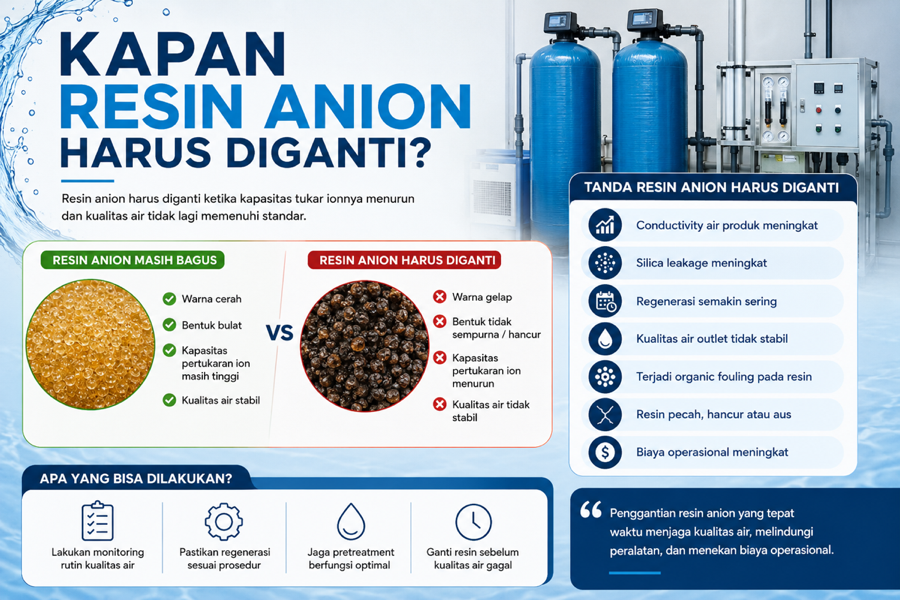
Signs the Resin Is Reaching the End of Its Life
The most common warning signs are:
- Outlet conductivity begins to rise
- Silica leakage increases
- Regeneration no longer restores the original performance
- The service cycle becomes shorter than before
- Water quality becomes inconsistent between cycles
- The resin bed shows physical damage or heavy fouling
If these symptoms appear repeatedly even after proper regeneration, replacement should be considered.
What Causes Anion Resin to Fail
Anion resin can degrade because of:
- Oxidation from chlorine or other oxidants
- Organic fouling
- Iron contamination
- Suspended solids or scaling
- Excessive temperature
- Improper regeneration
- Long service life without inspection
In many systems, the resin does not fail suddenly. It becomes less effective step by step until the outlet quality no longer meets the specification.
How to Check Resin Condition
Start by reviewing operating data:
- Compare current conductivity with past performance.
- Check silica leakage if the system is used for high-purity water.
- Review regeneration frequency and chemical consumption.
- Inspect the resin bed for discoloration, clumping, or bed loss.
- Confirm whether the problem is truly resin wear and not a valve, pump, or regeneration issue.
If performance remains poor after cleaning and regeneration, the resin is likely near replacement time.
Compare data at similar feed composition, flow, temperature, and endpoint. A shorter cycle during a higher ionic load does not by itself prove permanent resin damage. Confirm that the valve completes every regeneration step and that the distributor is not causing channeling or resin loss.
Replacement Is Better Than Waiting Too Long
Using exhausted resin too long can create larger problems downstream. In demin systems, poor resin performance may affect boilers, rinsing stages, product water quality, and sensitive industrial processes.
Replacing the resin on time is usually cheaper than dealing with repeated quality failures.
There is no universal service-life figure that applies to every anion resin. Record the installation date, batch, volume, conductivity or silica, throughput per cycle, regenerant use, pressure drop, and cleaning history. Replace from evidence of unrecoverable performance, not a generic age rule.
How to Extend Resin Life
To delay replacement, make sure the system has:
- Proper pretreatment
- Good control of chlorine and oxidants
- Correct regeneration chemistry
- Adequate backwash
- Regular water quality monitoring
Good operating discipline helps preserve resin performance and makes replacement decisions auditable.
Conclusion
Anion resin should be replaced when the system can no longer maintain outlet quality after proper regeneration. Rising conductivity, silica leakage, unstable cycles, and visible resin damage are the strongest indicators.
If your demineralization system depends on stable high-purity water, do not wait until failure becomes obvious at the process line. Monitor the resin early and replace it before it becomes a production risk.
For a replacement review, send feed and outlet analysis, flow, vessel size, installed resin model and volume, regeneration settings, pressure trend, and cycle history through the PT Watermart Perkasa contact page. Also compare the duty with the demineralizer application and the required conductivity or silica acceptance criteria.
Anion resin replacement FAQ
What is the clearest sign that anion resin needs replacement?
The clearest evidence is repeated failure to recover the required outlet quality or working capacity after correct regeneration, system troubleshooting, and an approved cleaning attempt. Confirm the finding with comparable operating data.
How many years does anion resin last?
There is no universal number. Feed quality, resin type, ionic load, oxidants, organics, temperature, regeneration, hydraulics, and maintenance all affect service life. Use operating trends and resin testing where justified.
Can fouled anion resin be cleaned?
Some fouling can be treated, but the cleaning method must match the resin and contaminant and follow manufacturer and site chemical-safety procedures. Physically damaged or irreversibly oxidized resin will not be restored by cleaning.
Does one high conductivity result prove resin failure?
No. Repeat the sample and check the instrument, sampling point, feed quality, flow, bypass, valve sequence, and regeneration. A confirmed trend under comparable conditions is stronger evidence.
What data should be sent for a replacement quotation?
Provide inlet/outlet analysis, flow and operating hours, vessel dimensions, resin model and volume, regeneration settings and chemical use, cycle length, pressure drop, bead observations, and the required outlet specification.
Technical sources
- DuPont Water Solutions, Fundamentals of Ion Exchange, Form 45-D01462-en, Rev. 1 (2019), accessed 1 August 2026.
- Purolite, Purofine PFA400 strong-base anion resin technical data sheet (2025), an example of model-specific physical, hydraulic, and backwash data to verify.