
Short answer: a brine tank is the salt tank in a water softener that prepares sodium- or potassium-chloride solution for regenerating cation-exchange resin. Size it from resin volume, the datasheet regenerant dose, regeneration frequency, refill requirement, salt freeboard, and overflow protection—not tank diameter alone.
A brine tank does not filter feed water directly. After the resin has retained calcium and magnesium, the system draws brine into the resin vessel, performs a slow rinse, then a fast rinse before returning to service. A refill fault, salt bridge, blocked injector/ejector, float problem, restricted drain, or incorrect valve sequence can leave regeneration incomplete. Buyers should record feed hardness, flow, resin volume, salt dose per regeneration, pressure, suction lift, brine concentration, cycle count, drain capacity, and control method before selecting components.
Use the softener salt, brine-tank refill, and regeneration worksheet to connect hardness load, resin working capacity, refill-water volume, and the salt-replenishment interval.
PT Watermart Perkasa supplies resin, FRP vessels, valves, controllers, and regeneration components for water softeners in Indonesia. This guide defines the starting data; final capacity still requires the resin datasheet, valve manual, and process calculation.
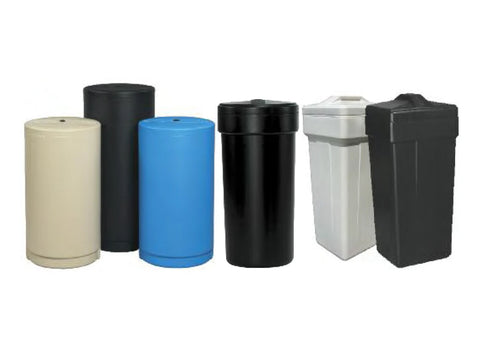
What is a Brine Tank?
A brine tank holds salt and water to form a regenerant solution. The solution restores softener-resin capacity so the resin can again retain hardness ions. A brine tank is not a disinfection unit and does not establish that water is safe to drink; its duty is to support a designed softening process.
Brine supplies sodium or potassium ions that replace hardness ions on the resin during regeneration. NSF’s NSF/ANSI 44 technical requirements published March 8, 2025 explain that residential-softener evaluation includes brine-system accuracy, softening capacity, rinse effectiveness, and pressure drop. This reference does not mean every product is NSF certified; buyers must check the listing for the specific model.
Brine-tank capacity must account for solution volume per regeneration, undissolved salt storage, the float working level, freeboard, and cleaning access. A larger tank does not automatically consume more salt; the regeneration program, resin volume, and resin/valve guidance determine the dose.
What sizing data does a brine-tank buyer need?
Sizing starts from regenerant demand and solution volume per cycle. Without these data, tank selection is only an estimate.
| Design input | Why it matters | Evidence to prepare |
|---|---|---|
| Resin type and volume | Establishes the capacity and regenerant basis | Resin datasheet, volume per vessel, and shipped ionic form |
| Salt dose per resin volume | Sets salt mass per regeneration | Working-capacity curve or resin-maker guidance |
| Refill volume and brine concentration | Sets the tank working volume | Valve program, refill time, and injector/ejector data |
| Regeneration frequency | Sets salt storage and refill logistics | Flow, daily use, hardness, and working capacity |
| Suction lift, pressure, and backpressure | Confirms that brine can be drawn in the designed time | Pipe layout, elevation, inlet pressure, and drain condition |
| Float, overflow, and service clearance | Reduces spill risk and permits inspection | Room dimensions, overflow elevation, lid access, and drain route |
An installation checklist prevents overflow and incomplete brine draw
The installation must let an operator observe level, add salt, remove sediment, and test suction without dismantling the main treatment train. Check these points before commissioning:
- Floor and support: confirm that a level base carries the tank, water, salt, pipe, and service loads at the full condition.
- Service clearance: leave room to open the lid, remove the float assembly, add salt, and clean the tank.
- Suction line: keep it as short and airtight as the manual requires; avoid air leaks, kinked tubing, and elevation beyond the injector/ejector capability.
- Overflow and drain: route them to a suitable discharge without a connection that can impose backpressure or reverse flow into the tank. Follow local codes and the system manual.
- Float and air check: test mechanical movement, shutoff level, and the air-check function after brine is depleted.
- Refill: measure actual water volume rather than program time alone because pressure and flow control affect the result.
- Materials: match the tank, tubing, seals, fittings, and valves to the regenerant, temperature, and cleaning products.
During commissioning, mark the level before draw, after draw, and after refill. Run a complete cycle while recording duration, inlet pressure, drain condition, refill volume, level change, and outlet hardness. This baseline helps distinguish normal variation from a leak, blockage, programming error, or declining resin performance.

How Brine Tanks Work
A brine tank receives refill water, dissolves salt, and supplies regenerant after the resin reaches its programmed working capacity. In the resin vessel, sodium or potassium displaces retained calcium and magnesium; the rinse stages then send regenerant and hardness ions to drain before the unit returns to service.
The valve refills the brine tank by programmed volume or time. After salt dissolves, an injector or ejector draws brine into the resin vessel; slow rinse provides contact time, then fast rinse sends residual regenerant to drain before the unit returns to service. Verify actual refill volume and draw rate because pressure, backpressure, nozzle, tubing, and suction lift affect the flow.
Use the salt type specified by the softener or resin manufacturer. Insoluble material and moisture can contribute to residue or salt bridging, but a failed brine draw may also come from the injector, tubing, float, pressure, or drain; inspect the entire path before changing salt.
A brine tank supports repeatable regeneration when refill, salt dissolution, brine draw, rinse, and drain all meet design. Use the water-softener maintenance checklist to record test results and cycle behavior.
AQ Matic sequences valves and brine draw
In a multi-valve system, AQ Matic stagers, controllers, valves, and fluid ejectors can be assessed for service, backwash, brine draw, slow rinse, fast rinse, and refill. The manufacturer’s 2021 catalog lists stagers for softener/filter duties and 540–546 Series fluid ejectors for regenerant draw; review the official AQ Matic catalog before matching a model.
For a quotation, provide the valve-position diagram for every stage, duration, flow, inlet and drain pressure, resin volume, regenerant and concentration, suction lift, valve count, flow-meter signal, interlocks, and the safe position after loss of power or pilot pressure. AQ Matic sequences flow; it does not replace salt-dose calculations or brine-tank sizing.
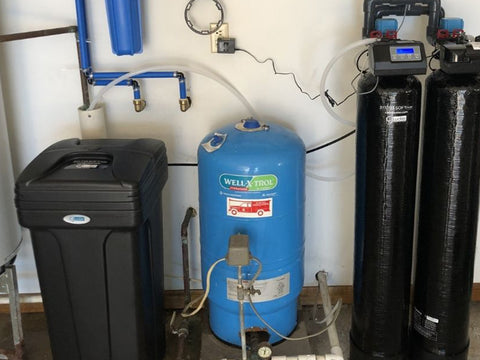
A brine tank preserves softener-resin capacity
The brine tank maintains regenerant supply so resin capacity can be restored. Incomplete regeneration can allow hardness leakage and increase scale risk in equipment; compare hardness before and after the unit to distinguish a regeneration fault from a feed-water change.
| Operating evidence | Expected result | If the result differs |
|---|---|---|
| Brine level during draw | Level falls by the designed volume and time | Check salt bridge, injector/ejector, tubing, float, pressure, and drain |
| Level after refill | Returns to setpoint without overflow | Check refill program, flow control, and float |
| Outlet hardness after regeneration | Returns to the process target | Check dose, contact time, rinse, resin, and valve position |
| Salt used per cycle | Matches the program and resin volume | Audit water meter, regeneration frequency, leakage, and capacity setting |

A brine tank is one part of an ion-exchange system. Buyers must also match TRILITE cation resin, FRP pressure vessels, valves, internal distributors, the drain, and test instruments to the flow and hardness target.
Frequently asked questions about brine tanks
How much salt should be added?
Use the regenerant dose in the resin datasheet or softener calculation, then apply it to the resin volume being regenerated. Do not set the dose from brine-tank size alone; working capacity, leakage target, and valve program also affect each cycle.
Why is salt visible but the softener does not draw brine?
Check for a salt bridge, water level, injector/ejector restriction, suction tubing, air check, float, inlet pressure, backpressure, and a blocked drain. Record the brine-level change during the draw stage before replacing parts.
When should the tank be cleaned?
Follow the unit manual and actual inspection. Clean when sediment interferes with dissolution, float movement, suction, or system hygiene; isolate the unit and follow the regenerant-handling procedure before opening the tank.
Send the water analysis, resin volume, flow data, regeneration program, salt dose, layout, and nameplate photographs through the PT Watermart Perkasa contact page for a brine-tank and softener-system review.