
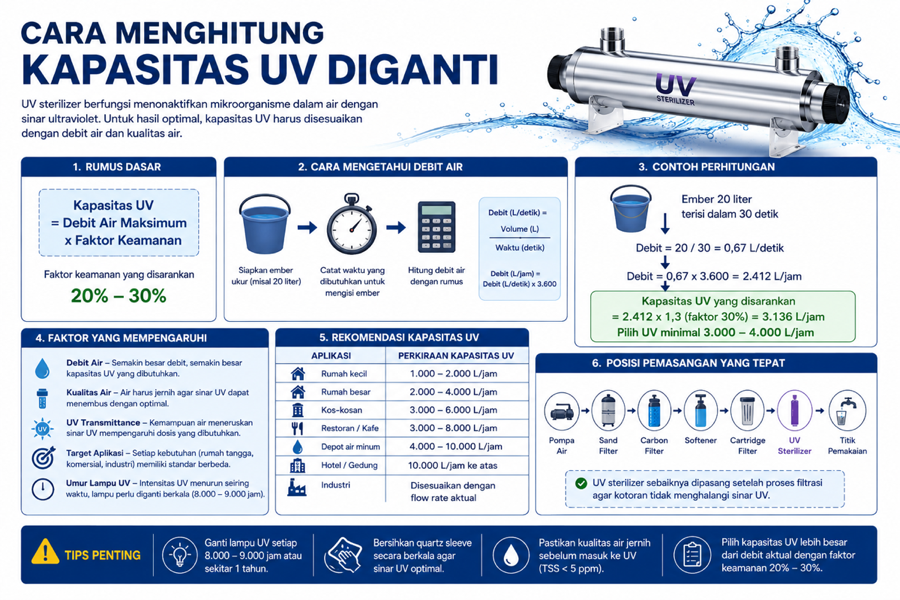
A UV sterilizer may look simple: water flows through the chamber, the lamp turns on, and the water leaves with lower microbiological risk. In practice, UV capacity should not be selected only by pipe size, lamp wattage, or chamber shape. It should be calculated from the maximum flow rate, the water quality before the UV unit, and the application target.
This article explains how to calculate UV sterilizer capacity when replacing an old unit, with examples for homes, refill water depots, buildings, restaurants, hotels, and industrial systems.
Why UV Capacity Should Be Recalculated
A UV unit that was sufficient in the past may no longer be suitable today. Water demand may change because more people use the system, a house is converted into a small business, a refill water depot increases production, or an industrial line raises its flow rate.
UV performance is also affected by water quality. Turbidity, iron, manganese, color, and fine particles can block UV light. For this reason, a UV sterilizer should be installed after filtration, not directly on untreated raw water.
For household systems, UV sizing is often related to sediment filters, carbon filters, softeners, cartridge filters, and pump capacity. You may also read the related guide on water softening equipment for household water treatment systems.
Basic Formula for UV Capacity
The simplest way to size a UV sterilizer is to start with the maximum water flow rate passing through the unit.
UV capacity = Maximum water flow rate x safety factor
A common safety factor is 20-30%. This gives the UV unit enough room to handle higher pump flow, freshly cleaned filters, or several outlets being opened at the same time.
Example:
2,000 liters/hour x 1.3 = 2,600 liters/hour
If the maximum flow rate is around 2,000 liters per hour, choose a UV sterilizer with at least 2,600 liters per hour capacity. In practice, this is usually rounded up to a 3,000 liters per hour unit.
How to Measure Flow Rate on Site
If there is no flow meter, you can estimate flow rate using a measured bucket and a stopwatch.
- Open a faucet on the line after the pump or at a point that represents the flow into the UV unit.
- Fill a bucket with a known volume, such as 20 liters.
- Record the time needed to fill the bucket.
- Convert the result into liters per hour.
Example: water fills a 20 liter bucket in 30 seconds.
20 liters / 30 seconds = 0.67 liters/second
0.67 x 3,600 = 2,412 liters/hour
With a 30% safety factor:
2,412 x 1.3 = 3,136 liters/hour
A safer UV capacity would be around 3,000-4,000 liters per hour.
Factors That Determine UV Size
Maximum Flow Rate
The faster water passes through the UV chamber, the shorter the contact time with ultraviolet light. If the flow rate is too high for the unit, disinfection may be less effective even when the lamp is still on.
Water Clarity Before UV
UV works best on clear water. Particles, mud, iron, manganese, and color can block light exposure. Pre-treatment such as sand filters, carbon filters, softeners, and cartridge filters remains important.
UV Transmittance
UV transmittance is the ability of water to transmit UV light. Low UV transmittance requires a higher UV dose or a larger unit. For industrial applications, this parameter should be checked from water analysis data.
Application Target
Homes, restaurants, refill water depots, hotels, hospitals, food and beverage plants, and pharmaceutical facilities have different risk levels. The more sensitive the application, the more important it is to size the system based on actual water quality and maximum flow data.
Lamp Age and Quartz Sleeve Condition
A UV lamp can still be visibly on even when its intensity has declined. The quartz sleeve can also be covered with scale, iron, or mineral deposits. Both conditions reduce UV performance.
Signs That UV Capacity Should Be Replaced or Upgraded
Consider replacing or upgrading the UV unit when:
- Water flow has increased from the original design.
- The UV lamp has exceeded its service life.
- Microbiological issues remain after UV treatment.
- The system is used for a larger application than originally planned.
- The chamber or quartz sleeve is difficult to clean.
- The ballast or power supply starts failing.
- Raw water becomes more turbid or changes in quality.
- The old UV unit no longer matches the actual flow rate.
If the system also uses a softener, resin regeneration and maintenance matter because water quality before UV affects the final result. See also the article on the impact of water softener regeneration cycles on wastewater.
Example Calculations
Home
Suppose a house needs around 1,500 liters of water per hour.
1,500 liters/hour x 1.3 = 1,950 liters/hour
Choose a UV sterilizer with at least 2,000 liters per hour capacity. If the house has many bathrooms, a large storage tank, or a home laundry business, increase the capacity so the UV unit does not operate too close to its maximum rating.
Refill Water Depot
Suppose the production flow is 3,000 liters per hour.
3,000 liters/hour x 1.3 = 3,900 liters/hour
The recommended UV capacity is at least 4,000 liters per hour. If the depot operates for long hours or has high production demand, the capacity can be increased to 5,000 liters per hour or more depending on system design.
Industry
Suppose a plant requires 10 m3/hour.
10 m3/hour x 1.3 = 13 m3/hour
Choose a UV sterilizer with at least 13 m3/hour capacity. In practice, the capacity is often rounded up to 15 m3/hour to provide an operating margin.
For food and beverage, pharmaceutical, cosmetic, hospital, hotel, and commercial building applications, UV selection should not rely on estimated flow alone. Use water quality data, maximum flow rate, and process requirements.
Correct UV Installation Position
A UV sterilizer should be installed near the final stage of the water treatment system, after filtration.
Typical sequence:
Water pump -> Sand filter -> Carbon filter -> Softener -> Cartridge filter -> UV sterilizer -> Point of use
If UV is installed before filtration, particles and turbidity can reduce UV effectiveness. Filter and softener maintenance therefore still affects disinfection performance.
To maintain system performance before UV, read the guide on water softener maintenance for long life and efficiency.
Common Mistakes When Replacing a UV Sterilizer
Many users replace UV equipment based only on pipe size or lamp wattage. Those two factors do not always represent the actual capacity.
- Selecting a UV unit that is too small for the actual flow rate.
- Not calculating maximum flow.
- Not replacing a lamp that has exceeded its service life.
- Not cleaning the quartz sleeve.
- Installing UV before filtration.
- Using UV on water that is still turbid.
- Ignoring system working pressure.
- Ignoring commercial or industrial requirements.
These mistakes can reduce disinfection performance even when the UV lamp is still on.
When Should a UV Lamp Be Replaced?
A UV lamp should be replaced based on operating hours, not only by whether it still lights up. Many UV lamps remain visibly on even though their ultraviolet intensity has dropped.
In general, UV lamps are replaced every 8,000-9,000 operating hours, or about once a year if they run continuously. The exact figure depends on the brand, lamp type, power quality, and operating conditions.
The quartz sleeve should also be cleaned regularly because scale, iron, manganese, and mineral deposits can block UV light.
UV Capacity Guide by Application
| Application | Estimated UV capacity |
|---|---|
| Small house | 1,000-2,000 liters/hour |
| Large house | 2,000-4,000 liters/hour |
| Boarding house | 3,000-6,000 liters/hour |
| Restaurant or cafe | 3,000-8,000 liters/hour |
| Refill water depot | 4,000-10,000 liters/hour |
| Hotel and building | 10,000 liters/hour and above |
| Industrial system | Based on actual flow rate |
This table is only an initial guide. Accurate sizing still requires checking flow rate, water quality, working pressure, and application purpose.
Conclusion
Calculating UV sterilizer capacity when replacing a unit should begin with maximum flow rate, water quality, and application requirements.
UV capacity = Maximum water flow rate x 20-30% safety factor
The right UV sterilizer helps the water treatment system operate more safely, consistently, and efficiently. However, UV cannot work alone. The water must be properly filtered first so UV light can pass through the water effectively.
FAQ About UV Sterilizer Capacity
Can a UV sterilizer kill bacteria in water?
A UV sterilizer helps inactivate certain bacteria and microorganisms using ultraviolet exposure. Its effectiveness depends on water clarity, UV capacity, and contact time.
Is a UV lamp still effective if it is still on?
Not always. A UV lamp may still be on, but its intensity decreases over time. That is why UV lamps should be replaced based on service life.
Can UV be installed directly after a well?
It is better not to install UV directly after untreated well water. Well water should pass through filtration first to reduce particles, mud, iron, manganese, and turbidity.
What UV capacity is suitable for a house?
For household use, UV capacity commonly ranges from 1,000-4,000 liters per hour, depending on water flow and the number of usage points.
Should UV capacity be higher than pump flow?
Yes. UV capacity should generally be higher than the actual pump flow, with a safety factor of around 20-30%, so disinfection remains stable.

.png)