
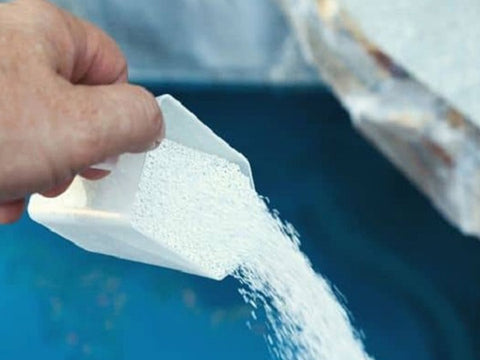
Short answer: calcium hypochlorite can disinfect water, but its dose must not be guessed. Operators need the product’s labelled available-chlorine percentage, measured chlorine demand, residual after effective contact time, and actual water flow. Turbidity, pH, temperature, and organic matter can all change the result.
Calcium hypochlorite is a strong solid oxidizer. In water, it produces chlorine species that can inactivate many microorganisms. It does not replace coagulation or filtration: water with high solids or organic loading normally needs pretreatment so the applied dose is not consumed before a disinfectant residual can be established.
Updated 2 August 2026: this guide now adds T10 verification, a dosing-interlock matrix, and a chlorinated-water release record.
What Is Calcium Hypochlorite and When Is It Selected?
Direct answer: calcium hypochlorite is a solid chlorine compound with the formula Ca(OCl)2. A plant may select it when it needs a solid chlorine source that can be stored, weighed, prepared as a stock solution, and metered under controlled conditions. Each delivery must still be checked against its label, certificate of analysis, SDS, granule or tablet form, and available-chlorine percentage because those details govern product-mass calculations and handling procedures.
CDC distinguishes liquid sodium hypochlorite from solid calcium hypochlorite. Selection should not be based only on price per kilogram: buyers need to assess active-chlorine consumption, storage stability, make-up space, dust exposure, tank and piping materials, dosing-pump range, and the operator’s ability to measure residual. For a new installation, chlorine-demand testing and hydraulic data should be available before the product and feed equipment are specified.
| Chlorine source | Supplied form | Buyer considerations | Main dosing data |
|---|---|---|---|
| Calcium hypochlorite | Solid; prepared as directed by the product supplier | Dry storage, weighing, dissolution, dust control, insolubles, and material compatibility | Available chlorine, product mass, stock strength, L/h, and injection pressure |
| Sodium hypochlorite | Liquid solution | Actual concentration, storage age and temperature, bulk tank, ventilation, and material compatibility | Active chlorine in g/L, daily use, L/h, and injection pressure |
| Chlorine gas | Pressurized gas | Requires dedicated containment, detection, ventilation, and operator competence; it is not a like-for-like substitution without design review | Mass feed, vacuum/injector duty, interlocks, and release scenarios |
Why is Chlorine Important for Water Treatment?
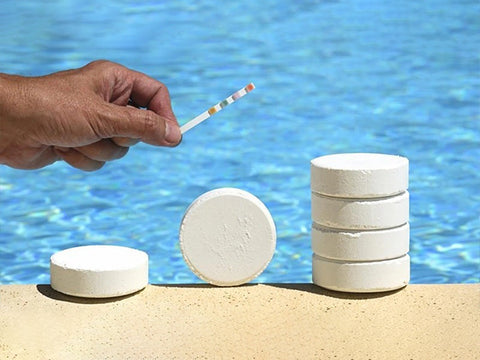
Calcium hypochlorite is useful because it provides chlorine in a solid form that can be measured and fed into a disinfection process. Performance depends on the free chlorine actually remaining, contact time, pH, temperature, turbidity, and the target organism—not on product mass alone.
The WHO Guidelines for drinking-water quality, fourth edition with the third addendum use a free chlorine residual of at least 0.5 mg/L after at least 30 minutes at pH below 8 as a reference condition for effective disinfection, with at least 0.2 mg/L at the point of delivery. These are verification references, not a universal plant dose; the installation still has to meet its product-water target, microbial risk controls, and applicable regulation.
For drinking water in Indonesia, the BPK legal database entry for Ministry of Health Regulation No. 2 of 2023 lists it as in force as of 2 August 2026, with a partial repeal by Regulation No. 3 of 2026. Regulation 2/2023 revoked Regulation 492/2010. Project teams must still check the consolidated text, local requirements, and end-user specification; process operating limits are not automatically the same as finished-water limits.
How Does Chlorine Clean Water?
Calcium hypochlorite reacts in water to form hypochlorous acid and hypochlorite ion. Their relative proportions change with pH, so pH must be recorded with chlorine residual and contact time. Organic matter, iron, manganese, ammonia, and other reducing substances can consume chlorine before the sampling point.
The practical relationship is:
applied chlorine dose = chlorine demand + measured chlorine residual
For example, if an applied dose of 2.0 mg/L produces a 0.6 mg/L free residual after the defined contact period, chlorine demand under those test conditions is about 1.4 mg/L. Repeat the test when flow, pH, turbidity, temperature, or source quality changes; one result does not represent every season.
How to calculate calcium hypochlorite dose from available chlorine
Use the available-chlorine percentage on the label or certificate of analysis. Do not assume that every calcium hypochlorite product has the same strength. For a batch of water, the preliminary calculation is:
product mass (g) = applied chlorine dose (mg/L) × water volume (m³) ÷ available-chlorine fraction
| Calculation input | Example | Verification note |
|---|---|---|
| Water volume | 100 m³ | Use effective volume, not only nominal tank size |
| Applied chlorine dose | 2.0 mg/L | Establish from demand testing and the residual target |
| Product available chlorine | 65%, or 0.65 | Copy from the label/COA for the batch being used |
| Preliminary product mass | 307.7 g | 2.0 × 100 ÷ 0.65; round only to the weighing resolution |
The 307.7 g result is a theoretical starting dose for this example, not a universal recipe. Dissolve the product according to its instructions, run the contact period, then measure free chlorine with a suitable method. Adjust the set point from the result, not from chlorine odour.
For continuous flow, estimate the pump output from the active chlorine that must be delivered:
pump rate (L/h) = dose (mg/L) × water flow (m³/h) ÷ active-chlorine concentration in stock (g/L)
At 20 m³/h and 2.0 mg/L, the process needs 40 g of active chlorine per hour. If the verified stock contains 10 g/L active chlorine, the initial pump setting is 4.0 L/h. Confirm that this lies inside the pump’s working range, then calibrate actual output at the real injection pressure.
How to check contact time and chlorine residual
Nominal detention time is effective contact-zone volume divided by flow. A 30 m³ tank at 60 m³/h gives 30 minutes nominally, but short-circuiting and poor mixing can make effective contact shorter. Use baffle information, tracer testing, or an engineer-approved design factor for final verification.
| Check | Formula or measurement point | Example |
|---|---|---|
| Nominal detention time | volume (m³) ÷ flow (m³/min) | 30 ÷ 1 = 30 minutes |
| Measured CT value | free residual C (mg/L) × effective time T (min) | 0.5 × 30 = 15 mg·min/L |
| Chlorine demand | applied dose − residual after contact | 2.0 − 0.6 = 1.4 mg/L |
| Distribution check | Residual at tank outlet and critical network points | Compare with operating limits and finished-water requirements |
The WHO reference of 0.5 mg/L for 30 minutes at pH <8 equals CT 15 mg·min/L, but the required CT depends on target organism, temperature, pH, and water quality. A large tank does not automatically provide adequate contact; verify residual at the point representing the shortest effective contact time.
Effective contact time uses T10, not nominal volume alone
The U.S. EPA Disinfection Profiling and Benchmarking Technical Guidance defines CT = C × T, where C is the residual at peak hourly flow and T is effective contact time. For a basin, T is commonly expressed as T10: the minimum detention time experienced by 90% of the water. T10 can come from a tracer test or, as an initial screen, theoretical detention time multiplied by a baffling factor. A generic factor does not replace a tracer study or regulatory acceptance.
This example shows why a 30 m³ tank at 60 m³/h does not automatically provide CT 15 mg·min/L. Its nominal detention time is 30 minutes, but the result changes when the flow pattern is considered.
| EPA screening hydraulic condition | T10/TDT factor | T10 from 30-minute TDT | CT at C = 0.5 mg/L |
|---|---|---|---|
| Unbaffled, mixed flow | 0.1 | 3 min | 1.5 mg·min/L |
| Poor baffling | 0.3 | 9 min | 4.5 mg·min/L |
| Average baffling | 0.5 | 15 min | 7.5 mg·min/L |
| Superior baffling | 0.7 | 21 min | 10.5 mg·min/L |
| Site tracer test | Enter measured T10 | Enter result | measured C × T10 |
These numbers are a diagnostic worksheet, not automatic compliance credit in Indonesia. Use peak flow, effective water volume at the lowest operating level, the actual injection point, and the correct sampling location. If the target organism or hydraulic basis has not been defined, do not declare the water ready to drink from a simple CT result.
Uses of Chlorine in Water Treatment
- Disinfection: Inactivates many bacteria and viruses when dose, pH, contact time, and residual are verified. Chlorine is not equally effective against every organism or under every condition.
- Distribution residual: A measured residual can provide continuing protection, but it must remain within finished-water and acceptability limits.
- Oxidation of selected constituents: Chlorine can react with iron, manganese, colour, or odour-causing compounds, but oxidant demand and by-products need assessment.
- Not a clarification substitute: Calcium hypochlorite does not settle turbidity by itself. Coagulation, settling, and media filtration may be required when particle or organic loading is high.
Tips for Safe and Effective Chlorine Use
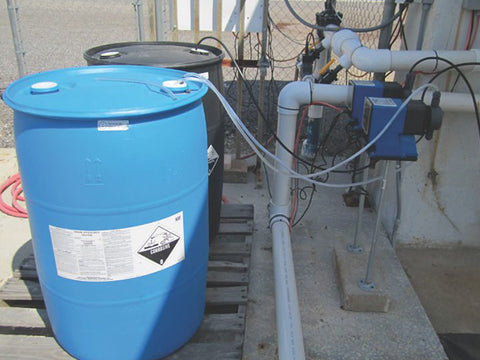
Safe practice starts with the product SDS and the site’s chemical-safety procedure. ATSDR’s hypochlorite guidance identifies calcium hypochlorite as an oxidizer that should be kept dry and ventilated, separated from acids, ammonia, amines, organic material, and other oxidizers. An incorrect mixture can release toxic gas or react violently. Because the Indonesian term air keras may mean strong acid or mineral hard water, use the air keras composition and identification guide before any unknown material enters the dosing area.
- Verify product identity, batch, available-chlorine percentage, date, SDS, and packaging condition.
- Use a dedicated ventilated area with eyewash, SDS-specified PPE, dedicated weighing tools, and a compatible tank. Never reuse a container that held another chemical.
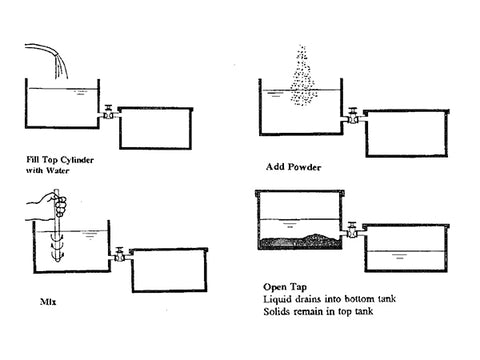
- Put water in the mix tank first, then add calcium hypochlorite slowly as directed by the manufacturer. Never add acid to “help” dissolution and never mix two chlorine products.
- Label stock strength, preparation time, batch, operator, and hazard. Protect the solution from heat, sunlight, and contamination.
- Calibrate pump output volumetrically, check the injection valve, prevent siphoning, and interlock dosing with water flow where the design permits.
- Measure residual after effective contact and log pH, flow, turbidity, temperature, dose, and result. Stop uncontrolled adjustment when a critical limit is exceeded and follow the plant escalation procedure.
Dosing interlocks and the water-release record
Interlocks must follow the site’s HAZOP or risk review; this table is a design discussion basis, not copy-ready control logic. The objective is to prevent chemical feed without proven water flow, use of an unready stock batch, and water release before the result at the verification point meets the project limits.
| Event or input | Safe response to design | Operator evidence |
|---|---|---|
| No proof of flow or flow below the validated minimum | Stop dosing and alarm; prevent the pump from running on an invalid ratio signal | Flow switch/transmitter status, flow, trip time, and pump response |
| Low stock level, mixer failure, or unreleased stock batch | Inhibit start or transfer to a verified standby pump/tank | Batch number, strength, level, mixer status, and active-tank identity |
| Analyzer sample flow lost or reading invalid | Reject the signal for automatic trim; use an approved safe mode while a manual test is completed | Fault code, blank/check-standard result, comparison test, and action |
| Residual after T10 below or above the operating limit | Hold or divert water where the facility permits; investigate demand, set point, pH, turbidity, and hydraulics | Residual, sample time/location, dose, flow, pH, turbidity, temperature, and disposition |
| Power returns after an outage | Restart in sequence only after water flow, mixing, valve position, and analyzer readiness are proven | Restart time, passed permissives, acknowledged alarms, and operator name |
A release record should include date and time; source and water volume; calcium-hypochlorite batch/COA; available chlorine; stock strength and age; minimum–maximum flow; dose and calibrated pump output; pH, turbidity, and temperature; T10 basis; residual at the contact outlet and designated network point; instrument status; microbiology/laboratory results required by the sampling plan; deviations; hold/release decision; and responsible sign-off. Release for consumption also requires commissioning, sanitation, consumable logs, representative sampling, and laboratory verification against the applicable drinking-water standard.
For a stock calculation, convert the target percentage to grams of active chlorine per litre. A 1.0% stock equals 10 g/L active chlorine; in theory, a 65% product would require 10 ÷ 0.65 = 15.4 g/L. This is an arithmetic example only. Use a concentration allowed by the label, SDS, tank material, and pump range, then verify it analytically because solution strength can change in storage.
PT Watermart Perkasa supplies chlorination dosing pumps, including LMI/Milton Roy and OBL. For selection, prepare chemical identity and concentration, required L/h, line pressure, wetted materials, voltage, control signal, and duty/standby requirements. If a downstream process instead requires removal of residual chlorine, assess industrial dechlorination chemicals from Beta Pramesti against free/total residual, flow, and process objective.

Calcium hypochlorite performs reliably only when four items are demonstrated together: correct active-chlorine mass, mixing, effective contact time, and residual at a representative point. Operating records should let staff trace each result to the product batch, flow, raw-water condition, pump setting, or contact-tank condition.
For an equipment review, send water analyses, minimum–maximum flow, trial dose, stock strength, injection pressure, and control requirements through the Watermart contact page. Dosing-pump selection does not replace dose-setting and water-quality verification by the responsible process specialist.
Common Calcium Hypochlorite Questions
Is calcium hypochlorite the same as chlorine?
Calcium hypochlorite is one chlorine-releasing compound. The broader chlorine category also includes sodium hypochlorite, chlorine gas, and other chlorine compounds. Because their form and strength differ, product doses cannot be exchanged kilogram for kilogram without calculating active chlorine.
How much calcium hypochlorite should be added to water?
There is no universal product dose. Establish applied chlorine from demand testing and the required residual after effective contact time, then divide the active-chlorine requirement by the labelled or COA available-chlorine fraction. Verify the result from measured residual, not odour.
What data are needed to select a dosing pump?
Prepare available-chlorine percentage, stock-solution strength and characteristics, minimum–maximum water flow, trial dose, required L/h, injection pressure, wetted materials, voltage, control signal, and duty/standby requirement.
Technical sources
- WHO: Guidelines for drinking-water quality, fourth edition incorporating the first, second and third addenda
- Indonesia Ministry of Health Regulation No. 2 of 2023
- CDC/ATSDR: Calcium Hypochlorite/Sodium Hypochlorite—Medical Management Guidelines
- CDC: Appendix E—Chlorine disinfectant solution preparation
- CDC: Chemical Disinfectants—Chlorine and Chlorine Compounds
- U.S. EPA: Disinfection Profiling and Benchmarking Technical Guidance Manual

.png)