
RO Membrane CIP: When Should You Clean?
Schedule RO membrane CIP from normalized operating trends, not a calendar or one raw reading. A decline in permeate flow, increase in salt passage, or increase in differential pressure can trigger cleaning after temperature, feed salinity, recovery, instrumentation, and pretreatment changes have been ruled out.
Updated 2 August 2026.
PT Watermart Perkasa, operating at water.co.id, supplies RO membranes and pretreatment components for commercial and industrial systems in Indonesia. This guide helps operators decide when to use cleaning in place (CIP), but the element manual, skid design, fouling analysis, safety data sheets, and project procedures still control the chemical, pH, temperature, flow, pressure, and contact time.
When does operating data indicate an RO membrane needs CIP?
The FilmTec Technical Manual, Revision 19 (February 2026), recommends cleaning when any of the following changes occurs against a normalized baseline. These are FilmTec reference points; use the current manufacturer manual for another brand or model.
| Normalized operating metric | FilmTec trigger for CIP evaluation | Check before cleaning |
|---|---|---|
| Permeate flow | Falls 10% | Water temperature, feed salinity, recovery, pressure, flowmeter calibration |
| Salt passage | Rises 5–10% | Conductivity meter, seals, O-rings, oxidation, leakage, feed change |
| Feed-to-concentrate pressure drop | Rises 10–15% | Cartridge filter, valves, flow, plugging, particulates, biofouling |
Normalization matters because colder feedwater can reduce flow without fouling. DuPont also calls for differential pressure to be recorded by stage, while TorayTrak compares current data with normalized startup conditions. Correct a pretreatment failure, recovery change, or instrument error before concluding that the membranes need CIP.
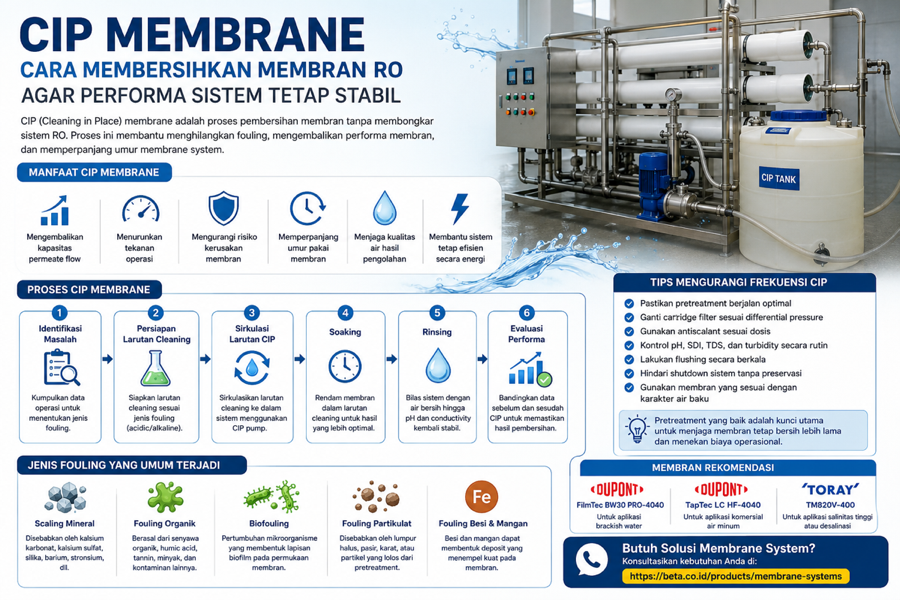
Why Is Membrane CIP Important for RO Systems?
The membrane is the core component of a reverse-osmosis system. When it becomes dirty, the entire system is affected. Pumps work harder, reject flow changes, permeate flow declines, and product-water quality becomes unstable.
Membrane CIP helps:
- Reduce excessive operating pressure
- Restore permeate-flow capacity
- Reduce the risk of permanent membrane damage
- Extend RO membrane service life
- Avoid premature membrane replacement
- Maintain treated-water quality
- Improve system energy efficiency
For industrial RO systems using DuPont FilmTec brackish-water membranes, DuPont TapTec commercial membranes, or Toray seawater membranes, a correct CIP program is essential for consistent membrane performance.
Common Types of Membrane Fouling
Before starting CIP, it is important to identify the type of deposit. Selecting the wrong cleaning chemical can make the process ineffective.
1. Mineral Scaling
Scaling may be caused by calcium carbonate, calcium sulfate, barium sulfate, strontium sulfate, or silica. It frequently occurs when antiscalant dosing is inadequate, recovery is too high, or feed-water quality changes.
2. Organic Fouling
Organic fouling can originate from organic compounds, humic acid, tannins, oil, or contaminants in surface water. It often causes permeate flow to decline gradually.
3. Biofouling
Biofouling results from microorganism growth on membrane surfaces. A common indication is rising differential pressure and unstable operation even when the pretreatment system appears normal.
4. Particulate Fouling
Particulate fouling comes from fine sludge, suspended solids, fine sand, pipe corrosion products, or filter media escaping pretreatment. It often occurs when cartridge filters are not replaced at the correct differential pressure.
5. Iron and Manganese Fouling
Feed water containing high iron or manganese can form deposits on membrane surfaces. Without effective pretreatment, membranes become dirty quickly and require more frequent CIP.
General Membrane CIP Procedure
Membrane CIP must be performed carefully and in accordance with the membrane manufacturer’s technical recommendations.
1. Identify the Problem
Before cleaning, record feed and reject pressure, permeate and concentrate flow, conductivity, pH, temperature, and differential pressure. These data help identify the fouling type and suitable cleaning chemical.
2. Prepare the Cleaning Solution
Cleaning solutions are generally acidic or alkaline, depending on the deposit. Acidic cleaners are commonly used for mineral scale, while alkaline cleaners are used for organic deposits, biofouling, and certain biological contaminants.
3. Circulate the CIP Solution
The solution is circulated through the pressure vessels with a CIP pump. Flow and pressure must remain within membrane limits. The objective is to dissolve and remove deposits from membrane surfaces.
4. Soak
For severe fouling, the membranes may need to soak in the cleaning solution. Soaking gives the chemical more time to act on deposits.
5. Rinse
After cleaning, rinse the system with clean water until pH and conductivity stabilize. Proper rinsing prevents residual chemicals from entering production.
6. Evaluate Performance
Restart the system and compare its operating data with the pre-CIP baseline. Cleaning is successful when flow improves, pressure falls, and permeate quality recovers.
The 2026 FilmTec manual calls for flushing with suitable chlorine-free water after cleaning, starting at reduced flow and pressure, and diverting permeate to drain for at least 30 minutes or until the water is clear. Follow the limits and sequence for the installed model; do not copy CIP conditions between brands.
Should the membrane be cleaned again or replaced after CIP?
Use normalized post-CIP data, system inspection, and the unit’s ability to meet its quality target—not calendar age alone.
| Result after stabilization | Initial decision | Evidence required next |
|---|---|---|
| Flow, salt passage, and pressure drop return near baseline | Return to service after rinsing and acceptance are complete | Record the new baseline, chemical, time, pH, temperature, flow, and samples |
| Performance partly recovers but remains outside limits | Diagnose the foulant and review the procedure before repeating CIP | Deposit analysis, pretreatment logs, compatibility, and instrument audit |
| Performance does not recover | Hold the unit and evaluate damage, seals, telescoping, oxidation, or permanent fouling | Element, vessel, and O-ring inspection; probing or autopsy where justified |
| Permeate quality fails even though flow recovers | Do not call the cleaning successful | Check seals, conductivity, salt passage, integrity, and the process target |
If performance does not recover, use the RO membrane damage diagnosis guide before deciding on replacement, then match the elements to the pressure vessels and system design.
Chemicals Used for Membrane CIP
CIP chemicals must be selected according to the fouling type. An unsuitable chemical may be ineffective or shorten membrane life.
- Acid cleaners are used for mineral scale, carbonate, and inorganic deposits.
- Alkaline cleaners are used for organics, light oils, biofilm, and biological fouling.
- Specialty cleaners are used for specific deposits such as iron, manganese, silica, or severe contamination.
Always verify compatibility with the membrane type, allowable pH range, temperature limit, and system materials.
How Membrane Selection Affects CIP
Membrane CIP is not only about cleaning chemicals. Correct membrane selection from the beginning also matters. A membrane suited to the feed-water characteristics is more stable, easier to maintain, and less prone to rapid fouling.
For brackish-water applications, review the DuPont FilmTec brackish-water membrane family and match the model to the water analysis and system projection.
For commercial applications, review DuPont TapTec membranes and confirm model limits in the latest datasheet.
For high-salinity or desalination applications, use the Toray seawater membrane selection page as a starting point before design projection.
Common Membrane CIP Mistakes
- Cleaning without analyzing operating data
- Using chemicals that do not match the fouling type
- Applying excessive CIP pressure
- Failing to control cleaning-solution temperature
- Operating outside the membrane pH limit
- Using an insufficient soaking period
- Rinsing the system inadequately
- Failing to record pre- and post-CIP data
- Ignoring pretreatment problems after cleaning
- Waiting until fouling becomes severe
Effective CIP is not merely a cleaning activity; it is part of a complete RO maintenance program.
How to Reduce Membrane CIP Frequency
- Keep multimedia filters operating correctly
- Replace cartridge filters according to differential pressure
- Dose antiscalant correctly
- Control feed-water pH when required
- Perform routine flushing
- Follow preservation procedures during extended shutdowns
- Monitor SDI, turbidity, TDS, pH, and conductivity
- Keep chemical dosing stable
- Select membranes suited to the feed-water characteristics
If pretreatment is poor, CIP provides only a temporary solution. The membrane will foul again because the root cause remains unresolved.
Membrane CIP for Indonesian Industries
Membrane CIP is widely required in food and beverage facilities, pharmaceutical plants, boiler-feed-water systems, power plants, hotels, hospitals, palm-oil mills, mining operations, textile plants, refill-water businesses, and seawater-desalination systems.
Feed-water quality varies significantly across Indonesia. Groundwater may contain iron, manganese, hardness, and high TDS. Surface water may contain organics, sludge, microorganisms, and suspended solids. Seawater requires specialized pretreatment and membranes because of its high salinity.
CIP programs should therefore be based on actual site conditions rather than a fixed cleaning calendar alone.
Membrane CIP FAQ
What is membrane CIP?
Membrane CIP is a Cleaning in Place process that cleans membranes without dismantling the entire membrane system.
When does an RO membrane require CIP?
Evaluate CIP when normalized data reaches the manufacturer’s trigger. FilmTec Revision 19 references a 10% permeate-flow decline, a 5–10% salt-passage increase, or a 10–15% pressure-drop increase from baseline.
Can CIP make a membrane like new?
CIP can restore performance, but the result depends on the fouling severity and membrane condition. It cannot reverse permanent membrane damage.
How long does membrane CIP take?
Duration depends on system size, fouling type, number of pressure vessels, and deposit severity. Industrial CIP may take several hours or longer when soaking is required.
Can every membrane use the same cleaning chemical?
No. Chemicals must be selected according to membrane type, pH and temperature limits, and the fouling being removed.
Conclusion
Membrane CIP is an essential part of maintaining industrial RO and membrane systems. Correct cleaning helps stabilize performance, maintain production capacity, and extend membrane life.
Chemical selection, fouling analysis, pH, temperature, flow, and pressure must all be controlled. Pretreatment must also be improved when necessary so the membrane does not foul again quickly.
Need a Membrane-System Solution?
Find RO membranes, cartridge filters, dosing pumps, pressure vessels, and CIP components for industrial systems. Send the water analysis, element model, vessel configuration, normalized data, cleaning history, and symptoms through the Watermart contact form.
Technical sources
- DuPont Water Solutions, FilmTec Reverse Osmosis/Nanofiltration Membranes Technical Manual, Form 45-D01504-en, Revision 19 (February 2026), accessed 2 August 2026.
- Toray Membrane, TorayTrak normalization tool and RO Operation, Maintenance and Handling Manual, accessed 2 August 2026.