
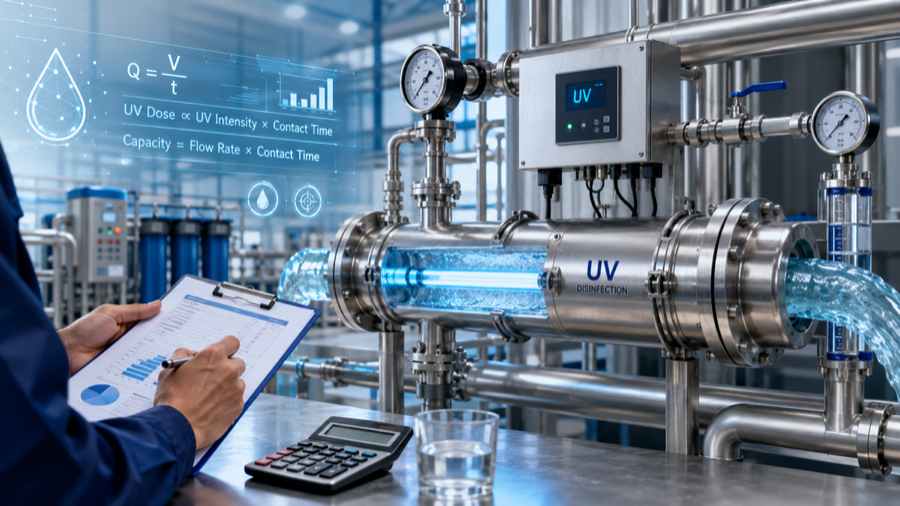
Size a commercial UV system from the peak flow at the required UV dose, not from lamp wattage or chamber size. Use the manufacturer’s flow-versus-dose data at the design UVT, then verify alarms, flow limitation, sleeve condition, and microbiological performance during commissioning.
Updated 16 July 2026: this guide now includes dose-based selection, published product-flow examples, NSF/ANSI 55 and Indonesian regulatory context, and an acceptance checklist.
PT Watermart Perkasa supplies UV systems and water-treatment components in Indonesia. A flow calculation plus margin is useful for preliminary screening, but final selection must follow the unit’s rated flow at the required dose and the worst credible water condition.
Why UV Capacity Must Be Calculated Correctly
UV sterilizers work by exposing water to ultraviolet light, especially UV-C, to help inactivate microorganisms such as bacteria, viruses, and certain microbes. For the process to be effective, water must pass through the UV chamber with enough contact time and light intensity.
If the flow rate is too high compared to the UV capacity, the water will pass through the chamber too quickly and the UV exposure will not be optimal. On the other hand, if the UV capacity is much larger than needed, the system will still work, but the purchase and electricity costs may be higher.
Basic Formula for Calculating UV Capacity
The simplest way to calculate UV capacity is to determine the maximum water flow that will pass through the UV unit.
Basic formula:
UV capacity = maximum water flow x safety factor
A preliminary 20% to 30% margin can cover flow variation and fouling when shortlisting units. It is not a substitute for dose validation: the reactor must still pass the design flow at the selected dose, minimum UVT, and the manufacturer’s stated end-of-lamp-life condition.
Common units:
- Liters per minute, or LPM
- Liters per hour, or LPH
- Cubic meters per hour, or m3/h
Simple conversions:
- 1 m3/h = 1,000 liters/hour
- 1,000 liters/hour = about 16.7 liters/minute
UV Dose, UVT, and Flow Must Be Selected Together
UV dose is expressed in mJ/cm² and, in principle, combines received intensity with exposure time. In a real reactor, flow distribution, UVT, sleeve fouling, lamp age, and chamber geometry affect delivered dose. Lamp wattage therefore cannot be converted directly into a safe flow rating.
| Design input | Value to record | Why it controls capacity |
|---|---|---|
| Peak flow | LPM or m³/h with all relevant outlets or pumps operating | Defines the shortest residence time |
| Dose or performance class | Datasheet value or process requirement | One reactor has different flows at different doses |
| Minimum UVT | UVT percentage at the specified wavelength and path length | Lower UVT reduces light penetration |
| Lamp condition | End-of-life factor and alarm status | Lamp output declines during service |
| Fouling allowance | Water hardness, iron, manganese, and cleaning interval | Deposits on the quartz sleeve reduce transmission |
| Hydraulics | Pressure, orientation, flow limiter, and start-stop pattern | Prevents excess flow and trapped air |
NSF/ANSI 55 distinguishes Class A systems for water that may be microbiologically unsafe from Class B systems that reduce non-disease-causing bacteria in already disinfected drinking water. Check the actual model listing for its class, reduction claim, and certified flow; the word “UV” alone does not establish performance.
Hydropro Flow Example at Three Doses
The HYDROPRO UV sterilizer product table shows why capacity cannot be represented by one flow number. The LPM values below are rounded conversions of the published GPM data on the local product page.
| Model | 16 mJ/cm² | 30 mJ/cm² | 40 mJ/cm² |
|---|---|---|---|
| HUV-L02 | 3.3 GPM (12.5 LPM) | 2.0 GPM (7.6 LPM) | 1.5 GPM (5.7 LPM) |
| HUV-L06 | 11 GPM (41.6 LPM) | 6 GPM (22.7 LPM) | 4.5 GPM (17.0 LPM) |
At a 16.7 LPM process flow, HUV-L06 appears to meet the published 30 and 40 mJ/cm² rows, while HUV-L02 does not. If the design flow includes a 30% margin and becomes 21.7 LPM, HUV-L06 still meets the 30 mJ/cm² row (22.7 LPM) but not the 40 mJ/cm² row (17.0 LPM). A 40 mJ/cm² application needs a larger model or lower flow.
Example: UV Capacity for a Refill Water Business
For example, a refill water business has a production capacity of 1,000 liters per hour. The flow rate is:
1,000 liters/hour / 60 minutes = 16.7 LPM
If a 30% safety factor is used, then:
16.7 LPM x 1.3 = 21.71 LPM
The preliminary design flow is therefore about 21.7 LPM. Select a model whose rated flow reaches that value at the required dose and UVT; a unit labeled 25 LPM at another dose is not automatically suitable.
For a more specific discussion about replacement and UV capacity calculations, you can also read How to Calculate UV Capacity When Replacing a Unit.
Example: UV Capacity for Restaurants, Hotels, and Industry
For restaurants, hotels, cafes, laundry businesses, clinics, food plants, or production facilities, UV capacity should be based on peak water demand. For example, the system may use 3,000 liters per hour during busy hours.
The flow rate is:
3,000 liters/hour / 1,000 = 3 m3/h
With a 30% safety factor:
3 m3/h x 1.3 = 3.9 m3/h
The preliminary design flow is therefore 3.9 m3/h. Select a reactor rated for at least that flow at the specified dose, UVT, end-of-lamp-life condition, and fouling allowance.
Factors That Affect UV Capacity
Besides flow rate, there are several important factors to consider before selecting UV capacity for a business.
1. Water Turbidity
Turbid water can block UV penetration. That is why water should already pass through filtration such as sand filters, carbon filters, cartridge filters, or other pretreatment systems before it enters the UV sterilizer.
2. UV Transmittance, or UVT
UVT shows how well UV light can pass through water. The lower the UVT, the harder it is for UV light to work effectively. In industrial and desalination applications, this parameter is very important for selecting the right UV design.
3. Peak Flow Rate
Do not calculate only from average daily usage. Use the peak flow rate, which is the highest flow that may occur when the system is operating at full load.
4. Business Application Type
Refill water businesses, hotels, restaurants, pharmaceuticals, food and beverage plants, and desalination systems have different standards. The higher the contamination risk, the more careful the UV capacity selection must be.
5. Condition of the UV Lamp and Quartz Sleeve
A UV lamp that is aging or a quartz sleeve that is dirty can reduce disinfection effectiveness. So even if the capacity is correct, routine maintenance is still essential.
UV Capacity for Refill Water Businesses
In refill water businesses, the UV unit is usually placed at the final stage before the water enters the gallon or product tank. The goal is to help ensure the output water is safer from microbiological contamination.
In this kind of system, the UV capacity should follow pump capacity and filling speed. If the pump can deliver 20 LPM, the UV should ideally be rated above 20 LPM so it does not become the weak point in the system.
For a more focused discussion about UV in refill depots and drinking water businesses, you can read UV Disinfection Systems for Refill Water Businesses.
UV Capacity for Household and Small Commercial Systems
In household systems or small businesses such as cafes, office pantries, small clinics, and home production units, UV can be used as part of a clean water treatment system. The capacity usually follows point-of-use demand, pump capacity, and the number of users.
To understand the components of UV systems on a household and small commercial scale, please read Household Water Treatment Systems: Components and UV Disinfection Technology.
Practical Steps to Determine UV Capacity
Here is a practical way to determine UV capacity for business use:
- Determine the pump capacity or maximum water flow.
- Convert the unit to LPM or m3/h.
- Add a 20% to 30% planning margin when operating variation requires it.
- Define the dose, minimum UVT, and end-of-lamp-life condition.
- Select a UV reactor whose rated flow meets all those conditions.
- Verify chamber material, pressure, alarms, flow limitation, and pretreatment needs.
UV Capacity Recommendation Table
| Water Demand | Estimated Flow | Preliminary Selection Flow (+30%) | Application |
|---|---|---|---|
| 500 liters/hour | 8.3 LPM | 10-12 LPM | Household, pantry, small cafe |
| 1,000 liters/hour | 16.7 LPM | 20-25 LPM | Refill depot, small business |
| 3,000 liters/hour | 3 m3/h | 4 m3/h | Restaurant, hotel, clinic, laundry |
| 5,000 liters/hour | 5 m3/h | 6-7 m3/h | Food industry, factory, commercial use |
| 10,000 liters/hour | 10 m3/h | 12-13 m3/h | Industry, desalination, large systems |
The preliminary-selection column is not a dose rating. Match every value to the reactor’s rated flow at the required dose and UVT.
UV for Desalination and Industrial Water Treatment
In desalination systems, UV can be used as part of the disinfection stage, either before or after the main process, depending on the system design. In this application, UV selection should not be based only on flow rate, but also on water quality, organic content, clarity, pretreatment system, and the final product water requirements.
For desalination businesses, industrial facilities, hotels, resorts, ships, small islands, or any system using seawater or brackish water, UV selection should be discussed with a water treatment supplier that understands the full system design.
Common Mistakes When Choosing a UV Sterilizer
Some common mistakes when choosing UV for business use include:
- Choosing UV only because it is the cheapest option.
- Not calculating the peak flow rate.
- Ignoring water quality before the UV unit.
- Not paying attention to the UV lamp replacement schedule.
- Using a small UV unit for a large pump capacity.
- Ignoring pretreatment or cartridge filtration when turbidity and particles shield microorganisms from UV.
These mistakes can make the disinfection system less effective and can reduce the quality of the produced water.
UV Commissioning and Verification Checklist
- Match the model, lamp number, chamber orientation, pressure limit, and flow direction to the datasheet.
- Measure actual peak flow; install a flow limiter or interlock if the pump can exceed the rating at the design dose.
- Record the worst credible water UVT and confirm pretreatment controls turbidity, iron, manganese, and hardness-related fouling.
- Test the ballast, UV-intensity monitor if fitted, lamp-failure alarm, operating-hours counter, and response to power loss.
- Flush and disinfect downstream piping and the product tank; UV cannot correct biofilm or recontamination after the reactor.
- Collect a representative microbiological sample after the system stabilizes and assess it against the end-use requirement.
- Retain baselines for flow, intensity/UV status, UVT, pressure, microbiology, sleeve cleaning, and lamp replacement.
For Indonesian refill-water depots, UV is one process barrier rather than stand-alone proof of compliance. Ministry of Health Regulation No. 2 of 2023, current at this 16 July 2026 update, contains environmental-health requirements and revoked the older Ministry of Health Regulation No. 43 of 2014 on refill-water-depot hygiene. Apply the current rule together with local licensing, inspection, and water-quality testing requirements.
Review UV and ozone sterilization systems for unit and datasheet comparisons, and use industrial and commercial cartridge filters when particulate pretreatment is required upstream of UV.
FAQ: How to Calculate UV Capacity for Business
1. Should UV capacity be the same as pump capacity?
The UV rated flow at the design dose must exceed actual peak flow. A 20% to 30% margin can support preliminary selection, but it still requires verification against dose, UVT, and end-of-lamp-life conditions.
2. Can UV kill all bacteria?
UV helps inactivate microorganisms, but effectiveness depends heavily on UV dose, water quality, water clarity, flow rate, and the condition of the UV lamp.
3. Should water be filtered before UV?
Yes. Water should go through filtration first so that particles and turbidity do not block UV light.
4. When should the UV lamp be replaced?
UV lamps should generally be replaced periodically according to the manufacturer recommendation or operating hours. For businesses that run every day, regular checks are strongly recommended.
5. Is UV suitable for desalination businesses?
Yes, UV can be used in desalination systems as part of the disinfection process. However, it must be matched to the system design, flow rate, water quality, and application target.
Conclusion
Calculate commercial UV capacity from peak flow and an operating margin, then match that value to the reactor’s rated flow at the required dose, UVT, and end-of-lamp-life condition. Water quality, pretreatment, hydraulics, alarms, and microbiological verification complete the selection.
For refill water businesses, restaurants, hotels, food industries, pharmaceuticals, and desalination systems, choosing the right UV sterilizer can help maintain water quality and support safer, more consistent operations.
Need a UV Equipment Supplier for Desalination in Indonesia?
If you need a supplier of UV equipment for desalination, refill water systems, industrial water treatment, hotels, resorts, or other water treatment needs in Indonesia, please consult your capacity and system specifications.
Consultation and orders for UV equipment:
Click WhatsApp: 0815-8609-3500

.png)