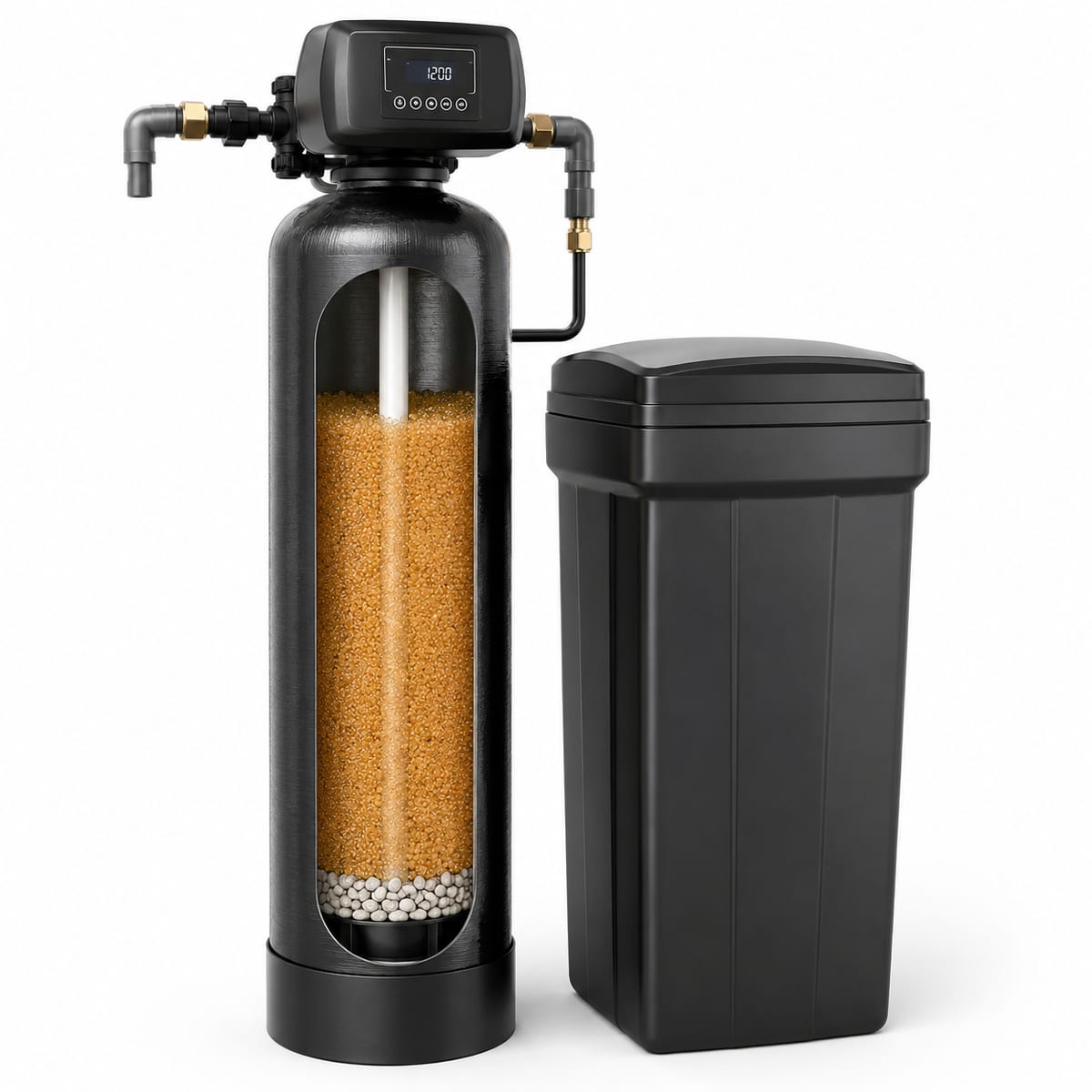
Water-softener salt is calculated from resin volume and the regenerant dose on the resin-capacity curve—not from brine-tank size. First calculate hardness load per cycle, select working capacity at the chosen salt dose, then verify refill volume, brine draw, rinse, outlet hardness, and the salt actually consumed during every regeneration.
This guide is an auditable preliminary worksheet. PT Watermart Perkasa supplies DIONIX ion-exchange resin, FRP pressure tanks, and Pentair Fleck control valves for selection against water-test results, peak flow, resin volume, and the regeneration sequence. Final figures must follow the current resin datasheet and the manual for the installed valve and model.
Calculate Hardness Load before Setting the Salt Dose
Hardness load defines the exchange capacity that must be restored during each cycle. Use total hardness as CaCO3, measured water volume, the outlet target, and the regeneration interval; pipe diameter or building capacity cannot replace those inputs.
| Input | Symbol and unit | Defensible source |
|---|---|---|
| Inlet hardness | Hin, mg/L as CaCO3 | Representative sample upstream of the softener |
| Outlet-hardness target | Hout, mg/L as CaCO3 | Process specification or operating target |
| Water use | Vday, m³/day | Flow meter or demand balance |
| Days per cycle | D, days | Volume-based program and reserve |
| Resin working capacity | Cwork, g CaCO3/L resin | Manufacturer curve at the selected salt dose |
| Resin volume | BV, L | Nameplate, loading record, or measurement |
Calculate the cycle load as follows:
Cycle load (g CaCO3) = Vday (m³/day) × (Hin − Hout) (mg/L) × D (days)
Theoretical resin volume (L) = cycle load (g CaCO3) ÷ Cwork (g CaCO3/L resin)
The first equation yields grams directly because 1 m³ equals 1,000 L and 1,000 mg equals 1 g. Cwork must be working capacity at the selected salt dose and leakage target, not laboratory total exchange capacity.
Worked Hardness-Load Example for 12 m³ per Day
This design example uses assumptions to demonstrate the method; it is not a product rating. Assume 12 m³/day, 280 mg/L inlet hardness, a 40 mg/L outlet target, and regeneration every two days.
| Step | Calculation | Result |
|---|---|---|
| Hardness reduction | 280 − 40 | 240 mg/L as CaCO3 |
| Daily load | 12 × 240 | 2,880 g CaCO3/day |
| Two-day load | 2,880 × 2 | 5,760 g CaCO3/cycle |
| Theoretical resin at a verified Cwork of 50 g/L | 5,760 ÷ 50 | 115.2 L |
The 50 g/L figure in the final row is a worksheet assumption. If the selected resin curve gives another working capacity at the approved dose, flow, and leakage target, repeat the calculation with that figure. Round the installed volume only after checking service flow, pressure drop, bed depth, freeboard, backwash, injector duty, and valve capacity.
Calculate Salt Dose, Refill Water, and Brine Volume
Salt mass per regeneration comes from the dose per litre of resin. Once the mass is known, calculate refill water using the applicable valve manual and confirm that brine-tank working volume, float, overflow, and suction remain adequate.
Salt per cycle (kg) = BV (L) × salt dose (g/L resin) ÷ 1,000
The Fleck 3900 NXT/NXT2 installer manual revised 4 December 2025 uses VWB = DSalt × BV ÷ Ssol, with Ssol equal to 360 g salt per litre of water; it also states that brine volume is approximately 1.125 times refill-water volume.1 That equation belongs to the basis in the Fleck manual—confirm the flow control, refill time, injector, pressure, and current model manual before changing a setting.
Continue the example with 125 L of installed resin and an approved resin curve calling for 120 g salt/L resin:
| Item | Calculation | Preliminary result |
|---|---|---|
| Salt per regeneration | 125 × 120 ÷ 1,000 | 15.0 kg |
| Refill water on the Fleck 3900 basis | 15,000 ÷ 360 | 41.7 L |
| Approximate brine volume | 41.7 × 1.125 | 46.9 L |
The 120 g/L dose is an example assumption, not a universal setpoint. As a model-specific comparison, the Pentair Everpure CES manual identifies minimum, medium, and maximum capacity settings based on 6, 9, and 15 lb of salt per ft³ of resin—approximately 2.72, 4.1, and 6.8 kg per 0.028 m³—and directs users to the unit performance table for usable capacity.2 Do not transfer figures from one product series to another resin or softener without approval.
Calculate Brine-Tank Refill Frequency from Actual Use
The brine tank needs enough salt inventory while preserving space for the float, refill water, expansion, and inspection. Storage capacity does not authorize a higher dose per cycle.
Regenerations per month = operating days per month ÷ days per cycle
Monthly salt requirement (kg) = salt per cycle × regenerations per month
At 15 kg/cycle and one regeneration every two days, 30 days of operation requires about 15 cycles or 225 kg of salt per month before a logistics allowance. A 14-day refill interval would require a theoretical 105 kg. Add inventory only while the level remains below the manual limit, the float can move freely, and the lid and inspection path remain accessible.
Compare the calculation with purchase records and the mass added by operators. A sudden increase can indicate changed hardness or volume, leakage, an incorrect capacity setting, excessive regeneration frequency, overfilling, or a meter fault.
Select Regeneration Settings from Operating Evidence
Metered regeneration usually follows changing demand better than a fixed timer, but either method still needs an appropriate reserve and maximum-day limit based on hygiene risk and the model manual.
| Decision | Evidence to use | Risk if incorrect |
|---|---|---|
| Cycle capacity | Resin curve, salt dose, leakage target, resin volume | Hardness breakthrough or excess salt |
| Reserve | Hourly/daily demand pattern and consequence of hard water | Regeneration too late or too early |
| Backwash time | Bed expansion, water temperature, drain flow | Poor reclassification or resin loss |
| Brine draw/slow rinse | Injector, pressure, suction lift, brine volume | Incomplete regeneration |
| Fast rinse | Flow, duration, outlet-quality release check | Residual regenerant enters service |
| Refill | Actual flow control and required volume | Weak brine, overflow, or inconsistent salt use |
| Return to service | Hardness test and release criteria | Off-specification water enters the process |
NSF/ANSI 44 addresses softening capacity, rinse effectiveness, pressure drop, and brine-system accuracy when residential cation-exchange softeners are certified.3 It is a useful performance checklist, but it does not establish certification for a particular model; verify the product listing separately.
Safe Steps for Refilling a Brine Tank
Safe refilling preserves float operation and prevents foreign material from entering the system. Follow the manual, SDS, facility procedure, and relevant lockout requirements.
- Record the starting level, alarms, last regeneration, and latest outlet-hardness result.
- Confirm the unit is not drawing brine or refilling. Bypass or isolate it as the manual requires before opening or cleaning components.
- Inspect the lid, overflow, float, air check, tubing, injector, and surrounding area for leaks or damage.
- Check for a salt bridge using the manufacturer’s method. Do not use a sharp tool near the float or tank wall.
- Use the salt type, purity, and form approved by the manufacturer. Never mix the regenerant with an unidentified chemical.
- Add clean salt gradually without covering the float, overflow, or service access.
- Weigh or record the packages added; pile height alone is not a reliable mass measurement.
- Close the tank, restore the correct valve position, and check for leaks and alarms.
- During the next regeneration, verify that level falls during draw and returns to setpoint after refill.
- Test outlet hardness and record cycle water and salt use before declaring normal service.
Pentair recommends 99% salt in crystal form for its own residential softeners.4 Treat that as model-specific guidance; another softener, resin, or facility procedure may require a different regenerant.
An Auditable Regeneration Log
A useful log connects salt consumption to the water capacity actually treated. Retain failed and passed results so a trend can be distinguished from a single event.
| Cycle point | Minimum record |
|---|---|
| Before regeneration | Totalizer, Hin, Hout, inlet/outlet pressure, salt level, alarms |
| Backwash | Flow, duration, pressure drop, drain condition, any resin loss |
| Brine draw/slow rinse | Start/end level, draw volume or time, pressure, backpressure |
| Fast rinse | Flow, duration, hardness or conductivity release check if specified |
| Refill | Actual volume, time, final level, float and overflow function |
| After regeneration | Hout, volume to breakthrough, salt per cycle, setting correction |
Investigate when outlet hardness does not return to target, the brine level does not fall, refill misses its setpoint, the drain continues flowing, salt use changes without a production change, or pressure drop rises. Check source-water data, the meter, valve, injector, drain, resin fouling, channeling, and salt bridging before merely increasing the dose.
Quick Troubleshooting for Salt and Brine Tanks
Use operating symptoms to choose the first check, then verify with hardness testing and regeneration records. Do not increase the salt dose until brine draw, rinse completion, and return-to-service position have been confirmed against the manual.
| Symptom | Cause to check | Evidence before correction |
|---|---|---|
| Salt is consumed faster than calculated | Excessive regeneration frequency, meter error, leakage, or higher inlet hardness | Water totalizer, cycle count, latest hardness analysis, and salt-addition log |
| Water remains hard after regeneration | No brine draw, blocked injector, salt bridge, resin fouling, or incorrect capacity setting | Brine level before/after draw, outlet-hardness test, drain pressure, and injector photo |
| Brine tank overflows or level does not reset | Excess refill, stuck float, drain/backpressure issue, or wrong flow control | Refill time, water volume, float position, overflow condition, and valve manual |
| Salty taste or high residual after service | Insufficient rinse, restricted drain, trapped regenerant, or valve-sequence failure | Outlet conductivity/TDS, fast-rinse duration, drain flow, and piston/valve status |
Commissioning and Treated-Water Verification
An assembled softener does not make water ready to drink by equipment selection alone. For potable use in Indonesia, define parameters and acceptance from the provisions and annex of Ministry of Health Regulation No. 2 of 2023 that remain in force, sanitize the system, retain consumable logs, collect representative samples, and obtain laboratory verification before release.5 Confirm any other current requirements for the location and intended water use. A3 Laboratories provides water-testing services where a project needs sampling and analysis before or after softening.
The resin vessel operates under pressure. The facility owner should have competent occupational-safety personnel determine classification, installation, inspection, and other obligations under Ministry of Manpower Regulation No. 37 of 2016 on pressure vessels and storage tanks; BPK records that parts were revoked by Ministry of Manpower Regulation No. 11 of 2026.6 Never open a housing, valve, or closure until pressure has been relieved, energy isolated, and a safe condition verified.
Data Required to Select Resin, Tank, and Control Valve
Prepare a water analysis, normal and peak flow, daily use, hardness target, resin volume, salt-dose curve, pressure, pipe size, drain capacity, electrical supply, and duty/standby philosophy. Review the softening application page for system context, then send the worksheet and nameplate photographs through the Watermart contact page.
PT Watermart Perkasa can help match resin, FRP tank, internal distributor, brine tank, valve, and instrumentation. The technical handoff should identify model and datasheet revision rather than only a brand name or tank volume.
Softener Salt and Regeneration FAQ
How many kilograms of salt are required per regeneration?
Multiply resin volume by the manufacturer’s salt dose, then divide by 1,000. For example, 125 L at 120 g/L requires 15 kg/cycle, but 120 g/L remains an assumption unless supported by the resin datasheet and the required working capacity.
When should salt be added to the brine tank?
Add salt before inventory drops below the manual minimum, accounting for consumption per cycle and delivery lead time. Do not fill until the float, overflow, or inspection access is covered.
Why is the water still hard after regeneration?
Check changes in inlet hardness, capacity and meter settings, salt bridging, brine draw, injector, refill, drain backpressure, rinse time, channeling, and resin fouling. Level and hardness records before and after the cycle are more useful than adding salt without a diagnosis.
Is time-clock regeneration adequate?
A timer can work where the manual and operating pattern allow it, but changing demand can regenerate too early or too late. A metered system still needs reserve, meter validation, and a maximum-day limit based on risk and operating procedure.
Footnotes
-
Pentair, Fleck 3900 NXT/NXT2 Installer Manual, Ref. MKT-IM-015/F, revision dated 4 December 2025, system-sizing section. ↩
-
Pentair Everpure, CES Series Water Softeners Installation, Operation & Maintenance Guide, minimum/medium/maximum salt-dose guidance for the CES series. ↩
-
NSF, NSF/ANSI 44 Technical Requirements, published 8 March 2025. ↩
-
Pentair Water Solutions, Frequently Asked Questions: What kind of salt should I use in my Pentair softener?, accessed 22 July 2026. ↩
-
Audit Board of the Republic of Indonesia, Ministry of Health Regulation No. 2 of 2023, effective 12 January 2023. The BPK database records a partial revocation by Ministry of Health Regulation No. 3 of 2026, except for Articles 12, 21, 23, 29, 32, 39, and 45 and the Annex. ↩
-
Audit Board of the Republic of Indonesia, Ministry of Manpower Regulation No. 37 of 2016, recorded as in force with partial revocation by Ministry of Manpower Regulation No. 11 of 2026. ↩