
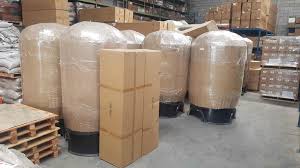
Select a water tank from usable volume, source, water-quality target, structure, and cleaning access—not label capacity alone. Specify compatible material, an opaque interior, covered vent, drain, and a base designed for filled weight. For drinking or food-contact water, the tank is storage only; filtration, disinfection, sanitation, sampling, and laboratory results still determine acceptance.
Updated 3 August 2026: usable-volume, turnover, redundancy, and hygienic-release records added.
PT Watermart Perkasa supplies water storage and ancillary tanks, FRP pressure tanks, Codeline RO pressure vessels, automatic control valves, cartridge filters, and dosing pumps for water-treatment systems in Indonesia.
Tips for Choosing a Water Tank
Start from the water balance. List the source flow, peak demand, treatment flow, backwash demand, and minimum reserve. A tank that is too small causes pump cycling and service interruptions; a tank that is too large can create long residence time, sediment buildup, and avoidable cleaning work.
| Decision point | Practical rule | Why it matters | Product handoff |
|---|---|---|---|
| Usable capacity | Required volume = daily demand x autonomy days + reserve. Keep dead volume and outlet height in mind. | Nominal tank size is not always the same as usable water above the outlet. | Water tank products |
| Filled weight | 1,000 L of water weighs about 1,000 kg before tank, frame, pipe, and live loads. | Roof slabs and steel towers must be checked for the filled condition, not the empty tank. | FRP and pressure tanks |
| Source quality | Well water with iron, manganese, hardness, or odor needs pretreatment before the clean-water tank. | A tank does not remove contaminants; it can only store the water it receives. | GreensandPlus iron and manganese pretreatment and DIONIX resin |
| Treatment process | RO systems usually need a raw-water buffer, cartridge prefilter, RO membrane train, and clean-water tank. | Separating raw and treated storage prevents untreated water from mixing with product water. | Reverse Osmosis systems and Codeline vessels |
| Access and hygiene | Specify a manhole, drain, screened vent, overflow, level control, and isolation valves. | Tanks that cannot be isolated, drained, or inspected are hard to maintain safely. | Control valves and dosing pumps |
Use the table below as a sizing method, not a universal standard. Replace the demand number with measured consumption, meter data, or the treatment plant design flow.
| Example demand | Reserve assumption | Calculated storage | Typical procurement note |
|---|---|---|---|
| 800 L/day small utility demand | 1 day + 20 percent reserve | 960 L | Choose a 1,000 L class tank or split into 2 x 500 L when access is tight. |
| 3,000 L/day building demand | 1 day + 20 percent reserve | 3,600 L | Use one 4,000 L class tank or parallel tanks so one unit can be isolated for cleaning. |
| 10,000 L/day refill-water or process demand | 0.5 day + 20 percent reserve | 6,000 L | Size raw and treated tanks separately; match them to RO or filtration production rate. |
How to calculate usable volume, turnover, and tank redundancy
The capacity on the tank label is not necessarily the water available for distribution. For operating assessment, use usable volume = volume at the operating high level − volume at the operating low level. Headspace above the high level, water below the outlet, and the volume retained to prevent pump suction from drawing air are not available storage.
Theoretical turnover time = usable volume ÷ average hourly demand. This is not a universal hygiene limit; it shows whether water may remain stored for too long relative to the project’s demand pattern and water-quality controls. Also calculate refill time at the minimum source flow. A 4,000 L tank with a measured 3,200 L usable volume and an average demand of 400 L/hour has a theoretical turnover of 8 hours, but the system still needs checks during peak demand and filter backwash.
| Design question | Evidence to record | Decision produced |
|---|---|---|
| Does usable volume cover peak demand? | 15- or 30-minute demand profile, high/low levels, source flow, and treatment flow | Set operating volume and level set points; do not use average daily consumption to cover a short peak |
| Can the tank refill before reaching low level? | Minimum refill flow during the dry season or low mains pressure, filter/RO production time, and backwash demand | Calculate recovery time; reduce service capacity or add buffer storage if the source cannot keep up |
| What happens while the tank is cleaned? | Isolation duration, minimum reserve, bypass route, and risk of mixing raw and treated water | Use two parallel tanks or a planned shutdown where service cannot stop; never create a bypass around a treatment barrier |
| Does water remain stored too long? | Daily inflow/outflow, weekend stagnation, temperature, disinfectant residual where used, and microbiology results | Adjust operating levels, recirculation, or flushing from risk and verification results |
With two parallel tanks, confirm that inlet and outlet piping produces real flow through both units. Two connected tanks can still leave one vessel stagnant. Provide isolation valves, drains, sampling points, visible overflows, and labels that distinguish raw-water from treated-water storage.
Hygienic commissioning record before a tank enters service
A new or repaired tank should be released to service from evidence, not merely because it looks clean. Cleaning and disinfection method, chemical concentration, contact time, flushing, and waste disposal must suit the tank material, approved project procedure, and intended water use; this guide does not prescribe one dose for every installation.
| Release stage | Minimum record | Criterion before proceeding |
|---|---|---|
| Document review | Material and suitability for intended water, nozzle drawing, nominal volume, structural limits, and permitted cleaning products | Documents match the tank, water, location, and intended use |
| Pre-fill inspection | Internal cleanliness, lid, gaskets, vent screen, overflow, drain, level sensors, and foreign material | No construction residue, unprotected opening, or unfinished fitting remains |
| Cleaning, disinfection, and flushing | Procedure, chemical and batch, measured concentration, start/finish time, flush volume, and responsible person | Approved procedure completed and flush water managed safely |
| Functional testing | High/low levels, overflow alarm, pump interlock, isolation valves, leaks, actual usable volume, and refill time | No leaks; alarms and interlocks operate; operating volume is documented |
| Water-quality verification | Sample point, date/time, tank condition, field parameters, laboratory sample number, and result | Water is released only for the intended use after it meets the project target and applicable requirements |
Keep this record with as-built drawings, internal photographs before closure, maintenance logs, and laboratory results. Where the source switches between a well and the municipal network, use the Jakarta well-water vs PDAM guide so the two source baselines remain separate.
For rooftop placement, ask a qualified civil or structural engineer to check the slab, tower, anchor, wind exposure, and seismic restraint. For ground-level placement, plan pump suction, drainage, flood protection, and safe access for cleaning crews.
Assortment of Tank Panels
Water tanks are commonly grouped by material and pressure duty. The most important distinction is whether the tank is atmospheric storage, such as a rooftop or ground tank, or a pressure vessel used inside a filtration, softener, or RO system.
| Tank type | Best fit | Main strength | Watch-outs |
|---|---|---|---|
| Polyethylene atmospheric tank | Clean-water storage for homes, buildings, small treatment plants, and refill-water businesses. | Light, corrosion resistant, widely available in many sizes. | Confirm potable-water suitability, UV protection, opaque wall, manhole, drain, and overflow details. |
| Stainless steel tank | Indoor or protected installations where appearance, cleanability, and rigidity matter. | Rigid and easy to wash when fabricated correctly. | Chloride-rich water, coastal air, poor welding, or incompatible chemicals can cause corrosion. |
| Fiberglass or FRP atmospheric tank | Larger custom storage, chemical service, or industrial sites. | Good corrosion resistance when resin and laminate are specified for the water. | Quality depends on laminate design, internal coating, UV protection, and manufacturer control. |
| FRP pressure tank | Media filters, softeners, demineralizers, and pretreatment vessels. | Designed for pressurized water-treatment processes. | Not a substitute for open storage; select by pressure rating, diameter, valve, distributor, and media bed. |
Fiber Glass Toren Tank
Fiberglass or FRP tanks can work well when the resin, laminate thickness, coating, and fittings match the water chemistry and installation environment. They are often selected for industrial storage or as pressure tanks in filtration and softening systems.
Check the specification carefully. For atmospheric storage, ask for UV protection, a clean internal surface, a secure manhole, overflow, drain, and vent screen. For pressurized filtration service, use a purpose-built FRP pressure tank and match it with the right distributor, media bed, and control valve.
Stainless Steel Water Tank
Stainless steel tanks are useful where the buyer needs a rigid, washable tank and can control the water chemistry. They are common in protected indoor or utility-room installations and in projects where visual finish matters.
Do not assume every stainless tank is suitable for every water source. Chloride, low pH, poor weld finishing, stagnant crevices, and coastal exposure can shorten service life. If the source is well water, brackish water, or chemically dosed water, check chloride, pH, iron, manganese, and cleaning chemicals before specifying stainless steel. The tank also still needs a dark interior, covered vent, drain, overflow, and inspection access.
Polyethylene Water Tank
Polyethylene tanks are the default choice for many clean-water storage duties because they are light, corrosion resistant, and easy to move before installation. For outdoor service, choose an opaque tank with UV-stabilized material so sunlight does not encourage algae growth inside the stored water.
For potable or food-contact use, ask for documentation that the tank material is suitable for drinking-water storage. Also check wall thickness, lid fit, outlet reinforcement, float-valve access, overflow size, and whether the tank can be drained completely during cleaning.
Potable-water and regulation notes
Tank selection cannot make unsafe water safe. If the tank serves drinking water, refill-water production, food and beverage operations, hotels, hospitals, or employee facilities, test both source and stored water. For an Indonesian project, read the status of Ministry of Health Regulation No. 2 of 2023 with Regulation No. 3 of 2026, which revokes the 2023 regulation with exceptions for specified articles and its annex.
For specified use classes, the 2023 annex includes values such as E. coli 0 CFU/100 ml, Total Coliform 0 CFU/100 ml, TDS below 300 mg/L, turbidity below 3 NTU, pH 6.5-8.5, dissolved iron 0.2 mg/L, and dissolved manganese 0.1 mg/L. Confirm the use class, active parameters, and sampling plan with the regulator or laboratory after the 2026 status change.
If your next step is water-quality verification, A3 Laboratories at lab.id provides water testing and water-quality analysis for clean water, drinking water, RO water, wastewater, groundwater, and seawater.
Maintenance checklist
| Frequency or trigger | What to check | Action |
|---|---|---|
| Monthly visual check | Lid, vent screen, overflow, insects, odor, color, sediment, leakage, and pump cycling. | Tighten covers, clear the overflow, record abnormal odor or color, and schedule cleaning if sediment is visible. |
| After construction, flooding, open-hatch work, or contamination complaint | Dirt entry, broken cover, dead insects, unusual smell, or changed water quality. | Isolate the tank, clean and disinfect as appropriate, flush the line, and retest before potable use. |
| Scheduled cleaning interval | Sediment depth, biofilm, internal surface condition, float valve, level sensor, and drain function. | Drain safely, clean internal surfaces, inspect fittings, restore covers, and document the service date. |
| Treatment-system service | Cartridge pressure drop, media backwash, RO permeate quality, dosing pump operation, and tank turnover. | Replace cartridges, adjust controls, check dosing pump output, and keep raw-water and treated-water tanks separated. |
When to ask Watermart
Ask Watermart when the tank is part of a treatment train, not just a standalone container. The selection should be coordinated with pumps, filters, valves, RO membranes, pressure vessels, chemical dosing, and the intended water-quality target. For procurement support, send your source-water data, daily demand, peak flow, installation location, and available floor or roof space through the Watermart contact page.