
Accessories & Ancillaries
Brine Tank & FRP Pressure Tank Indonesia
Select brine tanks, FRP tanks, and pressure tanks for softeners and filtration by resin volume, salt dose, flow, pressure, materials, and service space.
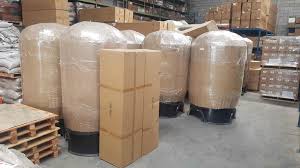
A brine tank stores salt solution for water-softener regeneration, while FRP tanks and pressure tanks serve different filtration or pressure-buffer duties. Buyers should match the tank to resin volume, regeneration cycle, flow, pressure, materials, service access, and installation space.
Updated 10 August 2026: this page clarifies brine tanks, FRP tanks, pressure tanks, and quotation data for softening and filtration.
Brine tank for water softeners
A brine tank is not a drinking-water storage tank; it stores salt and brine used to regenerate softener resin. Tank size should follow resin volume, salt dose, regeneration frequency, salt-storage space, refill water, and the way the valve draws brine.
| Buyer decision | Data to prepare | Related link |
|---|---|---|
| Brine tank size | Resin volume, inlet hardness, cycle capacity, regeneration frequency, and salt use | Softening application |
| Connection to valve or ejector | Brine draw rate, refill volume, tubing, check valve, and suction lift | AQ Matic |
| Replacement of an old tank | Tank photo, physical size, brine well, float assembly, connection, and operating issue | Filter and softener control valves |
| Complete system | Resin, FRP vessel, valve, distributor, salt, commissioning, and outlet sampling | Ion exchange resin |
An undersized brine tank may run short of solution during regeneration, while a tank that is difficult to clean can bridge salt and disrupt suction. Record salt level, refill volume, brine-draw time, and outlet hardness after regeneration so the issue can be separated between resin, valve, ejector, or salt tank.
FRP tanks for media filters and softeners
FRP tanks are used as vessels for filter media, activated carbon, iron-manganese media, or resin. Selection should consider diameter, height, working pressure, top/bottom distributor, freeboard for backwash expansion, and valve compatibility.
| Application | Tank and components to check | Design data |
|---|---|---|
| Sediment or multimedia filter | FRP tank, distributor, media, gravel, and backwash valve | Service/backwash flow, TSS, turbidity, drain, and installation space |
| Activated-carbon filter | FRP tank, activated carbon, underbed, and valve | Chlorine, organics, EBCT, backwash, and outlet target |
| Iron-manganese filter | FRP tank, Fe/Mn media, oxidation, and drain | Fe, Mn, pH, H2S, oxidant, flow, and temperature |
| Softener | FRP tank, cation resin, brine tank, injector/ejector, and valve | Hardness, peak flow, resin volume, salt dose, and regeneration schedule |
For filter vessels, also review FRP tanks, filter media, iron and manganese media, and activated-carbon media. Media selection alone is not enough when the tank cannot provide the correct freeboard, distributor, or backwash.
Pressure tanks for pump systems
A pressure tank stores pressure reserve and reduces pump start-stop cycling; it does not replace a filter or brine tank. Prepare peak flow, cut-in/cut-out settings, drawdown, precharge, maximum pressure, connection, installation space, and pump compatibility.
For pump-pressure duty, compare Pentair WellMate pressure tanks against actual system conditions. Do not use a pressure tank as evidence of water quality; quality still depends on the source water, treatment train, sanitation, and testing.
Tank quotation data
Send the required tank type, application, existing size, label photos, working pressure, flow, project location, installation space, valve type, media/resin, and target fix. For a brine tank, add resin volume, hardness, salt dose, regeneration frequency, refill water, and symptoms such as salt bridging, failed brine draw, or rising outlet hardness.
Brine tank FAQ
What does a brine tank do in a water softener?
A brine tank stores salt and brine solution for regenerating softener resin. The valve or ejector draws the solution during brine draw, slow rinse, fast rinse, and return to service.
Does a brine tank make water ready to drink?
No. A brine tank is only part of softener regeneration. Drinking water must meet applicable Indonesian standards, be commissioned and sanitised, keep consumables records, and be verified by representative sampling and laboratory testing.
What data are needed to select a brine tank?
Prepare resin volume, inlet hardness, outlet target, regeneration frequency, salt dose, refill water, valve/injector, installation space, and old tank photos for replacement work.