
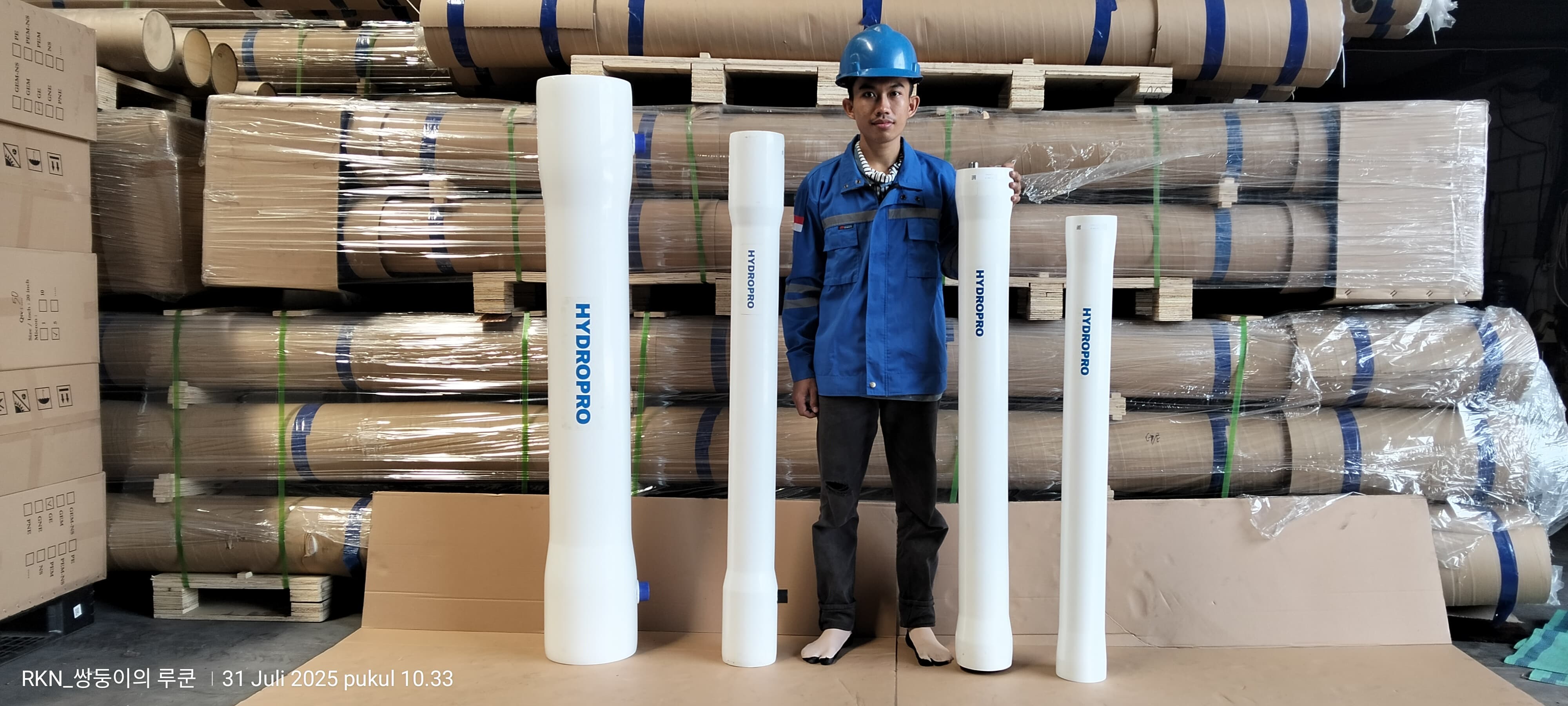
Commercial cartridge-housing sizing starts with peak flow and the cartridge pressure-drop curve for the design fluid. Divide peak flow by verified element flow at the allowable clean differential pressure, round up, then check micron efficiency, materials, temperature, pressure, solids loading, service clearance, and redundancy while a housing is open.
This guide provides a preliminary worksheet, not a generic flow rating per cartridge. PT Watermart Perkasa supplies industrial filter cartridges, Pentair Pentek cartridges, and Pentair AquaLine high-flow cartridges and 80CF housings. Final selection must use the datasheet, ΔP-versus-flow curve, fluid compatibility, and the facility’s safe-work procedure.
Required Inputs before Calculating Cartridge Count
Element count cannot be determined from 10-, 20-, 30-, or 40-inch length alone. Media area, pleated or depth construction, viscosity, temperature, micron efficiency, end connection, seals, and solids load can give cartridges of the same dimensions very different flow and service life.
| Design input | Symbol/unit | Why it matters |
|---|---|---|
| Normal and peak flow | Qnormal, Qpeak; m³/h | Establishes hydraulic duty and turndown |
| Element curve for design fluid | qelement at ΔPclean | Establishes defensible flow per cartridge |
| Turbidity, TSS, particle distribution | NTU, mg/L, particle count/size | Screens fouling and pretreatment needs |
| Retention rating and efficiency | nominal/absolute µm, beta or % | Matches the process-protection target |
| Pressure and temperature | bar, kPa, °C | Checks housing, seal, cartridge, and pump |
| Fluid chemistry | pH, oxidant, solvent, oil, salinity | Selects media, core, end cap, and O-ring |
| Process ΔP limits | clean, alarm, changeout | Maintains flow and downstream pressure |
| Operating pattern | hours/day, batch/continuous | Determines redundancy and changeout window |
| Service clearance | height, length, lifting space | Allows safe element removal |
Where source water varies seasonally, use a realistic worst case and provide sampling points upstream and downstream. A filter sized only at average flow often develops excessive pressure drop during peak demand or a solids upset.
Select Micron Rating from the Protection Target
A micron rating should state efficiency. Nominal does not represent one universal percentage, while an absolute rating still needs the manufacturer’s efficiency or beta ratio and test method.
| Design question | Evidence required |
|---|---|
| Is the duty prefiltration, polishing, or a final barrier? | Target particle size and outlet quality |
| Is nominal retention adequate? | Retention percentage at the stated size |
| Is absolute retention required? | Efficiency/beta ratio, challenge test, integrity basis |
| Does it protect RO, nozzles, exchangers, or a hygienic process? | Particle limit and consequence of breakthrough |
| Does the cartridge adsorb or only retain particles? | Media, contact time, and specific capacity |
Eaton describes a nominal rating as retaining an undefined percentage of particles, while an absolute-rated filter is used where practically all particles at the stated size or larger must be retained.1 Because terminology and test methods vary, compare measured efficiency rather than a micron number without context.
A cartridge is not proof that water is microbe-free or ready to drink. A microbial-reduction, food-contact, or certification claim must apply to the complete model and tested conditions; it cannot be transferred from another product with a similar pore size.
Calculate Element and Housing Count
Take qelement from the manufacturer curve at design temperature, viscosity, and approved clean ΔP. Do not use a marketing maximum flow without its operating point.
Nservice = round up [Qpeak ÷ qelement]
Actual flow per element = Qpeak ÷ active elements
Available filter ΔP = minimum upstream pressure − required downstream pressure − other pipe/valve losses
Once element count is known, select the housing arrangement:
| Operating requirement | Preliminary arrangement | Design note |
|---|---|---|
| Process may stop for changeout | One 100% duty housing | Define shutdown and drainage time |
| No interruption during changeout | Two 100% duty/standby housings | Each must carry Qpeak |
| Capacity grows in stages | Modular parallel housings | Balance branch flow |
| Frequent solids upsets | Backwash pretreatment + guard cartridge | Reduces premature blinding |
| Critical quality barrier | Coarse-to-fine stages with monitoring | Do not rely on one unverified housing |
An extra element inside the same housing provides more area, but it does not keep the housing available while its closure is open. Maintenance redundancy requires an isolatable path that still carries the specified flow.
Worked Sizing Example for 18 m³ per Hour
This example uses assumptions so the steps can be audited. Assume the selected cartridge curve verifies 3.0 m³/h per element at the design fluid and approved clean ΔP; the process needs 18 m³/h and cannot stop during changeout.
| Step | Calculation | Result |
|---|---|---|
| Minimum elements per active path | 18 ÷ 3.0 | 6 elements |
| Actual flow per element | 18 ÷ 6 | 3.0 m³/h |
| Housings for availability | 1 duty + 1 standby | 2 housings |
| Total installed elements | 6 × 2 | 12 elements |
| Elements operating normally | One housing active | 6 elements |
The result is two housings with six elements each only if the selected housing and cartridges are designed for that six-element configuration. Recalculate from the actual curve when temperature, viscosity, fluid, micron grade, or materials change. Install upstream and downstream pressure indication for each housing, not one pair around the complete parallel assembly.
If both housings normally operate 50/50 in parallel, calculate the one-housing-offline case. Each remaining path must still carry 18 m³/h, or the process needs an approved turndown; two housings each rated for only 9 m³/h do not provide 100% redundancy.
Establish Clean and Dirty Differential Pressure
Filter differential pressure is the simultaneous difference between inlet and outlet pressure. Record the commissioning baseline at the same flow, temperature, valve position, and fluid so later trends are comparable.
ΔPfilter = Pinlet − Poutlet
Keep three thresholds separate:
| Threshold | Purpose | Basis |
|---|---|---|
| Clean ΔP baseline | Proves installation and new-element condition | Cartridge curve + commissioning result |
| ΔP alarm | Provides time to prepare a changeout | Margin to process and element limits |
| Changeout ΔP | Stops or transfers duty | Lowest cartridge, housing, pump, process, or quality limit |
Do not confuse maximum housing operating pressure with allowable cartridge differential pressure. A housing may hold high system pressure while the element collapses at a much lower pressure difference. Check flow direction and collapse/burst rating at actual temperature.
Model-Specific Pentair AquaLine Example
The Pentair AquaLine ALN01-60B datasheet specifies a 60-inch element with 6.75-inch OD, nominal 1-micron retention, 54.4°C maximum temperature, and recommended changeout at 25–30 psid subject to process limits.2 That range equals approximately 1.72–2.07 bar and applies to that model; another grade or manufacturer can have a different limit.
Pentair lists the non-coded AquaLine 80CF15-60 housing at 150 psi/10 bar design and maximum operating pressure, 60°C maximum temperature, and 60-inch element length.3 The housing pressure rating does not change the cartridge ΔP limit. Confirm drawing, ports, code status, materials, closure, and current manual at procurement.
Housing and Material Selection Checklist
A housing that is hydraulically large enough may still be unsuitable because of materials, closure, seals, or layout.
- Match cartridge count, length, diameter, end connection, and flow direction.
- Verify design pressure, operating temperature, vacuum condition, transients, and water hammer.
- Check body, internals, core, end cap, gasket/O-ring, and cleaning-chemical compatibility.
- Provide a high-point vent, low-point drain, pressure indication on both sides, and sampling points where required.
- Make sure cartridges lift clear of ceilings, cable trays, pipes, and structures.
- Provide isolation, depressurization, drainage, and lockout points that can be operated safely.
- Balance parallel manifolds and verify branch flow, not only total flow.
- Define spent-element handling, drip containment, sanitation, and spare inventory.
Pentair’s AquaLine manual warns that a pressure-device closure can release explosively if installation, assembly, or damaged components are mishandled, and calls for qualified technicians.4 A changeout procedure should require venting and zero-pressure verification rather than assuming the housing is safe after a valve is closed.
Commissioning and Clean-ΔP Baseline Procedure
Commissioning proves flow distribution, sealing, instrumentation, and filtrate quality before operating data become the baseline.
- Verify housing, cartridge, seal, element count, flow direction, torque/closure, and inspection documents.
- Flush upstream piping and clean the housing under the approved procedure so construction debris does not immediately blind new elements.
- Install each cartridge with the correct adaptor and seal; never force an incompatible element.
- Vent air while filling slowly. Check for leaks before increasing pressure in controlled steps.
- Run several flow points through Qpeak and record Pinlet, Poutlet, ΔP, temperature, and branch flow.
- Sample inlet and outlet for the specified parameters and record time since start-up.
- Test alarms, duty/standby transfer, interlocks, drains, and depressurization.
- Retain the clean ΔP baseline and photographs of gauges, valves, labels, and the closure.
Where the cartridge is part of drinking-water treatment, complete sanitation, consumable records, representative sampling, and laboratory verification. Equipment selection or a low pressure drop does not establish that water is ready to drink.
Operating Log and Changeout Criteria
Change cartridges from evidence, not one calendar interval. A separate log for each housing makes fouling, maldistribution, and instrument faults easier to distinguish.
| Log data | How to use it |
|---|---|
| Flow, Pin, Pout, ΔP, temperature | Compare like-for-like operating conditions |
| Inlet/outlet turbidity, TSS, particle count | Assess loading and breakthrough |
| Operating hours and total volume | Compare life across element batches |
| Model, micron grade, lot, seals | Trace consumable-performance changes |
| Changeout reason | ΔP, flow loss, quality, shutdown, or damage |
| Used-element condition | Slime, scale, iron, oil, collapse, bypass, seal failure |
Trigger changeout at the most conservative of the manufacturer ΔP limit, downstream pressure requirement, flow loss, filtrate quality, approved hygienic duration, or physical damage. A high ΔP immediately after installation may indicate a closed valve, trapped air, wrong cartridge, viscous fluid, or construction debris—not normal element ageing.
Pressure Compliance and Water-Quality Verification
The facility owner should determine whether the housing and installation fall within Ministry of Manpower Regulation No. 37 of 2016 on occupational safety for pressure vessels and storage tanks. BPK records the regulation as in force with partial revocation by Ministry of Manpower Regulation No. 11 of 2026.5 Classification, inspection, and documentation need a competent party; this article does not make a legal determination.
For drinking water in Indonesia, prepare an acceptance plan from the provisions and annex of Ministry of Health Regulation No. 2 of 2023 that remain in force, including relevant parameters, sanitation, consumable logs, sampling points, and laboratory results.6 Confirm any other current requirements for the location and intended water use. Where feedwater and filtrate need testing before the next treatment decision, A3 Laboratories’ water-testing service provides a separate laboratory handoff from equipment selection.
Data Required for a Cartridge-Housing Quotation
Provide normal and peak flow, minimum/maximum pressure, temperature, fluid chemistry, TSS/turbidity/particle data, target micron and efficiency, clean/changeout ΔP, operating hours, redundancy, installation clearance, code requirement, materials, ports, and changeout schedule. Attach a P&ID or manifold sketch for parallel housings.
Send that design basis through the Watermart contact page. PT Watermart Perkasa can help evaluate element-to-housing fit, but the final rating remains tied to the exact model, current datasheet revision, and approved process conditions.
Commercial Cartridge-Housing Sizing FAQ
What is the flow of one 20- or 40-inch cartridge?
There is no universal number. Use the model curve for the fluid, temperature, micron grade, and design clean ΔP. The same length does not guarantee the same media area, efficiency, dirt capacity, or flow.
Is a 1-micron cartridge always better than 5 micron?
No. Finer retention can increase ΔP and shorten run length under a high solids load. Select from the particle size to be retained, demonstrated efficiency, downstream risk, and pretreatment.
When should a cartridge be changed?
Use the most conservative trigger among manufacturer ΔP, downstream pressure, flow loss, quality breakthrough, hygienic limit, or damage. Retain a clean baseline so an alarm or changeout is not based on one reading without context.
Are two parallel housings automatically redundant?
No. If each carries only half the flow, losing one reduces capacity. One-hundred-percent redundancy means the remaining housing, piping, valves, and pump can still deliver Qpeak or an approved turndown.
Footnotes
-
Eaton, Filtration + Separation: Bag Filtration Technical Article, discussion of nominal and absolute pore-size ratings. ↩
-
Pentair, AquaLine ALN01-60B Filter Element Datasheet, DS AQUALINE ALN01-60B EN 2916. ↩
-
Pentair, AquaLine Housings and Cartridges Specifications, 80CF15-60 specifications accessed 22 July 2026. ↩
-
Pentair, AquaLine 80CF15 150 PSI Operation and Maintenance Guide, revision dated 9 June 2023. ↩
-
Audit Board of the Republic of Indonesia, Ministry of Manpower Regulation No. 37 of 2016, recorded as in force with partial revocation by Ministry of Manpower Regulation No. 11 of 2026. ↩
-
Audit Board of the Republic of Indonesia, Ministry of Health Regulation No. 2 of 2023, effective 12 January 2023. The BPK database records a partial revocation by Ministry of Health Regulation No. 3 of 2026, except for Articles 12, 21, 23, 29, 32, 39, and 45 and the Annex. ↩