
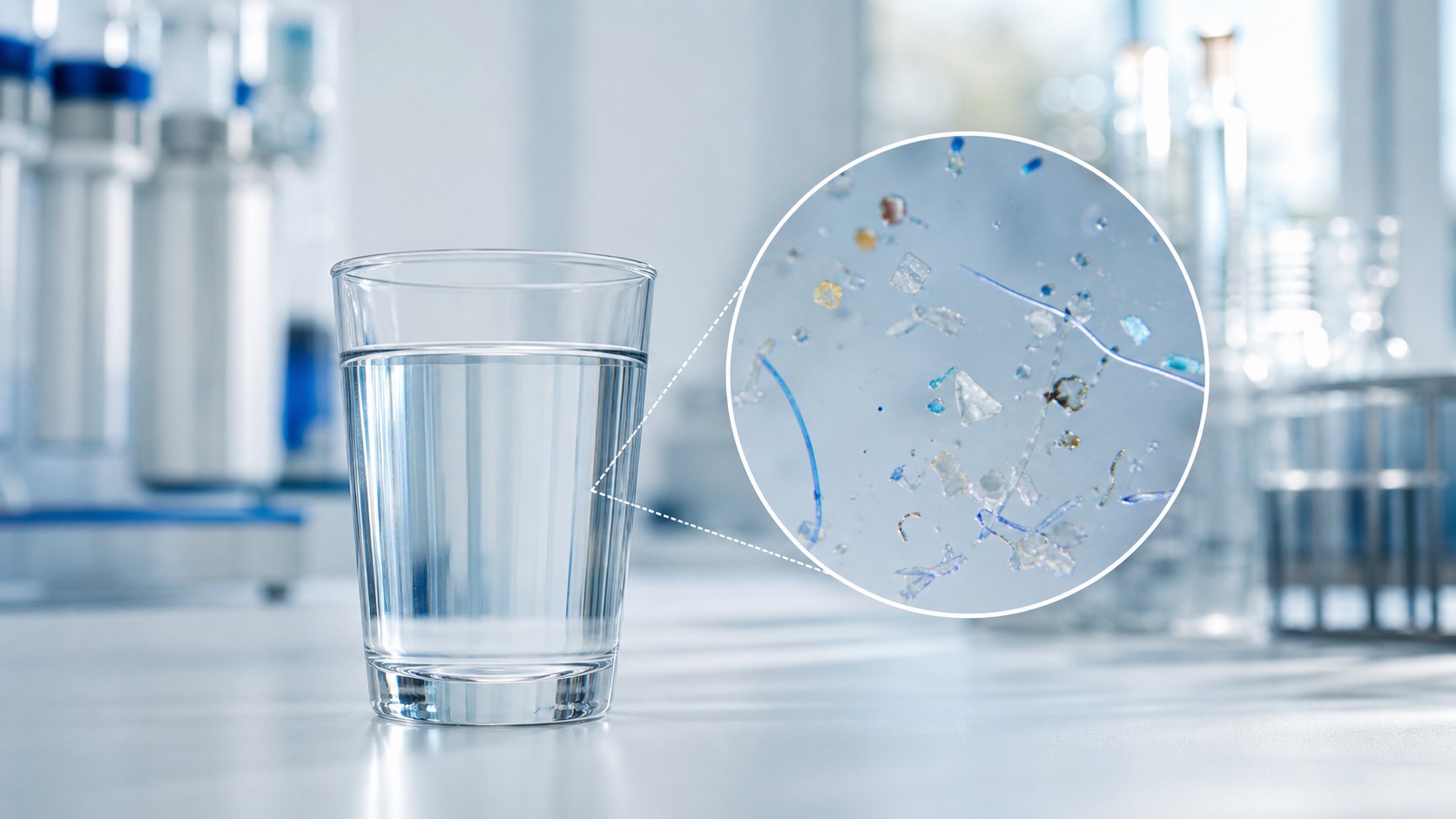
Short answer: microplastics have been detected in both tap and bottled drinking water, but reported counts depend heavily on sampling methods and detection limits. New research can see much smaller particles than older studies could. Detection is not the same as proof that bottled water causes a particular disease. WHO continues to identify major gaps in exposure and health-effect evidence.12
For homes, hotels, apartments, and commercial facilities, the responsible response is to reduce unnecessary single-use plastic, test source and product water, and select treatment against defined contaminants. A filter should not be selected from the word “microplastics” in marketing copy alone.
What Are Microplastics and Nanoplastics?
Microplastics generally means polymer particles smaller than 5 mm. Nanoplastics are smaller still, although research does not always use the same boundary. Differences in definitions, analytical instruments, laboratory contamination control, and particle-counting rules make results from different studies difficult to compare directly.
Particles can come from fragmented environmental waste, textile fibres, tyre wear, wastewater, distribution components, packaging, caps, and other materials along the water supply chain. Finding a polymer does not automatically identify one source.
What Did the 2024 Bottled-Water Study Find?
A 2024 PNAS study tested five samples from each of three bottled-water brands in the United States using stimulated Raman scattering. The researchers estimated an average of approximately 240,000 plastic particles per litre, with most in the nanoplastic size range.3
That result matters, but it has four important boundaries:
- Three brands cannot represent every product or country.
- The new method detected particles older methods missed; a higher count does not necessarily mean pollution suddenly increased.
- Particle count is not the same as plastic mass or toxic dose.
- The study measured occurrence, not disease among consumers.
The useful lesson is not that every litre contains the same number. It is that particle size and analytical method must accompany any comparison.
What Do We Know about Health Effects?
WHO’s 2019 drinking-water review concluded that evidence was limited and called for better-targeted research. Its 2022 review of exposure through food, water, and air again highlighted uncertainty around exposure, particle characteristics, toxicity, and nanoplastics.12
A 2024 observational study in the New England Journal of Medicine detected microplastics or nanoplastics in carotid plaques from some patients. The group with detected particles experienced more cardiovascular events or deaths during follow-up.4 This finding is scientifically important, but it does not prove causation, does not identify bottled water as the source, and came from patients with arterial disease undergoing surgery.
Both of these statements can therefore be true:
- plastic exposure deserves serious reduction and research;
- current evidence does not justify claiming that one package or particle count inevitably causes a specific disease.
Can Water Filters Reduce Microplastics?
WHO says treatment processes optimized for particle removal and microbial safety can also remove most microplastics. Actual performance depends on particle size, shape and density, coagulation, sedimentation, filter media, membrane integrity, and operating conditions.1
A 2023 point-of-use study tested PET and PVC fragments and nylon fibres roughly 30–1,000 µm in size. Two devices incorporating membrane barriers reduced fragments more effectively than a device using granular activated carbon and ion exchange alone. The device with a nominal 0.2 µm membrane had the best overall performance in that experiment.5
That study is not a certification for every filter and did not prove removal of all nanoplastics. It also showed why a media filter that lacks a defined physical barrier should not automatically receive a particle-reduction claim.
| Technology | Primary role | Microplastics note |
|---|---|---|
| Sediment/cartridge filtration | Retains particles to a stated rating | Request efficiency at a stated size, not only a nominal micron number |
| Carbon filtration | Taste, odour, chlorine, and specified compounds | Does not prove particle reduction without performance data |
| UF or microfiltration | Physical particle barrier | Check rating, integrity, fouling, and replacement interval |
| RO | Membrane treatment for dissolved ions and other targets | Needs pretreatment, pressure, reject-water management, and full-system verification |
| UV | Inactivates microorganisms | Does not physically remove particles from water |
Watermart supplies Pentair EU-25 UF, Everpure POU, and point-of-use filters and the Pentair ES60-S under-sink RO system. Suitability cannot be inferred from the technology name; begin with water analysis and current product data.
Checklist for Homes, Hotels, and Apartments
- Test all required drinking-water parameters under Indonesia’s Minister of Health Regulation No. 2 of 2023. Microplastics analysis does not replace routine microbiological and chemical testing.
- Map the source, tanks, pipes, pumps, treatment, outlets, and every material in contact with water.
- Define treatment targets from evidence: sediment, taste/odour, hardness, TDS, microorganisms, or another parameter.
- Design POE and POU as one system. See the hotel and apartment drinking-water guide.
- Complete commissioning, sanitation, inlet/outlet sampling, and laboratory verification before making a potable-water claim.
- Log differential pressure, flow, cartridge life, sanitation, product volume, and periodic test results.
- Reduce disposable bottles through reusable vessels supported by washing, inspection, and hygienic closure procedures.
Microplastics FAQ
Does bottled water always contain more microplastics than tap water?
The evidence does not support that universal statement. Concentrations vary by source, packaging, processing, location, particle-size range, and analytical method.
Does boiling remove microplastics?
Boiling is intended to control microbiological risk. Evaporated water does not automatically carry particles out of the vessel, so boiling should not be presented as a microplastics-removal method without a validated separation step.
Does RO guarantee microplastic-free water?
No system deserves an absolute claim without testing the complete configuration. A membrane can provide a strong physical barrier, but seals, bypass, membrane condition, pretreatment, storage, post-treatment plumbing, and sampling practice all affect results.
Is activated carbon enough?
Activated carbon is valuable for defined chemical and taste/odour targets. In the 2023 POU study, GAC and ion exchange without a membrane barrier did not consistently control the tested fragments.5
Conclusion
Microplastics are a serious environmental and research issue, but communication must separate particle occurrence, treatment performance, and evidence of health effects. For commercial buildings, the most useful actions today are reducing disposable packaging, maintaining a water-safety plan, selecting barriers from data, and verifying product water through sampling and laboratory analysis.
References
Footnotes
-
World Health Organization, Microplastics in drinking-water, 2019. ↩ ↩2 ↩3
-
World Health Organization, Dietary and inhalation exposure to nano- and microplastic particles, 2022. ↩ ↩2
-
Qian et al., “Rapid single-particle chemical imaging of nanoplastics by SRS microscopy”, PNAS, 2024. ↩
-
Marfella et al., “Microplastics and Nanoplastics in Atheromas and Cardiovascular Events”, New England Journal of Medicine, 2024. ↩
-
Cherian et al., “Microplastic Removal from Drinking Water Using Point-of-Use Devices”, Polymers, 2023. ↩ ↩2