Short answer: choose a home water filter from laboratory results, source-water risk, peak flow, and intended use. Sediment filters, activated carbon, softeners, iron-manganese media, UV, and RO solve different problems. Water that looks clear after filtration is not automatically safe to drink; drinking-water use requires verification of the treated water.
Start by recording whether the supply is municipal water, a well, or another source, then sample before and after the storage tank. Use a laboratory with the appropriate method scope for independent testing; lab.id can be a starting point for water testing, while PT Watermart Perkasa handles treatment-component selection.
If you already have test results and are comparing technologies, follow the steps for choosing the right home water filter to prepare flow, space, maintenance, and quotation data.
Why is a home water filter so important?
A filter protects plumbing and improves water only for the contaminants it is designed to address. Well water may carry sand, turbidity, iron, manganese, hardness, or microbes. Piped-water quality may change across a building tank and internal plumbing. Odour, colour, stains, or scale are clues, not a diagnosis.
| Symptom | Parameter to test | Note |
|---|---|---|
| Cloudiness or sand | Turbidity, TSS, particle size | Also inspect sediment entry and tank condition |
| Red-brown staining | Total/dissolved iron, pH | Separate iron from manganese |
| Black staining or darkening water | Manganese, iron, pH, alkalinity | Dissolved manganese may look clear at first |
| White scale and poor soap lather | Total hardness, Ca, Mg, TDS | Activated carbon does not soften water |
| Chlorine odour | Free chlorine, pH, organics | Carbon needs adequate capacity and contact time |
| Suspected faecal contamination | E. coli and total coliform | Taste, odour, and clarity cannot assess it |
The Most Common Types of Home Water Filters
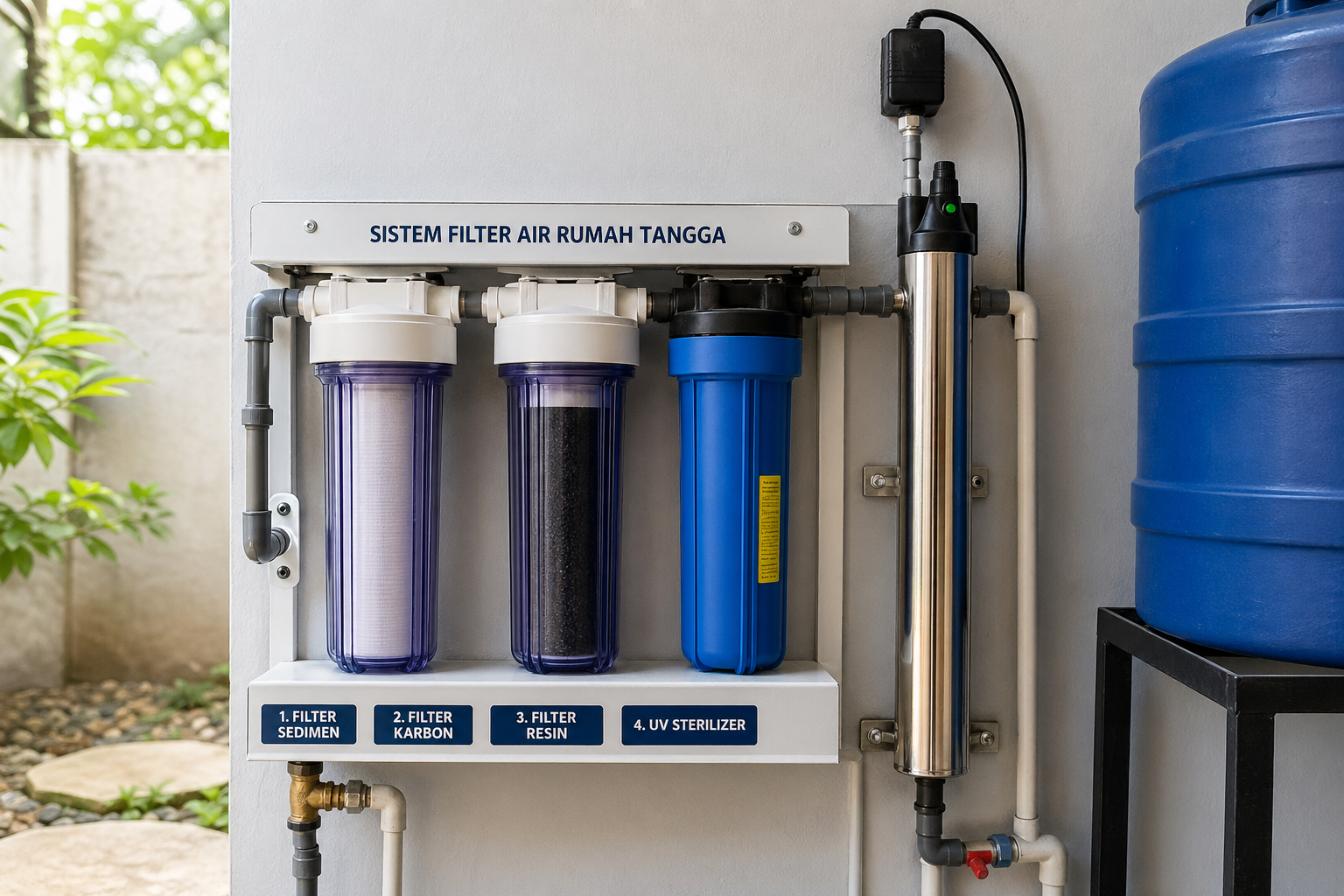
1. Sediment Filter
A filter cartridge or backwashing filter captures particles according to its rating and media configuration. Sediment filtration does not remove dissolved salts or guarantee microbial safety. Housing size, differential pressure, and flow determine replacement timing.
2. Activated Carbon
Activated-carbon media can reduce chlorine and selected taste- and odour-causing compounds. Performance depends on carbon type, contact time, inlet concentration, and breakthrough. Poorly maintained carbon can accumulate solids or support microbial growth.
3. Resin Filter
Cation resin in a softener exchanges hardness ions for regenerant ions. Other resins perform different duties; “resin filter” is not a valid blanket claim for all heavy metals. Select ion-exchange resin from ionic analysis, working capacity, and regeneration pattern.
4. Reverse Osmosis (RO)
Reverse-osmosis membranes reduce many dissolved ions at a drinking tap or in a central system. RO requires pretreatment, pressure, recovery control, concentrate disposal, sanitation, and permeate monitoring. It does not replace microbial testing or product-tank maintenance.
5. UV Sterilizer
A UV system inactivates microorganisms only when it delivers a validated dose and the feed water is sufficiently clear. UV does not remove iron, manganese, hardness, TDS, or particles; it needs pretreatment, a clean sleeve, an in-date lamp, and flow below its rating.
How to Choose the Right Home Water Filter
1. Check the Water Source
Record source, seasonal change, tank location, pipe materials, and whether the symptom appears everywhere or at one fixture. Sampling source and point of use helps separate raw-water issues from contamination in a tank or pipe.
2. Conduct a Water Quality Test
The minimum panel depends on use. Useful starting parameters for general household water often include pH, turbidity, TDS or conductivity, hardness, iron, manganese, colour, and odour. Drinking use adds microbial and chemical parameters required by the regulator and indicated by source risk.
Indonesia’s regulatory status changed in 2026: the Ministry of Health legal database marks Regulation No. 2 of 2023 as no longer in force following Regulation No. 3 of 2026, while identifying exceptions for specified articles and its annex. Ask the laboratory or regulator to confirm the parameter list and limits in force when testing is commissioned.
3. Choose a Multi-Stage System
Stages follow the contaminants and protect downstream equipment. Examples include sediment removal before carbon, oxidation and contact time before manganese media, softening before RO where scaling is a risk, and fine cartridge filtration before UV. More stages are not automatically better when test evidence does not support them.
4. Pay Attention to Capacity and Flow Rate
Use simultaneous peak flow, not daily consumption alone. If showers, taps, and a washing machine may run together, total their measured flows. Compare that requirement with filter service capacity at the allowed pressure drop.
For a backwashing filter, verify backwash flow separately. A pump adequate for household use may not expand the media bed during cleaning. For cartridge systems, install or record pressure before and after the housing so replacement follows differential pressure and declining flow.
Treatment Decision Table from Test Results
| Primary finding | Stage commonly considered | Not the primary solution |
|---|---|---|
| Sand, silt, rust | Settling where needed, backwash filter, then cartridge | UV or softener |
| Dissolved iron/manganese | Oxidation, contact tank, Inversand media, backwash | Fine cartridge alone |
| High hardness | Cation-resin softener and brine tank | Activated carbon |
| Chlorine/organic taste and odour | Carbon with adequate contact time | Sediment cartridge alone |
| High TDS or selected ions | RO after compatible pretreatment | UV |
| E. coli/coliform | Correct source and tank; validated disinfection, then retest | Judging by clarity |
| Multiple issues | Staged treatment in compatible priority order | One “all-purpose” cartridge |
Ideal Household Water Treatment System
There is no ideal train for every home. A practical sequence may include hygienic intake and storage, solids separation, specific treatment for iron/manganese or hardness where required, carbon for its target compounds, point-of-use RO, and validated disinfection when microbial risk requires it.
FRP tanks and distribution systems hold filter media, while automatic control valves manage service and backwash. Include drain capacity, pumps, electrical supply, bypasses, sample points, and service clearance from the start.
Risk of Harmful Substances in Household Water
Chemical and microbial contaminants do not always have a taste or colour. Chlorine can react with organic matter to form disinfection by-products, but removing all residual without maintaining tank hygiene may also raise microbial risk. Decisions must use test results and the whole system rather than one isolated number.
A household filter is not a drinking-water certificate. Test the treated water at the consumption point after commissioning and when the source changes, flooding occurs, tanks are cleaned, or monitoring indicates breakthrough.
Advantages of Using a Home Water Filter
1. Healthier Water
A correctly selected and verified system can reduce its target contaminants. Health claims must follow test evidence, not the presence of equipment.
2. Longer lasting equipment
Reducing sediment and hardness can reduce blockage or scaling in relevant appliances when the filter is maintained and does not impose excessive pressure drop.
3. Healthier Skin and Hair
Skin symptoms cannot be diagnosed from water quality alone. Measure chlorine, hardness, or other suspected parameters and refer health complaints to a medical professional.
4. Better Water Taste
Carbon and RO can improve taste for selected contaminants. Pleasant taste does not establish microbial or chemical safety.
Water Filter Recommendations for Various Conditions
Turbid Well Water
Test turbidity, TSS, iron, manganese, and microbes. Consider settling or oxidation where required, backwashing filtration, then cartridge polishing.
Chlorine Odor Water
Measure free chlorine and flow. Select carbon from contact-time and capacity requirements, then monitor breakthrough; a small cartridge should not be assumed to treat whole-house peak flow.
Hard Water (Lots of Lime)
Measure hardness as CaCO₃, flow, and daily volume. A softener needs calculated resin volume, working capacity, brine tank, salt dose, and regeneration schedule.
Drinking Water
Start with the quality requirement and test report. Select RO, UV, carbon, or a combination from risk; sanitation of the product tank, tap, and downstream tubing matters as much as the treatment unit.
Home Water Filters in Indonesia: Challenges and Solutions
Water quality may change with season, well condition, distribution network, building tank, and maintenance. An operable design—with available spares, bypass and sample points, and a clear service schedule—is more valuable than a complicated system that is not monitored.
Recordable Maintenance Schedule
| Check | Initial frequency | Action trigger |
|---|---|---|
| Pressure before/after filters | Weekly during commissioning | Manufacturer differential-pressure or flow limit |
| Colour, odour, turbidity, leakage | Weekly | Sudden change or plumbing work |
| Cartridge | By pressure drop and visual condition | Limit, low flow, or breakthrough |
| Media backwash | By time/volume and differential pressure | Dirty bed, high pressure drop, or poor product quality |
| Carbon/resin | By treated volume and product test | Chlorine, hardness, taste, or odour breakthrough |
| UV | Monitor alarm, lamp hours, and sleeve | Alarm, low output, or manufacturer schedule |
| Laboratory test | After commissioning and risk-based thereafter | Source change, flood, repair, or abnormal monitoring |
Frequently Asked Questions about Home Water Filters
Does a home water filter make water immediately safe to drink?
Not automatically. Drinking-water safety must be demonstrated by testing the treated water for the relevant microbial and chemical parameters. A filter reduces only the contaminants covered by its function, capacity, and operating conditions.
What home water filter capacity do I need?
Size from simultaneous peak flow, available pressure, raw-water quality, and backwash demand—not household occupancy alone. Record the flows of showers, taps, and appliances that may operate together before selecting housings, tanks, media, and control valves.
When should a cartridge or filter medium be replaced?
Use differential pressure, falling flow, treated volume, and product-water results as triggers. A calendar is useful for reminders, but raw-water condition and actual loading determine the service life of cartridges, carbon, resin, and other media.
Conclusion
The right home water filter begins with data: source, test results, peak flow, intended use, installation space, backwash capability, and maintenance plan. Use the decision table for initial screening, then verify both design and treated water.
PT Watermart Perkasa supplies filter cartridges, carbon media, Inversand media, ion-exchange resin, RO membranes, UV systems, tanks, and valves. Send test results, peak flow, installation photos, and intended use through the Watermart contact page for component selection based on evidence.
Regulatory sources
- Indonesia Ministry of Health legal database: Regulation No. 2 of 2023
- Indonesia Ministry of Health legal database: Regulation No. 3 of 2026
Home filter survey and handover checklist
Do not accept a system merely because the water looks clearer. Record peak flow, pressure before and after each filter, bypass location, and available backwash flow, then compare treated water with the test target. For a whole-house system, inspect every outlet under peak demand. For a drinking-water point of use, verify tap flow, product-tank sanitation, and the parameters relevant to drinking use.
| Stage | Record to hand over | Action criterion |
|---|---|---|
| Before installation | Test result, source, peak flow, space and drain | Do not select media from colour or odour alone |
| Commissioning | Inlet/outlet pressure, service flow, backwash flow, bypass position | Correct flow restrictions or drain faults before routine use |
| After commissioning | Treated-water result and inspection schedule | Retest after a source change or declining quality |
Send those records to the Watermart contact team when selecting filter cartridges, media, tanks, and valves—not only a photograph of the old unit.
Acceptance sampling-point matrix
Sampling points should follow the system duty. For whole-house treatment, sample the raw water before treatment and the treated water after the filter train; include the furthest outlet when a building tank or distribution pipe could affect the result. For a point-of-use unit, sample at the drinking tap after sanitation and flushing under the manufacturer’s instructions.
| System duty | Points to record | Acceptance evidence |
|---|---|---|
| Whole house | Raw water, post-filter, and furthest outlet where relevant | Target parameters improve, pressure remains stable at peak flow, no leakage |
| Drinking-water point of use | Unit feed and product tap | Sanitation complete, flow recorded, laboratory result meets the drinking-water purpose |
| Backwashing filter | Product water before and after a cycle, plus waste discharge | Quality recovers, media is not carried over, drain accepts actual flow |
Record date, time, operating condition, sampling location, and bottle identity in the handover record. A sample that does not represent normal use is not enough to accept the system.

.png)