Halal documentation for TRILITE ion exchange resin must be verified by exact grade, manufacturing site, certificate number, issuer, and validity—not by the brand name or a halal-logo image alone. Food-process buyers should also separate halal evidence from food-contact or food-processing evidence, then connect every approved document to the resin lot received.
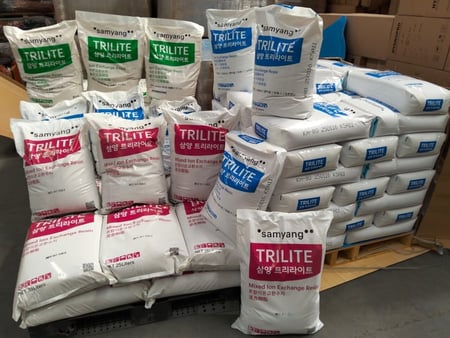
TRILITE™ is manufactured by Samyang Corporation, South Korea, in cation, anion, mixed bed, gel, and macroporous grades. Samyang lists halal, NSF, food-additive, kosher, ISO, and other certification categories on its certification page; that category list does not establish that every grade carries every certificate.1
Contact Us for a TRILITE Resin Consultation
What Is TRILITE Ion Exchange Resin?
TRILITE ion exchange resin is a bead-shaped medium containing active functional groups that exchange specific ions in water or another solution.
In water-treatment systems, ion exchange resin can be used to:
- Reduce calcium and magnesium that cause hardness.
- Remove positively charged ions, or cations.
- Remove negatively charged ions, or anions.
- Produce demineralized water.
- Produce high-purity water.
- Separate or purify selected compounds.
- Reduce color and contaminants in industrial processes.
- Support purification in food, beverage, pharmaceutical, and chemical production.
Ion exchange occurs when ions on the resin’s active functional groups are exchanged with ions in the water. Once its available capacity declines, the resin can be regenerated with an appropriate regenerant chemical.
TRILITE Resin Halal Certification

Halal certification provides additional assurance for industries that must maintain compliance across process materials, processing media, and production chains under applicable Indonesian halal standards.
Halal-certified ion exchange resin is particularly relevant to:
- Food and beverage manufacturing.
- Sugar and sweetener production.
- Pharmaceutical manufacturing.
- Cosmetics manufacturing.
- Food-ingredient production.
- Bottled drinking water production.
- Food and pharmaceutical testing laboratories.
- Facilities operating a halal product assurance system.
Halal certification is not limited to the resin’s constituent materials. It can also support supplier documentation, traceability, audits, and production-process compliance.

Always reconfirm the certificate document, validity period, covered product types, and certificate number before purchasing or conducting an audit.
Documents to Match Before Procuring TRILITE Resin
An auditable procurement file connects the grade ordered, the documents in force, and the lot received. Request the file before releasing the purchase order rather than waiting for a customer audit after the resin has entered a vessel.
| Document or evidence | Minimum matching fields | Buyer’s decision |
|---|---|---|
| Quotation and purchase order | TRILITE name, full grade, ionic form, quantity, packaging, application | Reject an abbreviated grade that cannot be traced to a datasheet |
| Halal certificate | Issuer, number, certificate holder, manufacturing site, covered grade/scope, validity | Match the correct product and facility; verify with the issuer or official database |
| Official datasheet | Grade title, revision/date, capacity, moisture, particle size, operating limits | Make the approved revision part of the contract specification |
| Certificate of Analysis | Grade, lot/batch number, date, results, release status | Match the lot to every bag label and the packing list |
| Food-contact/food-processing evidence where applicable | Regulation or scheme, covered grade, use limitations, date/revision | Do not treat a halal certificate as food-contact approval |
| SDS | Product identity, hazards, handling, storage, disposal, revision date | Align warehouse, commissioning, and spill procedures |
| Logistics records | Manufacturer, country of origin, lot, bag count, net weight, seal | Quarantine a shipment if labels, seals, or lots conflict |
In Indonesia, Government Regulation No. 42 of 2024 governs implementation of Halal Product Assurance and replaced Government Regulation No. 39 of 2021.2 BPJPH provides an official search by product name, business, or certificate number; foreign certificates also require the applicable registration or recognition route to match the supplier’s documents.3 Watermart can provide the available documents for shortlisted TRILITE resin grades for procurement review.
Receipt, Commissioning, and Lot-Traceability Gates
A new resin lot should not be accepted merely because the bag count is correct. Use these gates so QA, engineering, and operations approve the same evidence.
- Before the PO: approve the grade, process objective, datasheet revision, document list, and product-water acceptance criteria.
- At receipt: match seals, labels, grade, lot, quantity, package condition, CoA, packing list, and certificate. Photograph labels for each lot group and retain a sample where the site’s procedure requires it.
- Before loading: confirm that the vessel is clean, distributors and collectors are intact, freeboard and resin volume match the design, and the lot loaded into each vessel is recorded.
- During commissioning: backwash, condition, and rinse according to the grade datasheet. Record rinse volume/time, pH, conductivity, turbidity, and relevant product-quality parameters until the process criteria are met.
- Before production release: QA approves rinse results, product-water quality, halal/food-contact document status, and lot traceability. Commissioning water does not enter product before this gate passes.
- After release: document every top-up, partial replacement, resin transfer, or lot mixture so the vessel history can be reconstructed.
For food processing in the United States, 21 CFR 173.25 provides specific conditions for ion-exchange resins used in food treatment.4 It does not replace Indonesian requirements or customer specifications; it illustrates why food-processing evidence must be checked separately from halal certification.
Operating and Regeneration Record Checklist
Regeneration records show that approved resin continues to operate under a controlled process. One line per vessel and cycle should capture:
- date, time, vessel, operator, resin grade, and active lot number;
- total service volume or hours since the previous regeneration;
- influent and effluent quality used as the process acceptance gate;
- differential pressure and service flow before and after regeneration;
- regenerant identity/batch, concentration, volume or mass, and dose per resin volume;
- backwash, injection, displacement/slow rinse, and fast-rinse flow and duration;
- final-rinse pH and conductivity with the approved release criterion;
- alarms, channeling, resin loss, carryover, contamination, or repairs;
- regeneration-waste volume and destination under the facility’s procedure;
- operator and QA/engineering reviewer sign-off where required.
A change in supplier, manufacturing site, grade, raw material, certificate, packaging, or manufacturing process belongs in change control. Obtain the revised evidence before mixing lots or substituting a grade, then repeat the affected technical and compliance review.
Benefits of TRILITE Ion Exchange Resin
1. High Ion Exchange Capacity
TRILITE is designed with high exchange capacity to handle ionic loads in softening, demineralization, and specialized purification processes.
2. Comprehensive Product Selection
TRILITE product categories include:
- Strong acid cation resin.
- Strong base anion resin.
- Macroporous anion resin.
- Acrylic anion resin.
- Mixed bed resin.
- Resin for sugar purification and colored liquids.
- Resin for high-purity water production.
3. Regenerable Media
Most TRILITE ion exchange resins can be regenerated and reused through multiple operating cycles. Correct regeneration helps maintain capacity and control long-term operating costs.
4. Chemical and Mechanical Stability
The beads are engineered to withstand hydraulic pressure, changes in operating conditions, and chemical exposure within each product’s specified limits.
5. Suitable for Many Industries
TRILITE supports general water treatment and specialized applications in power generation, electronics, pharmaceuticals, sugar processing, metal recovery, and chemical purification.
6. Halal-Certified Options
Halal-certified options add value for industries that must control process materials and media under a halal product assurance system.
General TRILITE Resin Specifications
General Resin Information
| Product | Resin Type | Physical Form | Matrix | Functional Group | Ionic Form | Total Capacity | Moisture Retention |
|---|---|---|---|---|---|---|---|
| KH-80 | Strong Acid Cation Exchange Resin | Light-brown transparent spherical beads | Styrene-DVB, Gel | Sulfonic acid | Na⁺ | ≥ 2.00 eq/L | 43–50% |
| MA-12 | Strong Base Anion Exchange Resin | Beige transparent spherical beads | Styrene-DVB, Gel | Type 1 Quaternary Amine | Cl⁻ | ≥ 1.30 eq/L | 49–55% |
| MC-08 | Strong Acid Cation Exchange Resin | Khaki transparent spherical beads | Styrene-DVB, Gel | Sulfonic acid | Na⁺ | ≥ 2.00 eq/L | 43–49% |
| SM-210 | Mixed Bed Resin | Transparent spherical beads | Styrene-DVB, Gel | Sulfonic Acid and Quaternary Ammonium | H⁺ / OH⁻ | ≥ 1.8 / ≥ 1.0 eq/L | 50–56% / 62–70% |
| AMP14 | Macroporous Anion Exchange Resin | Ivory opaque spherical beads | Styrene-DVB, Macro | Tertiary Amine | Cl⁻ | ≥ 1.10 eq/L | 57–67% |
| ASP10 | Strong Base Acrylic Macroporous Anion | White opaque spherical beads | Acrylic-DVB, Macro | Quaternary Amine | Cl⁻ | ≥ 0.80 eq/L | 65–75% |
| KC-08 | Strong Acid Cation Exchange Resin | Goldenrod transparent spherical beads | Styrene-DVB, Gel | Sulfonic acid | Na⁺ | ≥ 2.00 eq/L | 43–50% |
Specifications may change when the manufacturer updates its datasheets. Use the latest official datasheet and a water analysis as the basis for product selection.
Operating Parameters and Applications
| Product | Maximum Operating Temperature | pH Range | Primary Applications |
|---|---|---|---|
| KH-80 | 120°C | 0–14 | Industrial and domestic softening and demineralization |
| MA-12 | 80°C in Cl⁻ form; 60°C in OH⁻ form | 0–14 | Demineralization, metal recovery, sugar purification, and specialized purification |
| MC-08 | 120°C | 0–14 | Softening, demineralization, lysine and sugar purification, and catalyst applications |
| SM-210 | 60°C | 0–14 | High-purity water for electronics, pharmaceuticals, power generation, and chemicals |
| AMP14 | 70°C in OH⁻ form; 90°C in Cl⁻ form | 0–14 | Water treatment, organic scavenging, amino-acid and sugar purification, and silica removal |
| ASP10 | Maximum 80°C in Cl⁻ form | 0–10 | Color reduction in highly colored sugar solutions |
| KC-08 | 120°C | 0–14 | Water treatment, industrial softening, and demineralization |
Selecting TRILITE Resin by Application
TRILITE KH-80
TRILITE KH-80 is a strong acid cation exchange resin with a gel-structure Styrene-DVB matrix, supplied in the sodium or Na⁺ form.
It is suitable for:
- Industrial water softeners.
- Hardness reduction.
- Demineralization.
- Reverse osmosis pretreatment.
- Domestic and commercial water treatment.
- Boiler-water treatment.
KH-80 offers high total exchange capacity and operates across a broad pH range.
TRILITE MA-12
TRILITE MA-12 is a Type 1 strong base anion exchange resin with a quaternary amine functional group.
It is suitable for:
- Demineralization systems.
- Strong-anion removal.
- Silica removal.
- Metal recovery.
- Sugar-solution purification.
- Purification of selected chemicals.
- Mixed bed systems paired with cation resin.
MA-12 can be used in either the Cl⁻ or OH⁻ form according to the process configuration.
TRILITE MC-08
TRILITE MC-08 is a strong acid cation gel resin supplied in Na⁺ form.
Applications include:
- Industrial water softening.
- Demineralization.
- Sugar-solution treatment.
- Lysine purification.
- Catalyst processes.
- Chemical separation and purification.
It can be considered for processes requiring stability at relatively high temperatures.
TRILITE SM-210
TRILITE SM-210 is a mixed bed resin combining H⁺-form cation resin and OH⁻-form anion resin. Mixed bed resin is used as a final purification step to produce low-conductivity, high-purity water.
Applications include:
- Electronics process water.
- Pharmaceutical water.
- Laboratory water.
- Boiler feedwater.
- Power generation.
- Semiconductor manufacturing.
- Chemical processing.
- Polishing downstream of reverse osmosis.
TRILITE AMP14
TRILITE AMP14 uses a macroporous structure that provides pore characteristics and surface area suited to selected purification processes.
It can be used for:
- Organic scavenging.
- Reduction of organic compounds.
- Sugar purification.
- Amino-acid purification.
- Silica removal.
- Industrial water treatment.
- Chemical separation.
Its macroporous structure can improve ion access and durability when treating solutions containing certain molecules or contaminants.
TRILITE ASP10
TRILITE ASP10 is an acrylic-DVB macroporous anion resin primarily used for:
- Color reduction in sugar solutions.
- Purification of highly colored liquids.
- Separation of selected organic compounds.
- Decolorization processes.
- Food and food-ingredient production.
Selection should account for operating pH, temperature, contaminant concentration, and regeneration method.
TRILITE KC-08
TRILITE KC-08 is a strong acid cation exchange resin for:
- Industrial water softening.
- Demineralization.
- Reverse osmosis pretreatment.
- Boiler-water treatment.
- Calcium and magnesium reduction.
- Industrial ion exchange systems.
TRILITE Applications Across Industries
Industrial Water Treatment
TRILITE can reduce hardness, remove dissolved ions, and produce water that meets process requirements.
Water Softener Systems
In a water-softening system, Na⁺-form cation resin exchanges calcium and magnesium for sodium. Match the resin with FRP vessels and automatic control valves using service flow, backwash demand, and the regeneration sequence.
Demineralization Systems
Demineralization generally combines H⁺-form cation resin with OH⁻-form anion resin to remove dissolved ions and produce water with very low total dissolved solids.
Mixed Bed Polishers
Mixed bed resin provides final polishing after reverse osmosis or demineralization. A mixed-bed application requires conductivity/resistivity monitoring, correct flow distribution, and an approved regeneration procedure for electronics, pharmaceutical, laboratory, or power-generation targets.
Food and Beverage
Ion exchange resin can support process-water purification, color reduction, sugar purification, and food or beverage processing. Halal-certified products add assurance for facilities subject to halal product requirements.
Pharmaceuticals
Pharmaceutical manufacturing requires tightly controlled water quality. Ion exchange resin may be used in pretreatment, demineralization, or polishing stages that support purified-water production.
Power Generation
Resin helps produce low-mineral boiler feedwater, reducing the risk of scale, corrosion, and deposits in boilers and steam systems.
Electronics
Electronics manufacturing needs high-purity water. Mixed bed resin can reduce conductivity and residual ions after reverse osmosis.
Sugar Processing
Selected resins can:
- Reduce sugar-solution color.
- Remove contaminant ions.
- Increase product purity.
- Support refining.
- Improve solution quality before downstream processing.
Metal Recovery
Ion exchange resin can capture, separate, or recover selected metal ions from process solutions and industrial wastewater.
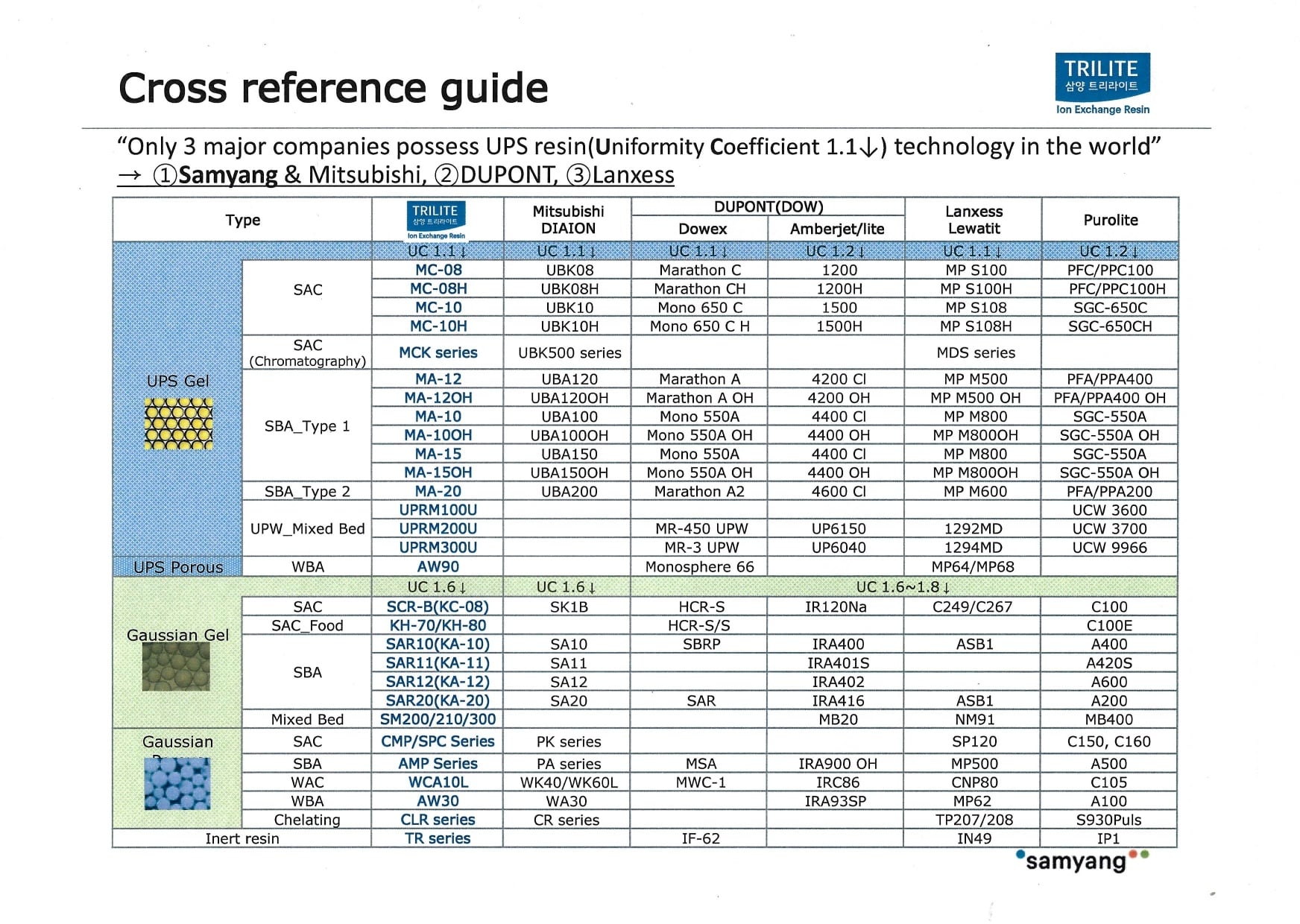
TRILITE vs. DIAION Resin
TRILITE and DIAION are ion exchange resin brands used in water treatment, material purification, and chemical separation. TRILITE is manufactured by Samyang Corporation in South Korea, while DIAION is associated with Mitsubishi Chemical Corporation, Japan.
Similarities Between TRILITE and DIAION
Both brands offer products for:
- Water softening.
- Demineralization.
- Mixed bed polishing.
- Sugar purification.
- Metal recovery.
- Ion separation.
- Industrial water treatment.
- Chemical processing.
Their ranges include strong and weak acid cation resins, strong and weak base anion resins, mixed bed, chelating, and adsorbent resins, as well as gel and macroporous structures.
Many products use Styrene-DVB matrices, while others use acrylic-DVB or specialized polymer structures. Cation and anion resins can generally be regenerated with appropriate chemicals, including salt for softening resin, acid for cation resin, caustic for anion resin, or a specialized regenerant.
Important Differences
Although the brands offer comparable categories, TRILITE and DIAION grades should not automatically be treated as identical.
Cross-referencing must consider:
- Resin type.
- Resin matrix.
- Gel or macroporous structure.
- Functional group.
- Supplied ionic form.
- Total exchange capacity.
- Moisture retention.
- Particle size.
- Uniformity coefficient.
- Operating temperature.
- pH range.
- Swelling rate.
- Regenerant and regeneration dose.
- Flow rate.
- Target water quality.
- Certification requirements.
Cross-referencing should be based on technical datasheets, water analysis, system design, and actual operating conditions.
How to Select the Right Ion Exchange Resin
Resin should not be selected on brand or price alone. It must match the feedwater quality, target water quality, and system configuration.
1. Analyze the Feedwater
Review parameters such as:
- Total hardness, calcium, and magnesium.
- Total dissolved solids and alkalinity.
- Silica, iron, and manganese.
- Chloride, sulfate, and nitrate.
- Organic content and total organic carbon where required.
- pH, conductivity, and turbidity.
2. Define the Treatment Objective
Softening, demineralization, mixed bed polishing, sugar purification, and metal recovery each require different resin characteristics.
3. Calculate System Capacity
Initial calculations generally consider flow rate, operating hours, ion concentration, resin exchange capacity, resin volume, service flow rate, operating time between regenerations, regenerant dose, and target product-water quality.
4. Review Operating Conditions
Confirm suitability for water temperature, pH, system pressure, chemical concentration, regenerant type, flow rate, organic contamination, and iron or manganese fouling risk.
5. Evaluate Certification Requirements
Food, beverage, pharmaceutical, cosmetic, and halal-product manufacturers should confirm that the available documentation satisfies their requirements.
6. Validate Cross-References
When replacing another brand, compare the complete technical specification. Do not select a replacement solely because both products are described as cation or anion resin.
Ion Exchange Resin Regeneration
Regeneration restores resin to its active ionic form.
Softener Resin Regeneration
Na⁺-form cation resin is generally regenerated with sodium chloride brine. A typical sequence includes:
- Backwash.
- Brine injection.
- Slow rinse.
- Fast rinse.
- Return to service.
Demineralization Cation Resin Regeneration
H⁺-form cation resin is typically regenerated with an acid such as hydrochloric or sulfuric acid, subject to system-design recommendations.
Anion Resin Regeneration
OH⁻-form anion resin is generally regenerated with sodium hydroxide. Chemical type, concentration, dose, contact time, and regeneration flow rate must follow the datasheet and system design.
Factors Affecting Resin Service Life
Resin life depends on:
- Feedwater quality.
- Regeneration frequency.
- Regenerant quality.
- Organic fouling.
- Oil contamination.
- Iron and manganese content.
- Oxidant exposure.
- Operating temperature.
- Differential pressure.
- Backwash velocity.
- Mechanical damage.
- Storage conditions.
- Start-up and shutdown procedures.
Correct operation and maintenance help deliver more stable performance and a longer service life.
Why Choose TRILITE Resin?
TRILITE can be considered by companies requiring:
- A comprehensive range of resin types.
- High ion exchange capacity.
- Softening and demineralization applications.
- High-purity water production.
- Sugar and industrial-solution purification.
- Mixed bed resin.
- Halal-certified product options.
- Product selection and cross-reference support.
- Industrial water-treatment solutions.
TRILITE Resin Consultation for Your Industry
Every water-treatment system has different requirements. Resin selection must be based on the water analysis, system capacity, target quality, and operating conditions.
Our team can assist with:
- Selecting a TRILITE resin grade.
- Cross-referencing other resin brands.
- Selecting softener and demineralization resin.
- Selecting mixed bed resin.
- Estimating required resin volume.
- Evaluating regeneration systems.
- Assessing food, beverage, pharmaceutical, electronics, and power-generation applications.
- Providing available technical documentation and certificates.
Send the water analysis, flow, quality target, vessel data, and document requirements through the Watermart contact page. For demineralization or mixed bed systems, include the required conductivity and flow instruments so the acceptance gate can be measured.
Frequently Asked Questions
Can TRILITE resin be used in a water softener?
Yes. Na⁺-form strong acid cation products such as KH-80 or KC-08 can reduce hardness-causing calcium and magnesium. Select the grade according to feedwater quality and system capacity.
Can TRILITE be used in a demineralization system?
Yes. A demineralization system can combine cation and anion resins. The grades must match the feedwater composition and target product-water quality.
What does mixed bed resin do?
Mixed bed resin combines H⁺-form cation resin and OH⁻-form anion resin in one vessel. It is generally used as a polishing stage to produce water with very low conductivity.
Is TRILITE resin halal-certified?
Selected TRILITE products are available with halal certification. Always confirm the latest certificate number, validity period, and covered product grades.
Can TRILITE replace DIAION resin?
It may replace a DIAION grade in certain applications when the technical specifications match. Cross-reference the resin type, matrix, functional group, capacity, moisture retention, particle size, ionic form, and operating conditions.
How long does ion exchange resin last?
Service life depends on water quality, regeneration frequency, chemical exposure, fouling, temperature, pressure, and maintenance. Capacity and physical condition should be checked periodically.
What is the difference between cation and anion resin?
Cation resin exchanges positively charged ions such as calcium, magnesium, and sodium. Anion resin exchanges negatively charged ions such as chloride, sulfate, nitrate, bicarbonate, and certain forms of silica.
Can ion exchange resin be reused?
Yes. Resin can be reused after regeneration with an appropriate chemical, provided it has not suffered permanent damage or significant capacity loss.
Get TRILITE Ion Exchange Resin
TRILITE ion exchange resin supports water softening, demineralization, mixed bed polishing, high-purity water, sugar purification, pharmaceuticals, electronics, power generation, and many other industrial applications.
Discuss Your TRILITE Resin Requirements
Footnotes
-
Samyang Corporation, TRILITE Certification, accessed July 20, 2026. ↩
-
Audit Board of the Republic of Indonesia, Government Regulation No. 42 of 2024 on Halal Product Assurance, effective October 17, 2024. ↩
-
Halal Product Assurance Organizing Agency (BPJPH), Halal Product Search, accessed July 20, 2026. ↩
-
U.S. Electronic Code of Federal Regulations, 21 CFR 173.25 — Ion-exchange resins, accessed July 20, 2026. ↩