Short answer: select DIONIX ion exchange resin from the ions to be exchanged, feedwater analysis, treated-water target, ionic load per cycle, working capacity at the proposed regeneration conditions, service and backwash flow, and the endpoint that operators will test. A resin name or bead colour is not enough.
Updated 30 July 2026: resin duty, load calculations, hydraulic data, storage, and acceptance evidence were clarified.
In this modern era, water quality is one of the important factors in supporting health and environmental sustainability.
Ion exchange resin transfers selected ions from water by exchanging them with mobile ions held by active groups in the resin. The process is reversible, but it is not particle filtration and it does not make water ready to drink by itself. Hardness, alkalinity, anions, silica, metals, organics, oxidants, oil, and suspended solids can change working capacity and resin life. Selection therefore starts with a water analysis and a process target.
PT Watermart Perkasa supplies DIONIX ion exchange resin in Indonesia for duties such as softening, demineralization, mixed-bed use, RO polishing, and other processes supported by the product datasheet. Available products, shipping ionic form, halal or food-contact documents, batch coverage, and document validity should be confirmed at quotation rather than inferred from the brand name.
| Process target | Resin family to assess | Main feedwater data | Endpoint proving the result |
|---|---|---|---|
| Softening | Sodium-form strong-acid cation | Total hardness, Ca, Mg, Fe, Mn, TDS, pH, flow, and daily volume | Outlet hardness, volume between regenerations, and leakage trend |
| Two-bed demineralization | Hydrogen-form cation followed by hydroxide-form anion | Complete cation-anion analysis, alkalinity, silica, CO2, organics, and temperature | Conductivity, silica, pH, and target ions |
| Mixed-bed polishing | Compatible cation and anion mixture | RO/demin feed quality, CO2, silica, and low ionic load | Conductivity/resistivity, silica, and run duration |
| Selective-ion removal or recovery | Selective resin supported by its datasheet | Chemical species, target concentration, competing ions, pH, and process matrix | Target-ion analysis, breakthrough curve, and regeneration balance |
The DuPont fundamentals of ion exchange describes a reversible exchange between ions in water and mobile ions in the resin without permanently changing the solid structure. This matters in practice: cation and anion resin are selected from target-ion charge and functional groups, not from a broad “purification resin” label.
What is Dionix Ion Exchange Resin?
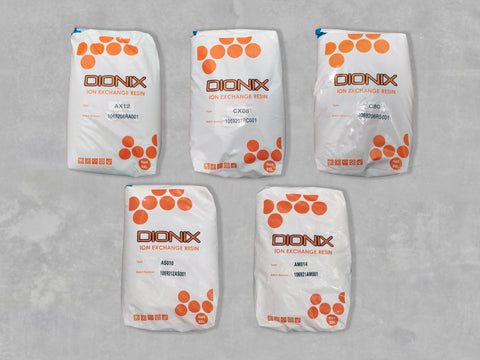
DIONIX is an ion exchange resin line marketed by Watermart. Models such as AM014, AS010, AX-12, C-80, and CX-08 appear in Watermart product material, but do not map a code to a duty from memory or name similarity. Request the current datasheet, ionic form, total and working capacity, bead size, uniformity coefficient where stated, moisture content, shipping weight, temperature limits, and regenerant.
Use the cation-versus-anion resin guide to understand exchange direction. Where the duty is softening, the water-softening application connects the resin with FRP vessels, automatic valves, brine, and hardness testing. For polishing after membranes, coordinate the design with Reverse Osmosis components.
Physical and Chemical Characteristics
The deciding characteristics extend beyond spherical beads and colour. Each quotation and commissioning record should identify:
| Resin data | Why it is required |
|---|---|
| Trade name, product code, batch, and ionic form | Prevents the wrong resin type or form being loaded |
| Polymer matrix and functional group | Determines exchange type, stability, and regenerant |
| Total capacity and working capacity | Total capacity is a laboratory property; sizing uses working capacity under the selected regeneration conditions |
| Bead-size range and uniformity | Affects pressure drop, distribution, backwash, and mixed-bed separation |
| Moisture content and shipping weight | Relates resin volume, delivered weight, and storage condition |
| Temperature, pH, oxidant, and organic limits | Protects the bead and functional groups from accelerated degradation |
| Certificates and scope | Shows which product, facility, batch, or period is actually covered |
Applications
DIONIX resin can be assessed for softening, demineralization, mixed-bed polishing, ion recovery, or a special process where the model and water conditions match. Do not use one resin for every target. A sodium-form cation resin, for example, exchanges calcium and magnesium in a softener but does not remove anions or total dissolved solids by itself.
For an initial volume estimate, calculate the ionic load:
load per cycle (kg as CaCO3) = concentration (mg/L as CaCO3) × water per cycle (m3) ÷ 1,000
Divide that load by the resin’s working capacity at the proposed regenerant dose and actual water condition, then add the design margin and the minimum volume required for hydraulic distribution. Do not substitute total datasheet capacity for working capacity. For mixed ions or demineralization, calculate in consistent equivalent units and use the manufacturer design method or an engineering review.
Sizing Data Sheet before Selecting Resin
- Full feedwater analysis and its variation, not TDS alone.
- Normal/peak flow, operating hours, daily volume, and desired run length.
- Outlet target: hardness, conductivity, resistivity, silica, or a specific ion.
- Vessel diameter, bed depth, freeboard, distributor, service flow, backwash flow, and drain capacity.
- Regenerant type, purity, concentration, dose, and local availability.
- Backwash, regeneration, slow-rinse, fast-rinse, and valve-interlock sequence.
- Sampling method, test instrument, endpoint limit, and response to breakthrough.
When feedwater carries iron, manganese, turbidity, or organics, pretreatment may be needed before the resin. Iron and manganese filter media, activated carbon, and cartridges should follow the analysis and treatability evidence; weak pretreatment merely moves the problem into the resin bed.
Storage and Handling
Follow the model label, SDS, and datasheet. Keep original packaging closed, prevent the beads from drying or freezing where the product document prohibits it, protect them from heat and sunlight, and segregate batches. Do not copy storage conditions from another resin type or brand.
Before loading, confirm that the vessel contains no debris or incompatible cleaner. Use approved-quality water, control filling to avoid bead damage, confirm resin volume and freeboard, then condition and rinse to the specified endpoint. Acid, caustic, or salt regenerants require a safety procedure, compatible materials, ventilation, spill containment, and appropriate waste management.
Commissioning and Acceptance Checklist
| Stage | Evidence recorded | Acceptance criterion |
|---|---|---|
| Resin receipt | Code, batch, weight/volume, package condition, datasheet, SDS, and requested certificates | Matches the purchase order with no damage or contamination |
| Loading | Resin volume, bed height, freeboard, distributor, and valve orientation | Matches the drawing and vessel data |
| Initial backwash and rinse | Flow, duration, bed expansion where observable, pressure drop, and rinse clarity | Stable distribution and the rinse endpoint is achieved |
| Service run | Flow, pressure drop, volume, feed and outlet quality over time | Outlet target is maintained for the agreed design run |
| Regeneration | Regenerant concentration and volume, contact time, slow/fast rinse, and waste | Sequence completes without alarms, leaks, or failed endpoint |
| Final verification | Representative sample, calibrated instrument, and laboratory analysis for final use | Meets the process specification and applicable requirements |
Drinking-water and food duties still require verified equipment, sanitation, consumable records, and sampling. Where independent testing is needed, use A3 Laboratories water-quality testing with the agreed parameters and methods.
Conclusion
DIONIX ion exchange resin should be selected from duty, water quality, working capacity, vessel hydraulics, regeneration, and verification method. PT Watermart Perkasa can review DIONIX products, FRP vessels, and automatic control valves when buyers send water analysis, outlet targets, flow, existing drawings, and operating records through the Watermart contact page.