
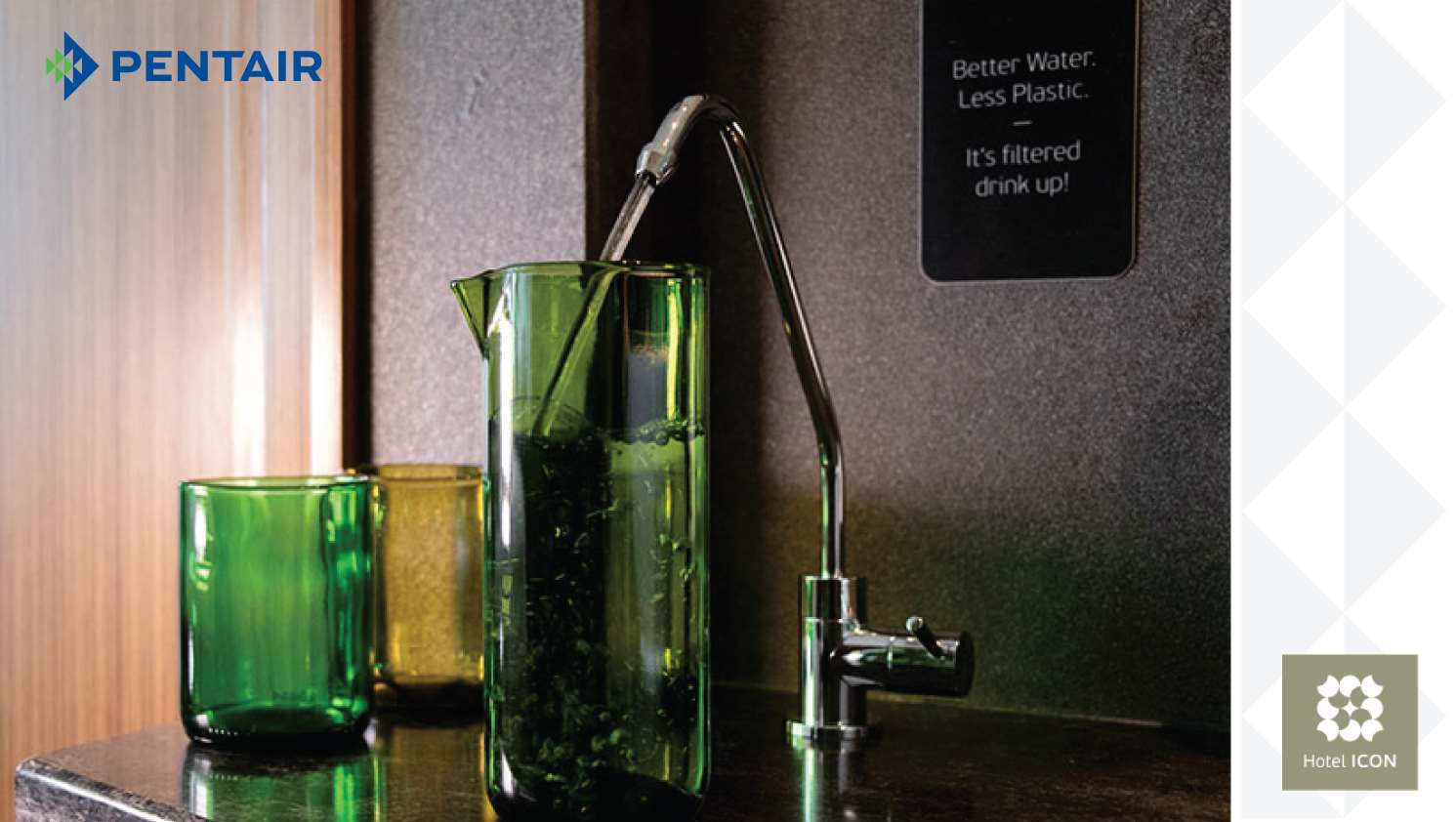
Short answer: hotels worldwide are not converging on one replacement for plastic water bottles. They are combining on-site filtered water, reusable glass bottles, in-room drinking-water taps, public refill stations, guest vessels, supplier programmes, and—in Hong Kong—a rule ending the free provision of certain plastic-bottled water in rooms. The common change is an operating system, not merely a packaging swap.
Five Real-World Examples
| Example | Reported action | Operating lesson |
|---|---|---|
| Six Senses | Produces and bottles water on site in reusable glass | Treatment, bottling, washing, and guest experience operate as one system |
| Soneva | Provides filtered water in reusable glass and asks guests not to bring plastic | Sustainability becomes part of resort positioning, not only a bin-side message |
| Accor | Removes or replaces a defined list of single-use items, including water bottles at many hotels | Procurement, brand standards, pilots, and reporting enable network scale |
| Hyatt | Adds water stations; one property installed filtered-water spouts in guestrooms | Refill can sit in public areas or directly at the point of consumption |
| Hong Kong | Since 22 April 2024, hotels cannot provide specified plastic-bottled water in rooms for free | Policy can accelerate change, but guests still need a convenient hygienic alternative |
Six Senses: Making Refill Part of the Experience
Six Senses says its on-property bottling in reusable glass avoids more than 1.5 million plastic bottles each year across its portfolio.1 At Six Senses Zighy Bay, local water is treated and offered still or sparkling. At Zil Pasyon in Seychelles, guests can visit the reverse-osmosis plant and water refinery as a resort activity.2
This provides a useful luxury-hotel anecdote: reducing plastic does not have to feel like reducing service. The treatment room, bottle, taste, presentation, and story can become part of the hospitality experience.
Claims about a carbon-free process or a property taste test remain claims by that property. Another hotel should calculate its own electricity, washing, replacements, and internal distribution.
Soneva: Reusable Water as Resort Identity
Soneva asks guests travelling to Soneva Jani not to bring plastic water bottles because the resort provides its own filtered water in reusable glass.3 Communication starts before arrival, so guests know what will be available and why the system is different.
The lesson is not that every hotel should tell guests to leave plastic at home. It is to manage expectations: explain refill locations, whether a vessel can leave the property, how bottles are cleaned, and who can assist a guest who needs sealed water for a specific reason.
Accor: Procurement and Brand Standards at Scale
Accor’s 2023 report stated that 79% of its hotels had removed the defined single-use plastic products from the guest experience, including water bottles, subject to exceptions. It also estimated that a 100-room hotel at 70% occupancy could avoid more than 29,000 bottles per year—an Accor scenario, not a universal number.4
By the end of 2025, Accor reported that 75% of its hotels had eliminated at least 90% of the identified single-use plastic items.5 The multi-year journey shows the need for item lists, regulatory and availability exceptions, alternative procurement, pilots, audits, and reporting.
At three Accor hotels in São Bernardo do Campo, Brazil, removing plastic bottles from food and beverage operations reportedly avoided 38,000 bottles annually. The team then planned a filtered-water machine and reusable bottles for guests.6
Hyatt: Refill Stations and In-Room Spouts
Hyatt announced more water stations in key hotel spaces for guests refilling reusable bottles. It also cited filtered-water spouts in all guestrooms at Park Hyatt Istanbul—Maçka Palas.7
The examples represent two different models:
- central refill stations: fewer treatment devices, but guests walk to a shared point and the hotel maintains a common area;
- in-room POU: service resembles complimentary bottles, but device count, sanitation, cartridges, service access, and leak protection increase.
Hong Kong: Regulation Changes the Hotel Default
Hong Kong’s regulation commenced on 22 April 2024. Hotels and guesthouses may not provide several disposable plastic toiletries and specified plastic-bottled water in accommodation areas free of charge; the regulated products may be supplied for a charge.8
This is often shortened to “Hong Kong banned bottled water.” That is inaccurate. The rule changes complimentary in-room plastic-bottled water as the default; it is not a blanket ban on the sale or use of packaged water.
Government papers prepared before implementation already described hotels moving to glass-bottled water or reusable containers filled at designated points.9 Regulation therefore followed and accelerated a market practice that had begun to emerge.
This Is Broader than a Few Resorts
The Global Tourism Plastics Initiative, led by UNEP and UN Tourism, asks tourism businesses to eliminate unnecessary plastic, move towards reuse, and report progress. Accor, Club Med, and Iberostar were among early signatories alongside organisations from several continents.10
It is still too broad to claim that “overseas hotels have abandoned plastic bottles.” Regulation, municipal water quality, hotel type, brand standards, and operational capability vary. A more accurate conclusion is: a growing group of hotel networks, resorts, cities, and regulators has changed plastic bottled water from a default into an option that must be justified.
Lessons for Indonesian Hotels and Apartments
- Start with purchasing and occupancy data, not campaign imagery.
- Test source water and the furthest outlets before selecting carbon, UF, RO, or a combination.
- Choose the service model: a bottling room, floor refill stations, dispensers, pantries, or RO in each room/unit.
- Design container sanitation, closure, washing, drying, storage, and traceability.
- Maintain options for infants, medical needs, emergencies, events, and guests requesting sealed water.
- Present test results and maintenance schedules responsibly; do not promise “zero microplastics” without a method and result.
- Pilot one floor or room type before a full rollout.
Watermart outlines the technical options on the hotel and apartment drinking-water page and the implementation roadmap. Point-of-use options include Pentair EU-25 UF and Everpure and Pentair ES60-S under-sink RO.
Conclusion
Overseas cases show that guests can accept—and sometimes value—refill systems when the water is easy to access, tastes consistent, arrives in a clean vessel, and is clearly explained. Success does not come from removing bottles on day one. It comes from treatment, hygiene, procurement, training, maintenance, and service recovery working together.
References
Footnotes
-
Six Senses, Plastic Freedom. ↩
-
Six Senses Zil Pasyon, Water Bottling Plant. ↩
-
Soneva Jani, Your Journey to Soneva Jani. ↩
-
Accor, Ensuring Future-Proof Operations. ↩
-
Accor, Plastic Sustainable Alternatives, Water Management and Teamwork in Brazil. ↩
-
Hyatt, Hyatt Announces Global Initiatives to Reduce Single-Use Plastics. ↩
-
Hong Kong Government, LCQ1: Regulating disposable plastic tableware and other plastic products. ↩
-
Hong Kong Legislative Council, discussion paper on disposable plastic products, 2022. ↩
-
United Nations Environment Programme, Global tourism sector should continue fight against plastic pollution, 2020. ↩