GreensandPlus and DMI-65 are both catalytic filter media, but neither is a universal winner. Select from Fe, Mn, H₂S, pH, oxidant strategy, water target, service flow, backwash capacity, and waste handling. Datasheet values define only the operating envelope; commissioning or a pilot on the project’s raw water must demonstrate the result.
Updated 3 August 2026: unsupported winner claims replaced with a source-led comparison, hydraulic calculations, and acceptance records.
Before comparing media, review how manganese greensand works and how to select it for the oxidation, contact, filtration, and backwash context. Every number below is a published manufacturer condition, not a result guarantee for every source water.
What is Inversand Manganese Greensand Plus?
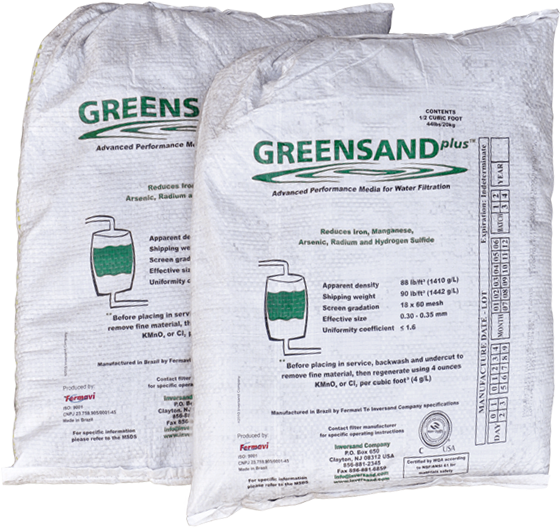
Inversand GreensandPlus™ uses a silica-sand core with a manganese-dioxide surface. It is applied to iron, manganese, and H₂S oxidation-filtration under suitable conditions; arsenic or radium applications require specific chemistry, pretreatment, and validation. Watermart supplies Inversand GreensandPlus and its technical data for selection with the vessel, underdrain, valve, and dosing system.
Excellence of Inversand Manganese Greensand Plus
Its assessable advantage is configuration flexibility, not a promise that it is always cheaper or more effective. The GreensandPlus technical sheet lists pH 6.2–8.5, service flow 2–12 gpm/ft², minimum backwash 12 gpm/ft² at 55°F (about 12.8°C), and minimum bed depth of 15 inches in dual-media service or 30 inches when used alone. That backwash condition targets at least 40% bed expansion for about 10 minutes.
The medium can be used in vertical or horizontal pressure filters and gravity filters, with the regeneration/oxidation method defined by the supplier guidance. Compatibility with chlorine or strong oxidants does not mean dosage can be selected without demand testing, material review, residual control, and a waste-disposal plan.
What is DMI65?
DMI-65® is catalytic filtration media with an active layer infused into the microporous matrix. The DMI-65 Technical Data Sheet lists pH 5.8–8.6, maximum temperature 45°C, minimum 600 mm bed depth, minimum 40% freeboard, service flow 5–30 m³/m²/hour, backwash 25–40 m³/m²/hour, and 20–50% bed expansion.
The manufacturer also requires initial sodium-hypochlorite activation and specifies a 0.1–0.3 mg/L chlorine residual during operation in its DMI-65 activation guidance. DMI-65 does not use periodic chemical regeneration in the same way as KMnO₄-regenerated media, but it still needs oxidant, calibrated dosing, backwash, rinse, and waste management.
Key Differences between Inversand Manganese Greensand Plus and DMI65
| Published parameter | GreensandPlus | DMI-65 | How to use the value correctly |
|---|---|---|---|
| pH range | 6.2–8.5 | 5.8–8.6 | A pH inside the range does not prove adequate oxidation; check Mn, H₂S, alkalinity, temperature, and oxidant |
| Service flow | 2–12 gpm/ft² (about 4.9–29.4 m/hour) | 5–30 m³/m²/hour | Select loading from residual target, bed depth, Fe/Mn load, and pilot; do not default to the maximum |
| Published backwash | Minimum 12 gpm/ft² at 55°F | 25–40 m³/m²/hour in the TDS | Calculate pump flow = filter area × backwash loading; correct for temperature, bed depth, underdrain, and actual expansion |
| Bed and freeboard | Minimum 15 inches dual-media or 30 inches single-media; ≥40% expansion at the reference condition | Minimum 600 mm bed; ≥40% freeboard; 20–50% expansion | Confirm available shell height, nozzle/underdrain position, and no media loss during backwash |
| Oxidant strategy | Follow the supplier’s continuous or intermittent regeneration/oxidation method | Initial NaOCl activation and operating chlorine residual under DMI-65 guidance | Compare chemical tank, pump, interlock, residual monitoring, safety, and waste requirements |
| Target duty | Fe, Mn, H₂S; other applications conditional | Primarily Fe/Mn; the manufacturer also describes selected other applications | Use test results, water target, and pilot evidence—not a marketing contaminant list—for acceptance |
The DMI-65 upper value of 30 m/hour is a published limit, not a drinking-water default. Its engineering page recommends about 5 m/hour and no more than 10 m/hour for large drinking-water plants; the upper range assumes a shallower bed and more relaxed residual Fe/Mn. GreensandPlus likewise cannot automatically be run at 12 gpm/ft² on every feedwater.
1. Media Composition and Technology
GreensandPlus is a silica-core granule with a manganese-dioxide coating. DMI-65 uses a microporous matrix with a catalytic layer produced by the manufacturer’s infusion process. Both assist oxidation and solids capture, but oxidation must still form filterable particles and backwash must remove those solids from the bed.
Do not treat catalytic media as an unlimited adsorbent. Run length depends on Fe/Mn mass loading, solids loading, filter area, oxidation quality, and backwash capacity. Include media, support gravel where used, and filled-water weight in vessel and structural checks.
2. Regeneration and Maintenance
The important difference is how the active surface is maintained. GreensandPlus can use an oxidant/regenerant regime defined by its supplier guidance. DMI-65 states that it requires no chemical regeneration but still requires initial activation and an operating oxidant residual. “No regeneration” therefore does not mean “no chemical”.
For either medium, record differential pressure, service flow, backwash flow and expansion, rinse duration, outlet quality, chemical consumption, and waste volume. A validated backwash trigger can combine pressure drop, run time, and breakthrough.
3. Application and Effectiveness of Contaminant Removal
State effectiveness as inlet and outlet quality at a defined flow and operating condition. Prepare total/dissolved Fe, total/dissolved Mn, H₂S, pH, alkalinity, dissolved oxygen, ORP or oxidant residual, turbidity, TSS, organics, temperature, and operating hours. Where arsenic or radium is a target, obtain species-specific or radiochemical analysis and specialist design; do not infer removal from the media nameplate.
For drinking-water use, the filter is only one barrier. Complete sanitation, flushing, representative sampling, and laboratory verification against applicable requirements. Water testing by A3 Laboratories can supply pre- and post-pilot data; equipment selection still follows the result and project target.
4. Operational Conditions
Compare worst cases rather than averages: minimum/maximum temperature, pH after dosing, peak flow, highest Fe/Mn, H₂S, operating hours, power loss, and backwash-water storage. The GreensandPlus summary table does not publish a maximum temperature; absence of a number is not permission for unlimited temperature, so confirm hot-water duty with the supplier.
A pilot should include realistic raw-water change. When the source shifts after rain or across seasons, recheck oxidant demand, filter run, and outlet quality before increasing loading.
5. Flow Speed and Operating Pressure
Calculate filter area = service flow ÷ selected service loading. Then calculate backwash flow = filter area × backwash loading at the design temperature and expansion. The vessel, control valve, pump, underdrain, drain, and backwash-water source must all pass that flow at the available pressure.
| Hydraulic commissioning test | Acceptance record |
|---|---|
| Minimum, normal, and peak service flow | Flow, velocity, inlet/outlet pressure, clean differential pressure, and outlet Fe/Mn |
| Actual backwash | Measured flow, temperature, duration, expansion height or verification method, waste colour/turbidity, and media carryover |
| Rinse and return to service | Duration, flow, oxidant residual, outlet Fe/Mn/turbidity, and volume discharged before product acceptance |
| Run to trigger | Hours and treated volume, pressure-drop trend, breakthrough, oxidant consumption, and waste per cycle |
Conclusion
GreensandPlus is more appropriate when the project’s operating method, vessel, and chemical strategy match its published envelope. DMI-65 is more appropriate where the plant can complete activation, maintain the operating oxidant residual, and meet its published bed/backwash conditions. Neither can be called more efficient or cheaper without calculating media, vessel, pump, chemical, energy, water loss, labour, monitoring, and replacement at the same duty.
Send the water analysis, average/peak flow, operating hours, outlet target, vessel diameter and height, available backwash flow, and discharge limits to PT Watermart Perkasa. The team can assess GreensandPlus, FRP vessels, automatic control valves, and dosing as one system, then define the pilot and acceptance record before full procurement.

.png)