
Membranes
Xelect ULP4040 vs XLP4040 4040 RO Membrane
Compare Xelect ULP4040 and XLP4040 for brackish-water RO: test pressure, permeate flow, salt rejection, operating limits, and required project design inputs.
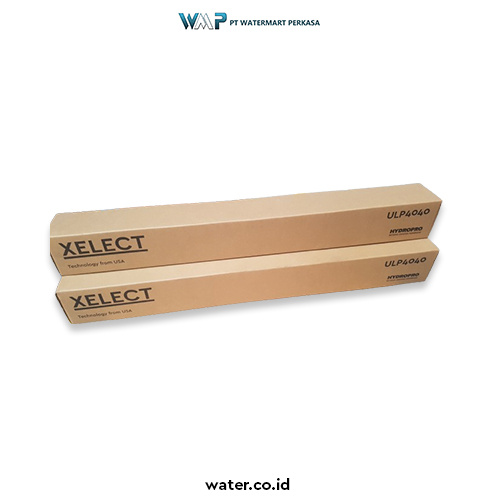
Should you choose Xelect ULP4040 or XLP4040 for brackish water?
Xelect XLP4040 is intended for municipal water or groundwater below 1,000 ppm salt content and is tested at 100 psi; ULP4040 covers feed below 1,500 ppm and is tested at 150 psi. PT Watermart Perkasa, through water.co.id, supplies both 4040 RO membranes for water-treatment projects in Indonesia.
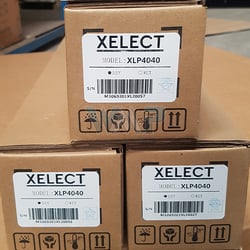
Both are 4-inch × 40-inch reverse-osmosis membrane elements for brackish water. Final selection should not rely on salt content alone: temperature, SDI, free chlorine, pH, target permeate flow, system recovery, and required product-water quality also affect the performance projection.
What is the difference between Xelect ULP4040 and XLP4040?
The main difference is the feed range and test pressure. XLP4040 is tested at lower pressure for lower-salt feed, while ULP4040 is tested at a higher NaCl concentration and pressure. Because their test conditions differ, the catalog flow and rejection figures below are not a head-to-head comparison on identical feed water.
| Selection data | Xelect ULP4040 | Xelect XLP4040 | What it means for a buyer |
|---|---|---|---|
| Datasheet application | Municipal water and groundwater below 1,500 ppm salt content | Municipal water and groundwater below 1,000 ppm salt content | Measure actual conductivity/TDS before choosing a model |
| NaCl concentration during testing | 1,500 ppm | 500 ppm | Catalog results use different test feeds |
| Test pressure | 150 psi (1.03 MPa) | 100 psi (0.69 MPa) | XLP4040 is intended for very-low-pressure operation on suitable feed |
| Catalog permeate flow | 2,600 GPD (9.8 T/D) | 2,400 GPD (9.1 T/D) | Single-element flow may vary by ±15% under test conditions |
| Stable salt rejection | 99.3% | 99.2% | Use a system projection to estimate actual product-water quality |
| Active membrane area | 85 ft² (7.9 m²) | 85 ft² (7.9 m²) | Both use the 4040 element format |
| Test recovery | 15% | 15% | Single-element recovery is not the whole-system recovery target |
Technical sources checked July 18, 2026: Xelect ULP4040 datasheet and Xelect XLP4040 datasheet. The table reports catalog test conditions and results, not guaranteed output on a specific feed.
What data is needed to select a 4040 RO membrane?
A defensible selection starts with feed-water data and the system target. Prepare the following information before requesting a projection or quotation:
- conductivity or TDS, temperature, pH, and water source;
- SDI or turbidity data and the proposed pretreatment;
- free chlorine after the dechlorination stage;
- target permeate flow, operating hours, and system recovery;
- required permeate quality, including conductivity or TDS limit;
- available pump pressure and pressure-vessel arrangement;
- elements per vessel, vessel count, and staging plan;
- existing-system data when the project is a retrofit.
These inputs distinguish dimensional compatibility from process suitability. Feed below 1,000 ppm does not automatically require XLP4040 if permeate targets, temperature, fouling risk, or pressure limits point to another configuration.
Which operating limits are shared by both models?
ULP4040 and XLP4040 have the same catalog operating limits. These maximum values are design boundaries, not recommended daily operating setpoints.
| Parameter | Datasheet limit |
|---|---|
| Maximum working pressure | 600 psi (4.14 MPa) |
| Maximum feed temperature | 45°C |
| Maximum feed SDI | 5.0 |
| Maximum free chlorine in feed | 0.1 mg/L |
| Continuous operating pH range | 2–11 |
| Chemical-cleaning pH range | 1–13 |
| Maximum pressure drop per element | 15 psi (0.1 MPa) |
Pretreatment should prevent the membrane from receiving solids, oxidants, or hydraulic conditions outside these limits. Record feed pressure, concentrate pressure, permeate flow, feed conductivity, and permeate conductivity during commissioning so later performance can be compared with the baseline.
Which components should be specified with an Xelect membrane?
Buyers normally need to match the membrane to a complete system rather than purchase an isolated element. water.co.id provides product paths for reverse-osmosis membranes, Codeline pressure vessels, Pentair Pentek pretreatment cartridges, and dosing pumps where the design requires them.
For an element replacement, verify housing dimensions, brine-seal position, adapters, interconnectors, flow direction, and O-ring condition. For a new system, request a projection that states feed assumptions, temperature, fouling factor, recovery, element count, and permeate-quality target. Send these inputs through the Watermart contact page so the model and components can be matched to the application.
Buyer questions about Xelect ULP4040 and XLP4040
Which model should be considered for feed below 1,000 ppm?
XLP4040 is a candidate because its datasheet places it on municipal water or groundwater below 1,000 ppm and tests it at 100 psi. The decision still needs a projection based on temperature, ionic composition, SDI, recovery, flow, and permeate target; salt content alone is insufficient.
Will a system always produce 2,600 or 2,400 GPD per element?
No. Those are catalog flows under each model’s stated test conditions, and the datasheets allow ±15% variation in single-element permeate flow. Temperature, pressure, salinity, fouling, recovery, and pretreatment condition can make actual system output different.
Are ULP4040 and XLP4040 suitable for seawater?
Both datasheets classify the products as brackish-water RO membranes for lower-salt municipal water and groundwater. Seawater requires a seawater RO membrane, pressure vessel, pump, pretreatment, and system projection suited to much higher salinity and pressure.
What should be included in a quotation request?
Provide the feed-water analysis, temperature, TDS or conductivity, SDI/turbidity, free chlorine, target permeate flow and quality, recovery, operating hours, pump pressure, and housing arrangement. For a retrofit, also include the old membrane model, element count, pressure-drop history, and product-water data.