Choose a cartridge filter for fine polishing, a small footprint, and intermittent service; choose a backwash filter for high solids loads and continuous flow when backwash water and drainage are available. Many reliable commercial trains use both in series: backwash media for pretreatment, followed by a cartridge as the downstream guard.
For rating and replacement triggers, see the sediment-filter guide for downstream-equipment protection, which uses nominal/absolute rating, differential pressure, flow, and breakthrough checks.
Updated 16 July 2026: this comparison now includes a decision matrix, sizing worksheet, drain demand, redundancy, and life-cycle cost inputs.
In the world of commercial water treatment, choosing the right filtration system is a crucial step to ensure optimal water quality.
Two types of filters that are often the top choice are cartridge filters and backwashing filters. Both systems have their own characteristics, advantages, and disadvantages that need to be carefully considered before making a decision. This article will take an in-depth look at both types of filters, compare their features, and provide guidance for choosing the system that best suits your commercial application needs.
| Design condition | Cartridge | Backwash media | Series combination |
|---|---|---|---|
| Low solids load, 1–10 µm polishing target | Usually suitable | May be excessive | Useful when upset risk is high |
| Large turbidity or sediment swings | Blinds quickly without pretreatment | More tolerant when media and backwash are correct | Strong option to protect RO or UV |
| No drain or backwash-water supply | Suitable if spent cartridges can be managed | Not suitable | Impractical without a drain |
| 24/7 operation without shutdown | Requires duty/standby housings | Requires twin vessels or staggered backwash | Redundancy must cover both stages |
| Very limited footprint | Usually advantageous | Vessel and backwash piping require space | Requires a layout compromise |
| Dissolved-compound adsorption target | Only with a specific cartridge medium | GAC or another adsorptive medium can be selected | Cartridge still guards downstream particles |
Introduction to Cartridge Filters and Backwashing

Cartridge filters and backwashing are two water filtration technologies that have long been used in various commercial and industrial applications. Cartridge filters generally consist of replaceable filter elements, usually cylindrical in shape, designed to capture particles and contaminants from water as it flows through them. On the other hand, backwashing filters use filter media such as sand, anthracite, or activated carbon that can be periodically cleaned by reversing the flow of water to remove accumulated impurities.
Before we dive into the comparison of these two systems, it is important to understand the basic working principles of each filter:
Cartridge Filter

Cartridge filters work on the principle of mechanical filtration. Untreated water is forced to flow through filter material that has microscopic pores. Particles larger than the pore size will be retained, while clean water will pass through. Cartridge filters are available in various pore sizes, ranging from 0.2 microns to 50 microns or more, depending on the level of filtration required.
One advantage of cartridge filters is the available range of micron ratings and materials. When considering Pentair Pentek cartridges, match the actual model number, nominal or absolute rating, differential-pressure data, and model-specific certification claim; certification on one model does not automatically cover every cartridge.
Filter Backwashing

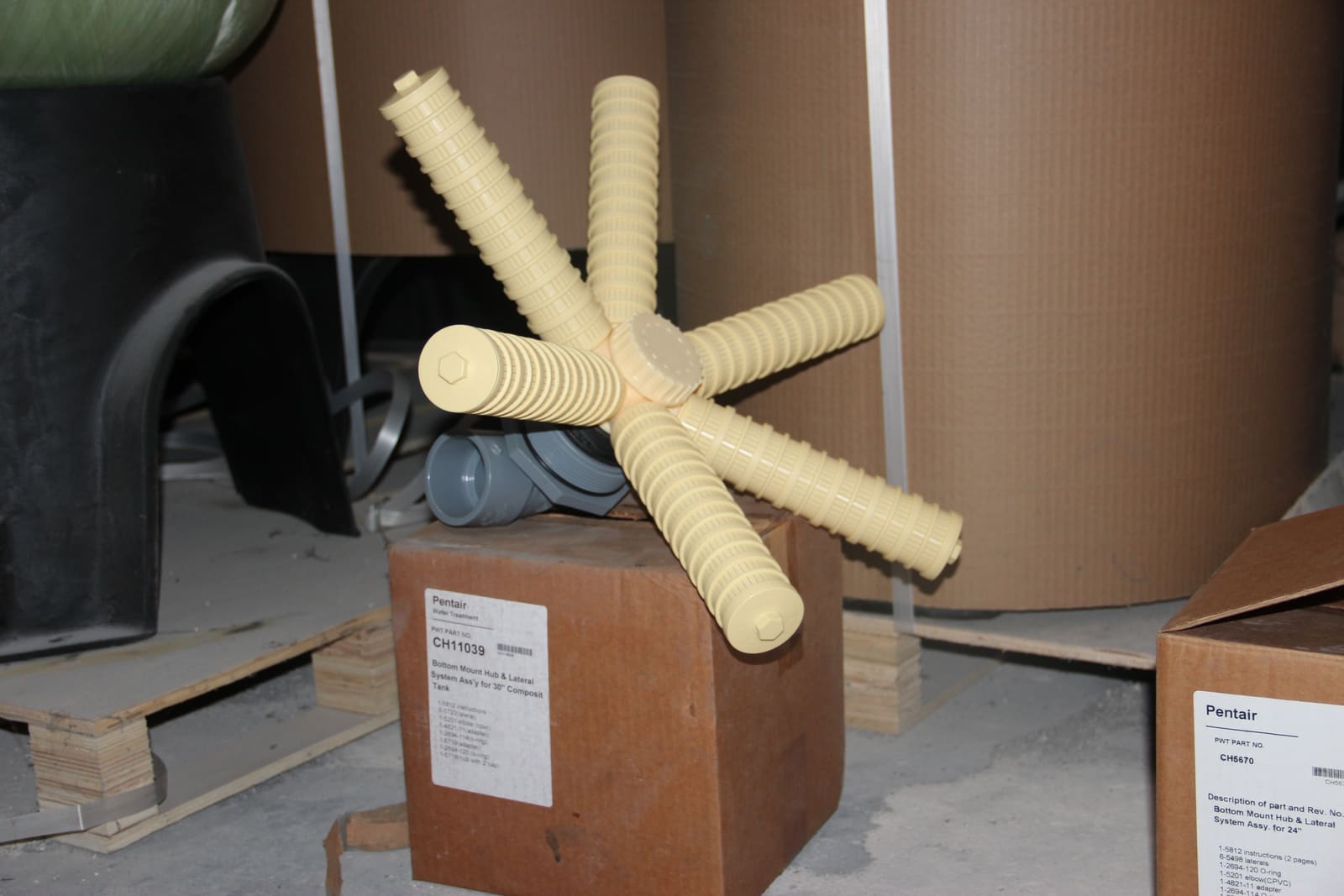
Backwashing filters, also known as media filters or filter beds, use layers of granular material such as sand, anthracite, or activated carbon to filter water. As water flows through the filter media, suspended particles and contaminants are trapped between the media grains. Over time, this accumulation of impurities will reduce the effectiveness of the filter and increase the pressure within the system.
To clean the filter, the backwashing process is performed by reversing the flow of water. Clean water is pumped upwards through the filter media, expanding the filter bed and releasing trapped impurities. This dirty water is then discharged, leaving the filter media clean and ready for reuse.
Modern backwashing systems often use a combination of water and air for more effective cleaning. As explained in the literature, “Modern filters use both air and water for backwashing. The most common sequence is to first pump air through the bed to break up the surface layer, which has usually been covered by the filtered material. After a short time, usually 2 or 3 minutes, water is also pumped through the filter at a low rate to provide limited bed expansion (usually less than 5%) and to carry impurities out of the media.” (Basic Water Treatment, 5th Edition, Binnie & Kimber)
In-Depth Comparison: Cartridge Filter vs Backwashing
To help you make the right decision, let’s compare these two types of filters in a few key aspects:
1. Filtration Effectiveness
Cartridge Filters: - Can filter very small particles, down to 0.2 microns or smaller. - Effective for removing sediment, chlorine, odor, and taste. - Ideal for applications that require highly purified water.
Backwashing Filter: - Effective for removing larger particles, typically up to 10-20 microns. - Excellent for reducing turbidity and removing sediment. - Can remove iron and manganese if using specialized media.
For applications that require effective iron removal, Clack Birm media for iron removal could be the right choice in a backwashing filter system.
2. Capacity and Flow Rate
Cartridge Filters: - Generally have a lower capacity than backwashing filters. - Flow rate varies depending on cartridge size and type. - Suitable for applications with lower or intermittent water demand.
Backwashing Filters: - Can handle high flow when vessel area and valve capacity are adequate. - Service loading must follow the media type, temperature, water quality, and effluent target. - Suitable for commercial applications with high demand and adequate backwash capacity.
3. Care and Maintenance
Filter Cartridge: - Replacement is triggered by differential pressure, flow loss, or quality breakthrough—not a fixed calendar. - The replacement process is relatively simple and quick. - Long-term operating cost can be high when the solids load is large.
Filter Backwashing: - Backwash is triggered by differential pressure, maximum hygienic time, treated volume, or effluent quality under the control philosophy. - Rate, duration, and bed expansion follow the media datasheet and water temperature. - Water use and drain capacity must be calculated.
For efficient backwashing systems, the use of corrosion-resistant Aquamatic automatic valves can improve system performance and reliability.
4. Output Water Quality
Filter Cartridge: - Can produce very high quality water, especially for small particles. - Effective in removing a wide range of contaminants including bacteria (with appropriate cartridge). - Output water quality is consistent until the cartridge needs to be replaced.
Backwashing filter: - Output water quality is generally good, but may not be as fine as cartridge filters for very small particles. - Effectiveness may decrease slightly before the next backwashing. - Very effective for reducing turbidity and removing large amounts of sediment.
5. Flexibility and Scalability
Filter Cartridge: - Easily customized by changing cartridge types for different filtration needs. - Limited scalability; to increase capacity, it is usually necessary to add a separate filter unit. - Suitable for applications that require flexibility in filtration type.
Backwashing filter: - Can be customized by replacing the filter media, but the process is more complex. - Highly scalable; can handle increased capacity by increasing tank size or number of units. - Ideal for applications that require high and consistent capacity.
For a scalable backwash system, preliminary sizing must match the FRP pressure vessel to media depth, freeboard, internals, service flow, and backwash flow.
6. Initial and Operating Costs
Filter Cartridge: - Initial costs are lower for small to medium-sized systems. - Long-term running costs can be higher due to the need for regular cartridge replacement. - Suitable for applications with limited initial budget but flexibility in running costs.
Backwashing Filters: - Higher initial cost, especially for large systems. - Long-term operational costs are lower, but need to consider water and electricity costs for backwashing. - More economical for large-scale applications with long-term use.
7. Space and Installation
Cartridge Filters: - Requires less space, ideal for locations with space constraints. - Installation is relatively simple and quick. - Suitable for applications that require a compact or portable system.
Backwashing Filters: - Requires larger space, especially for large-scale systems. - More complex installation, may require additional piping and pumps for backwashing. - Ideal for permanent installations with sufficient space.
For compact installations, compare industrial and commercial filter cartridges by element count, cartridge length, housing rating, differential-pressure limit, and changeout clearance.
Preliminary Cartridge and Backwash Filter Sizing Worksheet
This worksheet screens options before vendor selection. Final numbers must use cartridge differential-pressure curves, housing ratings, media datasheets, and valve and vessel limits.
| Input | Symbol/unit | How to use it |
|---|---|---|
| Operating and peak flow | Q normal, Q peak (m³/h) | Use Q peak for hydraulic sizing; record turndown and operating hours |
| Solids/turbidity load | mg/L, NTU, or SDI | Decide whether cartridges require media pretreatment |
| Particle target | Nominal/absolute µm | Match the downstream-process target, not simply the smallest number |
| Differential-pressure limit | Clean and changeout ΔP | Take limits from the housing, cartridge, pump, and manufacturer data |
| Media service loading | v service (m/h) | Initial bed area: A = Q peak / v service |
| Media backwash rate | v backwash (m/h) | Initial backwash flow: Q backwash = A × v backwash |
| Backwash/rinse time | Minutes per step | Waste volume: each step’s flow × duration |
| Redundancy | Duty/standby or N+1 | Maintain required flow during changeout or backwash |
For a circular vessel, estimate diameter from area with D = √(4A/π). Example: at Q peak 10 m³/h and a media-datasheet service velocity of 10 m/h, the initial area is 1 m² and theoretical diameter is 1.13 m. Then check bed depth, freeboard, backwash expansion, internals, FRP vessel rating, and filter control-valve capacity.
For cartridges, divide Q peak by the verified per-cartridge flow at the allowed clean ΔP, round up, and add redundancy if the process cannot stop. Cartridge diameter and length alone are not flow ratings. Compare industrial filter cartridges and Pentair Pentek cartridges against housing data, temperature, chemical compatibility, and micron target.
Apply that equation to a duty/standby layout with the commercial cartridge-housing sizing guide, including an 18 m³/h example, clean-versus-dirty ΔP, service clearance, and commissioning procedure.
The US EPA describes granular activated carbon (GAC) as a porous adsorption medium whose design requires adjustment of bed depth, loading rate, and bed volumes to breakthrough. GAC in a backwash vessel therefore cannot be judged as an ordinary sediment filter; the target contaminant and sampling plan control media changeout.
Five-Year Cost Inputs to Compare
- Housing or vessel, valve, backwash pump, instrumentation, and drain works.
- Cartridges per changeout, data-based frequency, labor, and disposal.
- Backwash and rinse water, pump energy, downtime, and wastewater-treatment cost.
- Media replacement or top-up, internal inspection, spare valves, O-rings, and distributors.
- Risk cost: cartridge rupture, media carryover, undersized drainage, or downstream shutdown.
Choosing the Right System for Your Commercial Application
After understanding the difference between cartridge filters and backwashing, the next step is to determine which system is best suited for the specific needs of your commercial application. Here are some key factors to consider:
1. Volume of Water Required
If your application requires a consistently large volume of water, a backwashing filter may be a better choice. These systems can handle higher flow rates and larger volumes of water compared to most cartridge filter systems.
2. Desired Input and Output Water Quality
Consider the input water quality and the level of purification you need. If your input water has high levels of turbidity or sediment, a backwashing filter may be more effective. However, if you need water with a very high level of purity, a low micron-rated cartridge filter may be more appropriate.
3. Available Space
If space is a constraint, cartridge filters generally require a smaller installation area. However, if you have sufficient space, backwashing filters can provide greater capacity in the long run.
4. Initial and Long-term Budget
Consider not only initial costs, but also long-term operational costs. Cartridge filters may have lower initial costs but higher replacement costs, while backwashing filters have higher initial costs but lower running costs in the long run.
5. Maintenance Needs
An automatic backwash filter still needs valve inspection, cycle verification, and quality monitoring. Cartridges are simpler to replace, but labor and element inventory rise with solids loading; select the system around the maintenance team rather than a “fit and forget” assumption.
6. System Flexibility
If you expect your filtration needs may change over time, cartridge filters offer greater flexibility in terms of the ability to switch cartridge types for different needs.
7. Industry Regulations and Standards
Make sure the system you choose meets all regulations and industry standards that apply to your application. Some industries may have specific requirements that are more easily met by one type of filter.
Current Innovations and Trends in Filtration Technology
Along with technological developments, the water filtration industry continues to experience significant innovation. Some of the latest trends to note include:
1. Hybrid Systems
Some manufacturers are now developing systems that combine the advantages of cartridge filters and backwashing in one unit. These systems offer greater flexibility and efficiency for a variety of applications.
2. Advanced Filter Material
Developments in material technology have resulted in more effective and durable filter media and cartridges. For example, Xelect ULP and XLP RO membranes offer high performance with lower operating pressures, improving the energy efficiency of filtration systems.
3. Smart Control System
The integration of IoT (Internet of Things) and AI (Artificial Intelligence) technologies in filtration systems enables real-time monitoring, performance optimization, and predictive maintenance. This can improve operational efficiency and reduce downtime.
4. Focus on Sustainability
The trend towards more sustainable practices has driven the development of more energy- and water-efficient filtration systems. This includes increased backwashing efficiency and the use of recyclable filter materials.
Case Studies: Filtration System Implementation in Various Industries
To give a real picture of how cartridge filters and backwashing are implemented in commercial situations, let’s take a look at some case studies:
1. Food and Beverage Industry
A common design pattern uses backwash media to absorb the bulk sediment load, followed by a cartridge as a guard before a critical process. Final micron rating, material, and control points must follow the product-water specification and source-water analysis.
2. Hotels and Resorts
In desalination, media and cartridge filters are pretreatment; salt separation still occurs at the membrane. Select DuPont FilmTec seawater RO membranes from water analysis, target recovery, permeate quality, and pretreatment design.
3. Health Facilities
Healthcare facilities have different specifications for utility, laboratory, and clinical water. Select cartridge or media filtration only after the authorized team defines quality, validation, sanitation, and redundancy requirements for each loop.
4. Manufacturing Industry
In high-purity process water, a cartridge can guard against particles but is not the complete treatment train. Use water-treatment conductivity instruments alongside the other quality parameters defined by the process owner.
Conclusion
The choice between cartridge filters and backwashing for commercial applications is not a decision that can be made in general. Each system has its own advantages and disadvantages, and the best choice will largely depend on the specific needs of your application.
Cartridge filters offer flexibility, ease of replacement, and excellent filtration capabilities for small particles. These systems are ideal for applications that require very high water quality or have space limitations. On the other hand, backwashing filters excel at handling large volumes of water, have lower long-term operational costs, and are highly effective at removing sediment and turbidity.
In many cases, a combination of both systems might provide the optimal solution. For example, using a backwashing filter for pre-treatment, followed by a cartridge filter for final purification.
The most important thing is to conduct a thorough analysis of your application’s specific needs, considering factors such as input water quality, required volume, available space, budget, and maintenance requirements. Consulting a water filtration expert and conducting small-scale trials can also help you make an informed decision.
With the right selection of filtration system, you can ensure high-quality water supply for your commercial applications, improve operational efficiency, and ultimately add value to your business.
Questions and Answers About Cartridge Filters and Backwashing
1. Can the cartridge filter be reused after washing?
Answer: Most cartridge filters are designed for single use and are not recommended for washing and reuse. Washing the cartridge can damage the filter structure and reduce its effectiveness. However, there are some types of cartridges that can be washed, such as pleated polyester or stainless steel cartridges. But keep in mind that even for these types, the filtration effectiveness may be reduced after a few washes.
2. How often does backwashing filters need to be backwashed?
Answer: Set backwash frequency from differential pressure, treated volume, effluent quality, maximum hygienic time, and the media datasheet. Record baseline ΔP after rinse, then verify that each cycle restores ΔP and quality without carrying media to drain. A timer can set the maximum interval, but actual condition should remain the primary trigger.
3. How to determine the right pore size (micron rating) for a cartridge filter?
Answer: Selection of the proper pore size depends on the type of contaminant to be removed and the desired water quality. As a general guide: - 20-50 microns: for coarse filtration, removing sand and large sediments. - 5-20 microns: for medium filtration, removing fine dust and most sediments. - 1-5 microns: for fine filtration, removing most suspended particles. - Sub-micron (0.5 microns or less): for very fine filtration, can remove some bacteria and colloids. For specialized applications, such as the pharmaceutical or electronics industry, filters with even lower micron ratings may be required.
References
-
Binnie, C., & Kimber, M. (2013). Basic Water Treatment (5th Edition). “Modern filters use air and water for backwashing. The most common sequence is first to pump air through the bed to break up the surface layer, which has normally become blinded with filtered material. After a short time, typically 2 or 3 min, water is also pumped through the filter at a low rate to provide a limited bed expansion (typically less than 5%) and to carry dirt out of the media.” (p. 148)
-
Byrne, W. Reverse Osmosis: A Practical Guide for Industrial Users. “Backwashing an activated carbon filter is important to remove suspended solids and debris that may have been filtered by the carbon. This helps prevent compaction and clogging of the carbon bed.” (p. 84)
-
Hussain, A., & Bhattacharya, A. Advanced Design of Wastewater Treatment Plants: Emerging Research and Opportunities. “Backwash rate: 15 cm/min to 90 cm/min, normally 45 cm/min. Filter Rate: 500 L/m^2 of bed area/min. Normally: 10 to 15 minutes are used for backwash.” (p. 242)

.png)