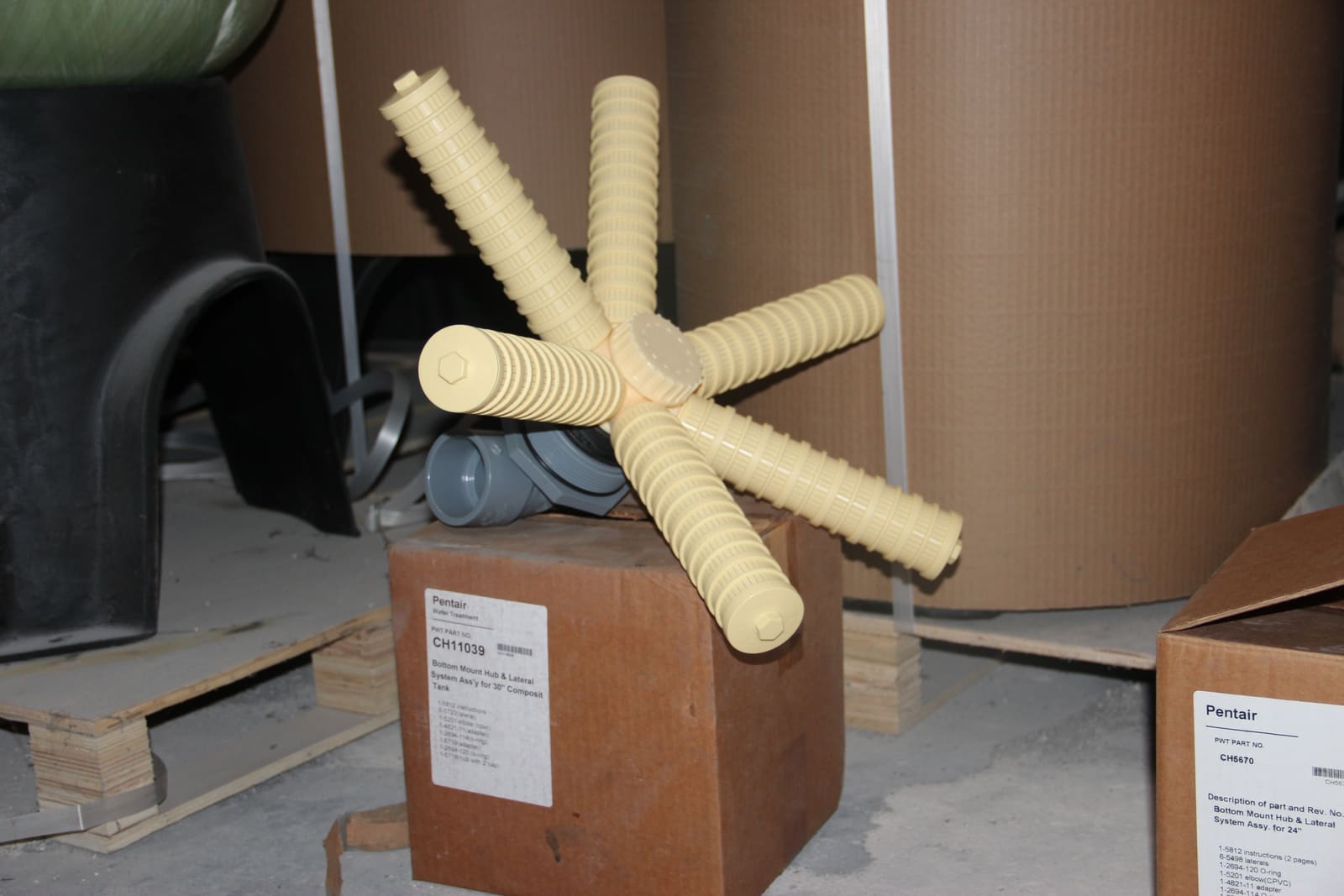
Quick answer: a borehole well is a groundwater source drilled vertically into an aquifer. For buyers, the critical decision is not only drilling depth; it is the system after the pump, including booster pumps, Pentair WellMate pressure tanks, FRP tanks, iron and manganese media, softening, cartridge filtration, and RO when source-water data requires it.
This article helps you understand the required components in a modern borehole water system. Use flow rate, pressure, water color, odor, hardness, TDS, iron, and manganese as the basis for equipment selection, not drilling depth alone.
For a system with several filter stages, backwash, or softener regeneration, define the sequence and flow data at the design stage. AQ Matic valves and controllers for filters and softeners can be assessed against the process diagram so service, backwash, rinse, and regeneration do not depend only on manual operation.
Before setting the pump duty, reconcile the contractor’s data with this guide to aquifer types, bore logs, pumping tests, and groundwater-quality risks.
Updated 9 August 2026: this guide adds specific-capacity calculations, recovery review, sustainable duty, the current Indonesian groundwater-use rule, and a component-selection checklist after water testing.
Selecting filters after the borehole water test
Direct answer: a borehole water test should be converted into a treatment sequence, not a shopping list. Iron, manganese, hardness, TDS, turbidity, bacteria, peak flow, and pressure decide whether the system only needs media filtration and cartridges or also needs softening, UV, RO, and automatic control.
| Borehole finding | Components usually evaluated | Decision data required |
|---|---|---|
| Yellow water, rust stains, manganese, or H2S odour | Iron-manganese filter media, GreensandPlus, oxidation, and FRP vessels | Total/dissolved Fe-Mn, pH, H2S, service flow, backwash flow, drain, and outlet target |
| Fine sediment or protection before RO | Pentair Pentek cartridges, AquaLine, or cartridge housings | Micron rating, normal/peak flow, clean-dirty differential pressure, housing size, and consumables stock |
| Hardness and scale | Softening, DIONIX resin, and regeneration valves | Hardness, resin volume, cycle capacity, salt/brine, drain, and regeneration schedule |
| High TDS or brackish tendency | RO membranes, cartridges, dosing, vessels, and reject disposal | Ion analysis, salinity, SDI, recovery, pressure, permeate target, and sanitation |
| Large homes or buildings with changing demand | Pentair C500 automatic prefilter or Pentair HydraSmart as the test results support | Peak flow, outlet count, installation space, inlet quality, maintenance responsibility, and replacement records |
What is a borehole well and why is it widely used?

A borehole extracts groundwater through vertical drilling into a selected aquifer interval. Flow and quality are not determined by depth alone; they depend on aquifer conditions, casing and screen construction, pump position, abstraction rate, and contamination risks around the well.
A borehole can support year-round demand when pumping-test evidence shows adequate yield and abstraction remains within the source’s capacity. Planning therefore needs to treat the source, pump, storage, pressure, treatment, monitoring, and permits as one system.
How to Interpret a Borehole Pumping and Recovery Test
Direct answer: pump duty should not be selected from a momentary flow reading. Use the flow–drawdown–time curve, water-quality changes during the test, recovery after shutdown, intake position, and pump operating limits to define a sustainable duty. A “litres per minute” figure without water levels and test duration is not adequate acceptance evidence.
Two preliminary calculations help compare results, but do not replace hydrogeological interpretation:
Drawdown (m) = pumping water-level depth − static water-level depth, when both are measured downward from the same datum.Specific capacity = pumping rate (m³/h) ÷ drawdown (m), reported with test duration and stage.
Example, not a yield guarantee: static level is 12 m below the measuring point and the water level at a stable test rate of 3.0 m³/h is 18 m. Drawdown is 18 − 12 = 6 m, so specific capacity under that test condition is 3.0 ÷ 6 = 0.50 m³/h per m. Do not transfer this value to another well or extrapolate it without evidence; specific capacity can change with time, rate, screen blockage, season, and aquifer condition.
| Test evidence | What should be visible | Decision supported |
|---|---|---|
| Static water level before the test | Datum, stabilization time, and preceding pumping history | Baseline for drawdown and pump submergence |
| Flow and water level versus time | Concurrent readings at each stage, not one final number | Yield stability and the flow–drawdown relationship |
| Recovery after shutdown | Water level and time as it approaches baseline | Source recovery and storage required between pumping periods |
| Water quality during the test | Turbidity, sand, colour, conductivity, and other changing parameters | More well development, repeat sampling, or a different duty |
| Intake depth and minimum water level | Safe intake clearance from dynamic level and the well base/screen | Protection against dry running, sand entry, and motor cooling failure |
| Recommended duty | Flow, operating hours, water-level limit, alarm, and stop condition | Pump setpoints, storage, metering, and operating surveillance |
Sustainable duty is not automatically a fixed percentage of the test flow. The responsible technical party should use the full curve, recovery, seasonal condition, well construction, permit/approval requirements, and possible effects on nearby sources. Install a totalizer and trend water level so declining specific capacity can be separated from pump or filter faults.
The Correct Stages of Borehole Construction
1. Site Survey and Needs Analysis
First, you need to determine your daily water needs. Next, you must estimate the desired discharge, pressure, and water quality. That way, the system design becomes more accurate.
2. Drilling Process
Once the survey is complete, the technical team drills down to the aquifer. At this stage, the depth of the well greatly affects the pump and distribution system specifications.
3. Water Pump Installation
Once the drilling is complete, the system requires a suitable pump. Therefore, pump selection is a key factor in the success of the borehole.
For booster or distribution duty after storage, see rotary vane and booster pumps for water treatment.
Submersible pumps are often used for deep wells, while jet pumps are suitable for specific depths. In addition, quality pumps keep the discharge stable and reduce energy consumption.
Borehole Commissioning and Handover Checklist
Direct answer: a borehole is not ready for acceptance merely because it produces water. Handover should include the bore log, casing and screen construction, pumping-test and recovery curves, pump position, duty point, baseline water levels, raw-water analysis, and treated-water targets. These records separate source, pump, pressure-tank, and treatment faults when performance changes.
| Handover evidence | Minimum record | Project acceptance test |
|---|---|---|
| Bore log and construction | Total depth, geological layers, casing diameter, screen intervals, gravel pack, sanitary seal, and pump-intake position | Installed data agree with the as-built drawing and intended water-bearing zone |
| Pumping test | Test flow, time, static level, drawdown, dynamic level, recovery, and water condition during the test | Pump duty remains within a sustainable flow; motor and intake are protected against dry running |
| Pump and pressure performance | Operating flow, pressure, motor current, cut-in/cut-out, precharge, and starts per hour | Values agree with the pump curve, motor limits, and Pentair WellMate pressure-tank settings |
| Raw-water quality | Sampling point and time, pH, TDS or conductivity, turbidity, color, iron, manganese, hardness, nitrate, and microbiology as required by use | Results map to written product-water targets and the treatment sequence |
| Treated-water baseline | Parameters before and after each unit at design flow | Filters, softener, disinfection, and RO meet written targets rather than merely producing clear water |
| Operating package | Flow diagram, setpoints, sampling schedule, spare parts, alarms, backwash/regeneration procedure, and service contacts | Operators can repeat measurements and trace deviations after handover |
For Indonesian projects, Minister of Energy and Mineral Resources Regulation No. 4 of 2026 has applied since 22 January 2026 and repealed Regulation No. 14 of 2024. The 2026 rule covers groundwater-use guidance and administrative-penalty procedures connected with permit/approval regularisation. Confirm the competent authority, approval type, technical submissions, metering, reporting, non-tax revenue obligations, and local rules for the project location and use before drilling or abstraction. This guide is not a substitute for a project-specific permitting review.
As a maintenance baseline, the CDC well-testing guidance updated 1 July 2024 recommends annual testing for total coliforms, nitrate, TDS, and pH, plus locally relevant parameters. Retesting is also appropriate after flooding, well repair, a change in color, taste, or odor, or suspected contamination. Indonesian projects should still set their parameter list and acceptance limits from the intended use and applicable local regulations.
Groundwater testing by A3 Laboratories can provide an independent baseline. PT Watermart Perkasa can then select distribution pumps, pressure tanks, filtration media, softeners, cartridges, and RO from the evidence instead of guessing from water color or well depth.
The Important Role of a Pressure Tank in a Borehole System
Once the pump is running, the system needs a pressure tank to keep the pressure stable. Without a pressure tank, the pump will often turn on and off. As a result, pump life can decrease.
Pressure tanks store pressurized water. They also help keep flow more consistent across points of use.
To stabilize pressure and reduce pump start-stop cycling, see Pentair WellMate composite pressure tanks. With the right pressure tank, borehole systems work more efficiently, run more quietly, and last longer.
FRP Tank: A Mandatory Reservoir for Modern Borehole Systems
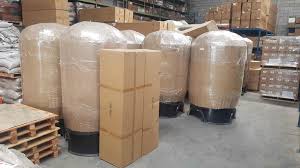
In addition to a pressure tank, some systems need a water storage tank to separate well operation from demand patterns or provide treatment contact time. FRP (Fiberglass Reinforced Plastic) is one option where corrosion resistance and water compatibility matter.
FRP does not rust like carbon steel, but resin compatibility, pressure, temperature, UV exposure, connections, and inspection requirements still need review. Capacity follows the demand balance, well flow, pump operating window, and required reserve—not material alone.
For media vessels, filter tanks, or water-treatment storage duty, see HydroPro and Pentair Structural FRP tanks.
More importantly, FRP tanks help keep the system running even if the pump temporarily stops. Thus, the water supply remains secure.
Why is Filtration System So Important in Bore Wells?
Borehole water often contains iron, manganese, odors, or fine particles. Therefore, filtration systems play a crucial role. Without filtration, water quality deteriorates and equipment breaks down quickly.
If the main symptom is yellow water, rust staining, or metallic odor, start with the iron removal application and iron and manganese filter media. For fine particles and turbidity, Hydrogard Anthracite can be used as an early filtration stage before cartridges or downstream treatment. If the water is hard and forms scale, evaluate water softening and ion exchange resin.
Anthracite Media Filter
Anthracite filters out fine particles and improves water clarity. In addition, this media works effectively as the initial stage of filtration.
See anthracite media products on the Hydrogard Anthracite filter media page.
With anthracite, the filtration system works more efficiently and equipment after the filter is better protected.
The Role of Dosing Pump in Borehole Water Treatment
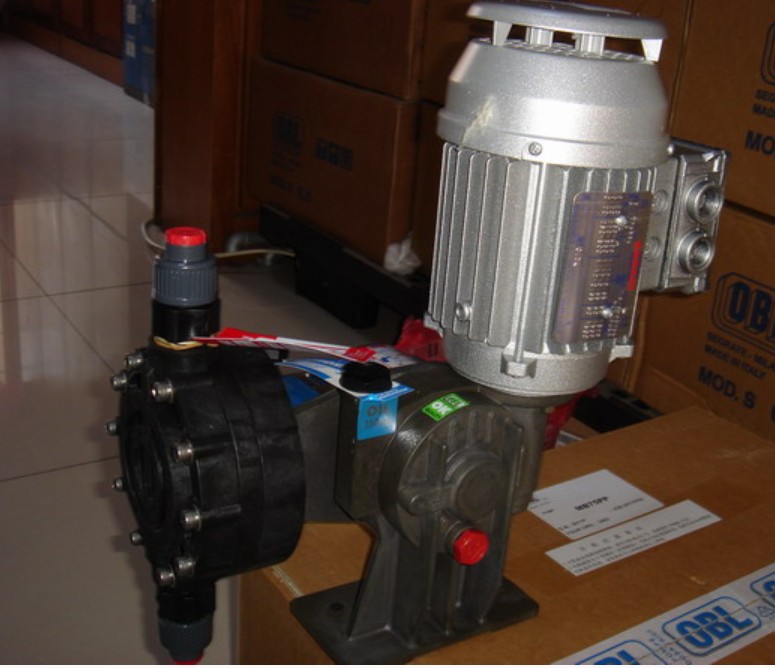
When water quality requires chemical adjustments, the system needs a dosing pump. Dosing pumps inject chemicals in a controlled manner. Thus, the water pH, odor, and metal content can be controlled.
A selection of dosing pumps is available here:
dosing pumps for water treatment
Dosing pumps are particularly relevant for industrial, commercial, and public well systems that demand consistent water quality.
The Ideal Setup of a Professional Borehole System
For the system to work optimally, you need to put together the following circuit:
- Well water pump
- Pressure tank
- FRP tank
- Filtration system (anthracite and other media)
- Dosing pump (if required)
With this sequence, the borehole system produces cleaner water, stable pressure, and longer equipment life.
Data to Prepare Before Buying Borehole System Components
| Field data | Why it matters | Components usually selected |
|---|---|---|
| Peak flow and daily water use | Sizes the pump, pressure tank, and vessel capacity | booster pumps, Pentair WellMate, FRP tanks |
| Iron, manganese, color, and odor | Determines oxidation and filtration media needs | iron removal, iron-manganese media, dosing pumps |
| Hardness | Determines whether a softener and cation resin are required | Use the hard-water diagnosis guide before selecting softening systems and ion exchange resin |
| TDS or signs of brackish water | Determines whether RO is required after pretreatment | Evaluate reverse osmosis, cartridge housings, and RO membranes; for a demin-water target, continue to the aquades production guide |
| Sediment and turbidity | Protects valves, pumps, cartridges, and membranes from fouling | media filtration, Hydrogard Anthracite, Pentek cartridges |
Common Mistakes in Borehole Construction
However, many projects suffer from the following mistakes:
- Choosing the wrong pump
- Ignoring the pressure tank
- Not using an FRP tank
- Not installing a filtration system
- Neglecting water quality control
Therefore, system planning should always consider long-term needs.
Advantages of boreholes (compared to PDAMs)
- More self-sufficient: not dependent on flow schedules/network interruptions.
- Monthly costs can be lower (after initial investment), especially if water usage is high.
- Discharge can be large (if aquifer is good and pump is adequate), suitable for business, washing, production, etc.
- You can control the quality: You can install filters according to the problem (iron, manganese, odor, TDS, bacteria).
Disadvantages of drilled wells (compared to PDAM)
-
Large initial investment: drilling, casing pipe, pump, electricity, reservoir, and usually filter.
-
Water quality is often “unstable”: depending on season, depth, and soil conditions - can appear:
- High iron/manganese (yellow water, rust stains)
- Odor/color (organics, sulfides)
- Brackish water/High TDS (in areas near the coast/rob)
- Bacteria (if well construction is poor or infiltration is polluted)
-
Hidden operating costs: pump electricity, pump servicing, filter media replacement, periodic lab tests.
-
Risk of lowering the water table: lower discharge, pump often stalls, need for deepening.
-
Licensing/regulations: in some areas groundwater use (especially for businesses) may be restricted/required a license.
-
Potential to damage equipment if quality is poor: hardness, corrosion, clog pipes, damage washing machines/boilers.
Advantages of PDAM water (compared to borehole)
- More practical: no need for drilling, pumping, and well maintenance.
- Generally treated & disinfected (safer for consumption if network is maintained).
- More consistent quality (usually) compared to groundwater which changes.
- No need for electricity for “water production” (still need pumps if pressure is low and reservoirs are used).
Disadvantages of PDAM water
- Network dependent: can be off, small, or unstable (especially peak hours).
- Monthly charges increase with usage; less economical if water consumption is high.
- Sometimes smells of chlorine / momentarily cloudy (e.g. after pipe repair or flushing).
- Pressure is sometimes low so you still need a reservoir and booster pump.
To summarize: which one to choose?
- Choose a borehole if: you have a large usage, need a stable supply, and are ready to invest + maintain (ideally a filtration system & quality test).
- Choose PDAM if: you want to be practical, relatively stable quality, and usage is not too large.
- The safest & most convenient is often a combination: PDAM for drinking/cooking + borehole for washing/bathing (with filtration), or PDAM as a backup when the well has problems.
If the source choice also includes surface water, compare seasonal change and unit-process needs in the river raw-water treatment guide. For borehole equipment selection, prepare the location (city/district), estimated flow rate, and nearby water symptoms such as yellow color, odor, brackish taste, or scaling. Watermart can help match those data points to borehole components and filtration systems.
Borehole Well FAQ
Can borehole water be used directly for drinking?
Not automatically. Borehole water should be tested first, especially for iron, manganese, hardness, TDS, odor, color, turbidity, and microbiology. The result determines whether the system needs filtration only, softening, disinfection, or RO.
What filters are usually needed for borehole water?
There is no single filter arrangement that fits every well. Yellow or stained water usually points to iron and manganese media, scale points to softening, high sediment needs media filtration and cartridges, while high TDS may require RO after pretreatment.
When does a borehole system need reverse osmosis?
RO is considered when TDS is high, the water is brackish, or the target water quality is stricter than normal filtration can achieve. Before RO, borehole water still needs pretreatment such as sediment filtration, iron-manganese removal, softening when required, and cartridge housings to protect the membranes.
Why are Water.co.id Products Suitable for Your Borehole System?
The products available at water.co.id are designed for professional clean water applications. Moreover, these products support a wide range of project scales, from household to industrial.
Furthermore, each product has clear technical specifications, is compatible with modern borehole systems, and supports operational efficiency.
Special Recommendation: HydroPro FRP Tank
If you are looking for a high-quality FRP tank, the HydroPro FRP Tank is the right choice. This product offers:
- High-quality FRP material
- Corrosion resistance
- Long service life
- Suitable for home to industrial borehole systems
See HydroPro FRP Pressure Tank options for filter vessels and water-treatment systems.
Conclusion: A Good Borehole System Starts with the Right Components
In conclusion, a borehole well is more than just a hole and a pump. A good system requires careful planning, the right product selection, and integration between components. With quality pumps, reliable pressure tanks, durable FRP tanks, effective filtration, and precision dosing pumps, a borehole system can perform reliably over the long run.
Therefore, if you want to build or upgrade a borehole system, make sure you choose the right and reliable products.

.png)