

Short answer: do not select a reverse osmosis membrane from the labels TFC, CTA, 4040, or 8040 alone. Match membrane chemistry, feedwater salinity and ion analysis, permeate target, pressure, recovery, pretreatment, pressure-vessel dimensions, and every model-specific operating limit.
Updated 30 July 2026: material differences, feedwater duty, selection inputs, and commissioning baselines were clarified.
With its ability to filter contaminants down to a microscopic scale, RO provides an essential solution for a wide range of needs, from domestic use to industrial applications.
RO separates feedwater into permeate and concentrate across a semipermeable membrane under pressure. The membrane is one part of a treatment train: strainers, media filtration or UF, cartridges, dosing, pumps, pressure vessels, instruments, and post-treatment all affect the result. A high datasheet rejection does not prevent failure caused by oxidants, fouling, scaling, incorrect pressure, or incompatible installation hardware.
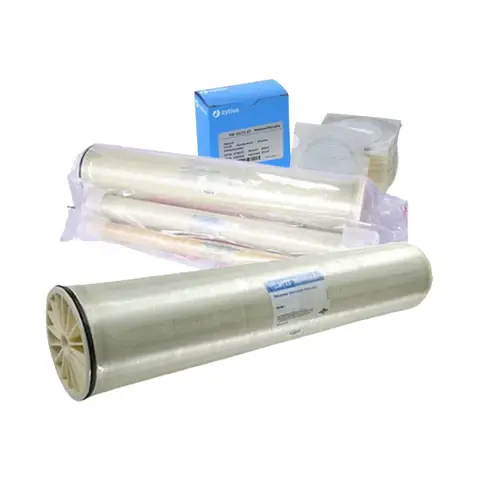
Use two classifications. First, distinguish active-layer chemistry such as thin-film composite (TFC) polyamide and cellulose triacetate (CTA). Second, distinguish model duty—tap-water RO, brackish-water RO (BWRO), seawater RO (SWRO), or a special-purpose element—from the current manufacturer datasheet. A 4040 or 8040 designation identifies mechanical format; it does not establish salinity, pressure, capacity, or product-water quality.
| Selection question | Evidence required | Decision affected |
|---|---|---|
| What is in the feedwater? | Ion analysis, TDS/conductivity, pH, temperature, turbidity, SDI15, iron, manganese, silica, and organics | Membrane class, pretreatment, recovery, and scaling/fouling risk |
| What must the product water achieve? | Conductivity/TDS and critical-ion limits, flow, final use, and separate microbiological parameters | One or two passes, remineralization, polishing, and laboratory verification |
| Are oxidants present? | Free chlorine, ozone, ORP, dosing points, and dechlorination interlocks | Membrane compatibility and polyamide protection |
| What is the mechanical arrangement? | Element diameter and length, elements per vessel, pressure rating, ports, adapters, and seals | Matching 4040/8040 RO membranes and Codeline pressure vessels |
| How will performance be proven? | Flow, pressure, temperature, recovery, feed/permeate/concentrate conductivity, and normalization baseline | Commissioning evidence and triggers for investigation or cleaning |
Types of Reverse Osmosis Membrane
1. Thin-Film Composite (TFC) Membrane

Modern TFC membranes commonly use an active polyamide layer on a support structure. The family is broad: BWRO, SWRO, low-energy, and high-rejection models may all use TFC construction while carrying different limits for pressure, flux, salt rejection, pH, temperature, and fouling conditions.
Polyamide is not a “chlorine-resistant” default. The DuPont FilmTec technical manual requires oxidants to be controlled within element limits; use the current model document for residual chlorine, dechlorination, and storage. When upstream treatment uses chlorination, measure oxidant residual and provide an interlock before water reaches the membrane.
2. Cellulose Triacetate (CTA) Membrane

CTA is a different membrane chemistry with operating, preservation, and chemical-tolerance requirements that must be read from the model datasheet. Do not assume CTA is the better choice simply because feedwater contains chlorine or because the element will remain in storage. Check rejection, pressure limits, pH and temperature range, biocontrol requirements, replacement availability, and compatibility with the existing system.
For a new plant or retrofit, compare TFC and CTA models at equivalent test conditions. Flow or rejection figures taken from datasheets with different temperature, pressure, salt concentration, and recovery are not directly comparable.
Select Membrane Duty from Feedwater, Not from the Name
| Duty being assessed | Distinguishing data | Risk of a mismatch | Watermart handoff |
|---|---|---|---|
| Tap water or relatively low-TDS feed | Available pressure, chlorine, ion/taste target, point-of-use flow | Inadequate flow, oxidant damage, or unsupported product-water claims | Pentair ES60-S under-sink RO where the tested duty is suitable |
| Brackish or process water | Full ion analysis and TDS, temperature, scaling projection, recovery target | Scaling, salt passage, inadequate pressure, or incompatible vessel | DuPont FilmTec BWRO membranes and Toray BWRO membranes |
| Seawater or high-salinity water | Salinity, temperature, boron where relevant, intake condition, SDI15, biofouling, permeate target | High energy demand, poor permeate quality, fouling, or a missed second-pass requirement | DuPont FilmTec SWRO membranes and Toray SWRO membranes |
| Existing-element replacement | Label photograph, model, age, element count, vessel, adapters, operating and cleaning data | An element fits physically but not the duty or hydraulic limits | Nameplate review, Codeline housing, seals, and skid arrangement |
Antiscalant, dechlorination, and chemical-cleaning requirements should follow the analysis and membrane recommendation. Where the project needs that program, see RO chemicals and membrane cleaning from Beta Pramesti; Watermart can coordinate the membrane and hardware selection.
Minimum Data before Requesting an RO Membrane Quote
- Attach a representative feedwater analysis, including seasonal or source variation.
- State hourly and daily permeate demand, operating hours, and target recovery.
- Define product-water quality and final use; “clear” is not a specification.
- For replacement work, send the element label, vessel nameplate, both end closures, ports, and element arrangement per housing.
- Record feed, permeate, and concentrate flow, pressure, temperature, and conductivity from the existing system.
- List pretreatment, chemical dosing, chlorine residual, cartridge history, and CIP records.
PT Watermart Perkasa supplies RO components in Indonesia, including membranes, filter cartridges, dosing pumps, and pressure vessels. Models and availability are confirmed at quotation; a shared brand or nominal size does not prove interchangeability.
Commissioning Baselines That Make Performance Verifiable
After startup under the model manual, record the stable conditions that will become the comparison baseline:
| Initial record | Why it matters |
|---|---|
| Feed, permeate, and concentrate flow | Calculates actual recovery and checks the flow balance |
| Feed, interstage, concentrate, and permeate pressure | Establishes pressure drop and net driving conditions |
| Temperature and conductivity of all three streams | Separates changing feed conditions from membrane-performance changes |
| Chlorine/ORP and SDI15 or turbidity after pretreatment | Shows that protection was in control when the baseline was taken |
| Model, serial/batch, element position, vessel, adapters, and seals | Traces installation errors or element differences |
| Product-water test results for the intended use | Proves water suitability; equipment selection alone does not make water ready to drink |
Normalize flow and salt passage by the manufacturer method rather than comparing raw figures at different temperatures or salinities. When data move, check instruments, valves, seal leakage, pretreatment, scaling, fouling, and oxidants before declaring that replacement is required.
Frequently Asked Questions about RO Membrane Types
Are all 4040 membranes interchangeable?
No. The 4040 format identifies nominal dimensions only. Models can differ in active chemistry, feedwater duty, pressure limit, flow, rejection, spacer, feed direction, adapters, seals, and test conditions. Match the old label, new datasheet, and vessel arrangement before replacement.
Is the highest salt rejection always the best choice?
No. Read rejection with the test conditions, permeate target, pressure, energy, flux, recovery, fouling risk, and pretreatment. A high-rejection model can still give inadequate flow or fail early when used outside its intended duty and operating limits.